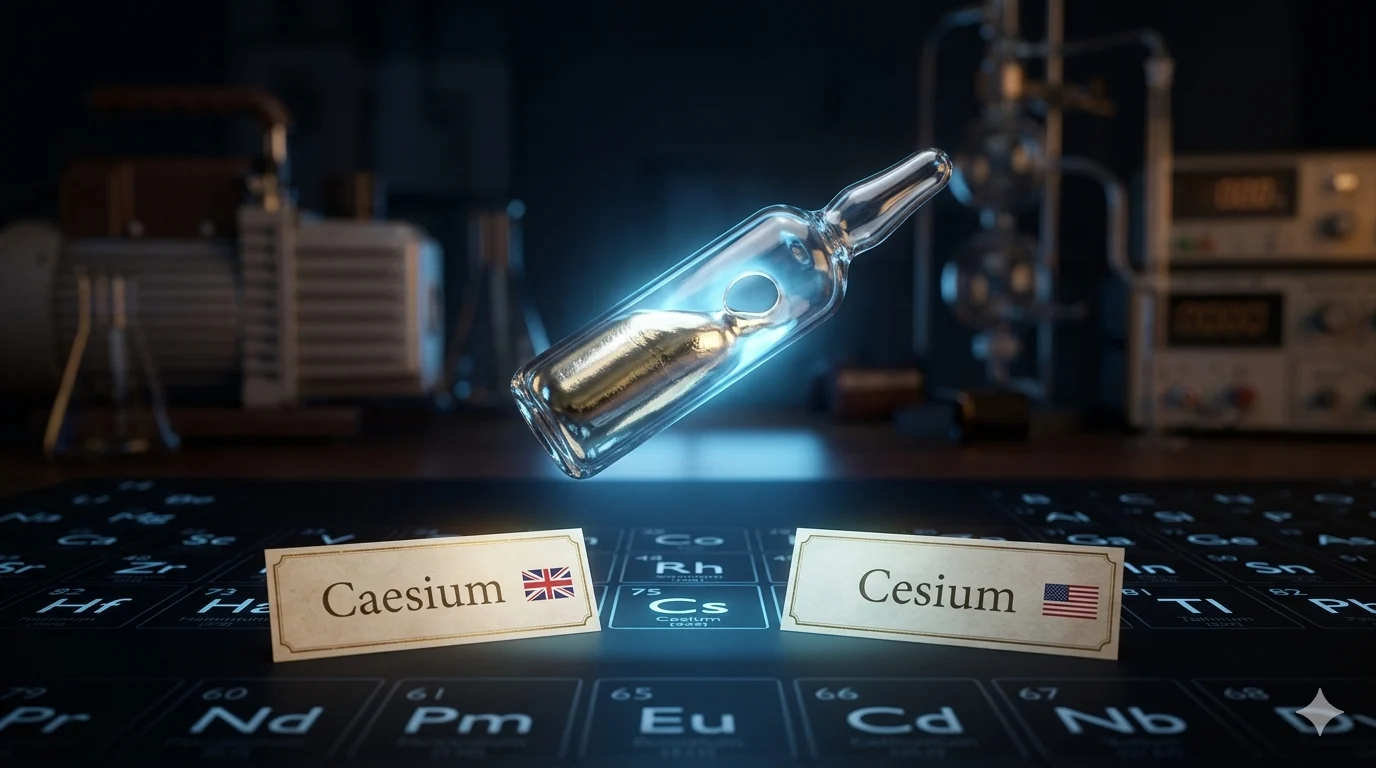
People search for caesium or cesium every single day because they see two different spellings and get completely confused. A student in London opens a textbook and sees “caesium.” A student in New York opens a textbook and sees “cesium.” Both are looking at the exact same element. So who is right? Is it caesium or cesium? Which spelling should you use in your homework, your email to a professor, or your science blog?
This confusion stops right here.
This long, detailed, and simple guide will answer every single question you have about caesium or cesium. You will learn the caesium or cesium difference in less than 30 seconds. You will understand the history of both spellings. You will know exactly when to use each one – for American readers, British readers, and the rest of the world.
But this article is not just about spelling. You will also discover amazing facts about this incredible element. We will answer what is caesium used for in detail – from atomic clocks to cancer treatment. We will answer where is cesium found on Earth. We will check the current caesium or cesium price and explain why it is so expensive. We will explore the caesium element in the periodic table. We will understand the cesium symbol (Cs) and the cesium atomic number (55). We will even look at the caesium or cesium ion (Cs⁺) and how it helps spacecraft travel through space. 🚀
By the time you finish reading this guide, you will never be confused about is it caesium or cesium again. You will also know more about this element than 99% of people on the planet.
Let’s begin.
Caesium or Cesium
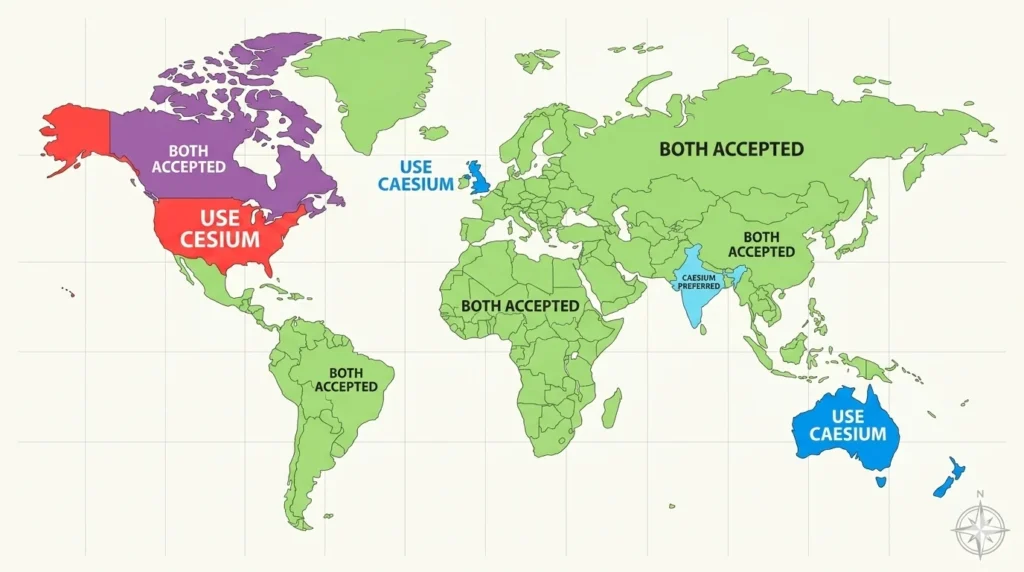
The shortest answer: Both spellings are 100% correct. Use cesium in the United States. Use caesium in the United Kingdom, Australia, New Zealand, South Africa, India, and most other English-speaking countries outside North America.
The longer answer: This is not a right-or-wrong situation. This is a regional spelling difference – just like “color” vs “colour” or “tire” vs “tyre.” The element itself does not care how you spell its name. It behaves exactly the same way everywhere on planet Earth.
Let me show you with clear examples:
📌 American English example:
“Cesium is the most reactive metal on Earth. It explodes when it touches water.” – Dr. Sarah Johnson, MIT chemist
📌 British English example:
“Caesium is the most reactive metal on Earth. It explodes when it touches water.” – Dr. James Davies, Oxford chemist
See? The sentence is identical except for the spelling. Both scientists are talking about the exact same element.
What about the periodic table? The caesium or cesium in periodic table appears in Group 1, Period 6. It is right below rubidium and above francium. The cesium symbol is Cs – and this symbol NEVER changes. The cesium atomic number is 55 – and this number NEVER changes. The caesium element has atomic weight 132.9 – and this NEVER changes.
What about the price? The caesium or cesium price in 2026 is approximately $60 to $120 per gram. To understand how expensive that is, compare it to silver. Silver costs about $0.80 per gram. So caesium or cesium is roughly 100 times more expensive than silver. 💰
What about the ion? The caesium or cesium ion (written as Cs⁺) is the form of this element that loses one electron. This ion is incredibly useful. It is used in atomic clocks, ion thrusters for spacecraft, and even some medical treatments.
Quick summary table:
| Question | Answer |
|---|---|
| Is it caesium or cesium? | Both are correct |
| Use cesium where? | USA |
| Use caesium where? | UK, Australia, NZ, India, South Africa |
| Cesium symbol? | Cs |
| Cesium atomic number? | 55 |
| Caesium or cesium price? | $60–$120 per gram |
| Caesium or cesium ion? | Cs⁺ |
⚡ Super fast fact: Caesium or cesium was the FIRST element discovered using a spectroscope. Before 1860, no one knew it existed. The bright blue lines in the flame gave it away.
The Origin of Caesium or Cesium
The story of caesium or cesium begins in 1860 in a small German town called Bad Dürkheim. This town had a famous spa with mineral water. People went there to bathe in the water and feel better. But two scientists had a different plan. They wanted to know what was INSIDE that water. 🔍
The Two Scientists
Robert Bunsen – You know his name. He invented the Bunsen burner, which every chemistry student uses today. He was German, with a big beard and sharp eyes.
Gustav Kirchhoff – He was also German. He invented the spectroscope, a tool that splits light into its different colors, like a rainbow.
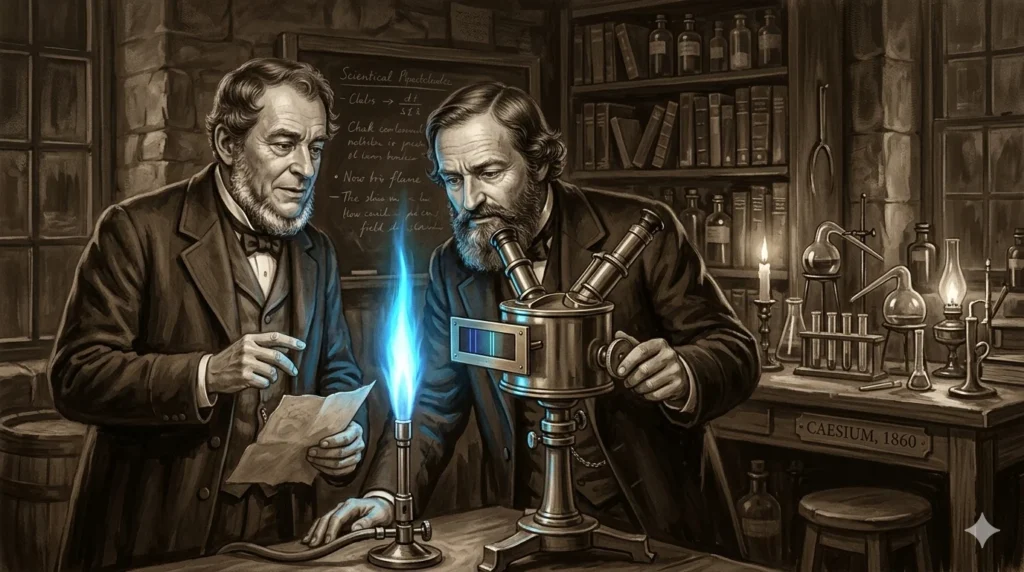
Together, these two men changed chemistry forever.
The Discovery
Bunsen and Kirchhoff took some mineral water from the spa. They heated it in a flame. Then they looked at the flame through Kirchhoff’s spectroscope.
Most elements produce specific colored lines when they burn. Sodium gives bright yellow. Copper gives green. Potassium gives lilac.
But this water showed something strange. There were two bright blue lines that no scientist had ever seen before. The blue was the color of a perfect summer sky – clear, bright, and beautiful. ☀️💙
The Naming
Bunsen and Kirchhoff knew they had found a new element. They needed a name. They looked at the brilliant blue lines and thought of the Latin word caesius, which means “sky blue.”
So they named the new element caesium.
For the next several decades, everyone in the world spelled it caesium. There was no debate. No confusion. No “caesium or cesium” question. Everyone agreed.
The Change
So what happened? How did we end up with two spellings?
The answer is American English spelling reform.
In the early 1800s, an American named Noah Webster (the man who wrote Webster’s Dictionary) believed that English spelling should be simpler. He thought that many British spellings had extra, unnecessary letters. He wanted to remove those letters.
For example:
- Colour became color
- Centre became center
- Travelled became traveled
- Encyclopaedia became encyclopedia
And caesium became cesium.
Webster’s dictionary became very popular in the United States. American schools taught his spellings. American newspapers used his spellings. Over time, Americans forgot the old British spellings.
But in Britain, Canada, Australia, New Zealand, and other English-speaking countries, people kept the original spellings. They kept the “ae” in caesium. They kept the “u” in colour. They kept the “re” in centre.
And that is how the caesium or cesium difference was born. One spelling change, 160 years ago, created a confusion that lasts until today.
The Element Itself
Let’s talk about the caesium element itself – not the spelling.
The caesium element is an alkali metal. The alkali metals are in Group 1 of the periodic table. They include lithium, sodium, potassium, rubidium, caesium, and francium.
All alkali metals are soft and reactive. But caesium is the MOST reactive of all the stable alkali metals. (Francium is more reactive but it is radioactive and extremely rare.)
Physical properties of caesium or cesium:
| Property | Value |
|---|---|
| Melting point | 83°F (28.5°C) |
| Boiling point | 1,202°F (650°C) |
| Density | 1.93 g/cm³ (lighter than water? No – water is 1.0, so it sinks) |
| Color | Silvery-gold (not just silver – it has a warm golden tint) |
| Softness | Softer than soap. You can cut it with a plastic knife. |
Chemical properties:
- Reacts violently with water (explosion 💥)
- Reacts with air (catches fire spontaneously 🔥)
- Must be stored under oil or in sealed glass with argon gas
- Gives away its one outer electron very easily
Why is it so reactive? The caesium element has one electron in its outermost shell. This electron is very, very far from the nucleus. The nucleus does not hold it tightly. So the electron is easy to remove. When caesium touches water, it rips oxygen atoms from water molecules. This releases hydrogen gas. The heat from the reaction ignites the hydrogen. BOOM. 💥
The Sky Blue Connection
Remember the name caesius meaning sky blue? Here is a beautiful fact. When caesium burns, it produces a flame that is truly sky blue. Not purple-blue. Not green-blue. Pure, bright, beautiful sky blue.
You can see this blue flame in chemistry demonstrations. It is stunning. 💙
So every time you see the word caesium or cesium, remember: this metal was named for the color of the sky on a perfect summer day.
British English vs American English Spelling
The caesium or cesium spelling difference is not unique. English has many words where British spelling uses “ae” or “oe” and American spelling uses just “e”. Let me show you the full picture. 📚
The “AE” to “E” Change
This is the most common pattern. British English keeps the “ae” (called a digraph). American English drops the “a” and keeps only the “e”.
Complete list of examples:
| British English 🇬🇧 | American English 🇺🇸 |
|---|---|
| Caesium | Cesium |
| Anaemia | Anemia |
| Anaesthesia | Anesthesia |
| Encyclopaedia | Encyclopedia |
| Paediatric | Pediatric |
| Haemoglobin | Hemoglobin |
| Leukaemia | Leukemia |
| Palaeontology | Paleontology |
| Manoeuvre | Maneuver |
| Foetus | Fetus |
| Oestrogen | Estrogen |
| Diarrhoea | Diarrhea |
| Gonorrhoea | Gonorrhea |
| Amoeba | Ameba (rare) |
Notice a pattern? Many of these words are scientific or medical terms. That is why caesium or cesium – a scientific term – follows this exact same rule.
The “OE” to “E” Change
Some words use “oe” in British English and just “e” in American English.
| British English 🇬🇧 | American English 🇺🇸 |
|---|---|
| Oesophagus | Esophagus |
| Oestrogen | Estrogen |
| Oecology | Ecology (rare) |
Not All “AE” Words Changed
Some words kept the “ae” in American English too. For example:
- Aerial (same in both)
- Aesthetic (same in both – but “esthetic” is also accepted in US)
- Archaeology (same in both – but “archeology” exists)
So why did caesium change but aerial did not? There is no perfect rule. Language change is messy. It depends on how common the word was, who used it, and which dictionary writers made which decisions.
Pronunciation – Same for Both
Here is something very important. Caesium and cesium are pronounced exactly the same way.
Say it out loud: SEE-zee-um
Not “KAY-zee-um.” Not “KAH-zee-um.” Not “SEE-shee-um.”
SEE-zee-um – three syllables. First syllable “SEE” (like see with your eyes). Second syllable “zee” (like the letter Z). Third syllable “um” (like um, I’m thinking).
Both spellings use this same pronunciation. There is no difference.
What About Other Languages?
The caesium or cesium debate is only in English. Other languages have their own spellings:
| Language | Spelling |
|---|---|
| German | Cäsium |
| French | Césium |
| Spanish | Cesio |
| Italian | Cesio |
| Portuguese | Césio |
| Russian | Цезий (Tseziy) |
| Chinese | 铯 (Sè) |
| Japanese | セシウム (Seshiumu) |
| Hindi | सीज़ियम (Seeziyam) |
Notice that most languages use a “C” or “S” sound at the beginning. No other language has the “ae” vs “e” debate. Only English.
Which Spelling Should You Use?
Choosing caesium or cesium is very easy if you follow this simple decision tree. 🌳
Decision Tree (Follow these steps)
Step 1: Who is your audience?
- If your audience is American → Go to Step 2A
- If your audience is British, Australian, New Zealand, or South African → Go to Step 2B
- If your audience is Indian, Singaporean, or other Commonwealth → Go to Step 2C
- If your audience is international (mixed countries) → Go to Step 2D
Step 2A (American audience): Use cesium. Always. Do not use caesium. Your readers will think it is a typo.
Step 2B (UK/Australia/NZ/SA audience): Use caesium. Always. This is the standard spelling in schools and universities in these countries.
Step 2C (Indian/Singaporean/Commonwealth audience): British English is traditional, but American English is growing. Caesium is safer for formal writing. Cesium is acceptable for casual writing. Pick one and stay consistent.
Step 2D (International audience): Here you have two choices:
- Choice 1: Use cesium because it has higher global search volume (more people search for it)
- Choice 2: Use caesium because it is the IUPAC official recommendation (international science standard)
Both are fine. The most important rule is: Do not mix them.
Detailed Audience Guide
🇺🇸 United States
Use: Cesium
The United States is the largest English-speaking country in the world. Almost all American textbooks, scientific papers, and websites use cesium. If you write “caesium” for an American reader, they may think you made a spelling mistake.
Examples of American sources that use “cesium”:
- American Chemical Society journals
- Los Alamos National Laboratory
- US Geological Survey
- MIT, Stanford, Harvard (in US-based publications)
- Wikipedia (US English version)
🇬🇧 United Kingdom
Use: Caesium
The United Kingdom invented the English language. British schools teach caesium as the correct spelling. The Royal Society of Chemistry uses caesium. Oxford and Cambridge use caesium.
Examples of British sources that use “caesium”:
- Royal Society of Chemistry
- Oxford University Press
- Cambridge University Press
- BBC Science
- UK government publications
🇦🇺 Australia and 🇳🇿 New Zealand
Use: Caesium (but cesium is seen occasionally)
Australia and New Zealand follow British English for most spellings. Schools teach caesium. However, because of American media and software, some Australians use cesium informally.
Safe choice: Use caesium for formal writing in Australia and New Zealand.
🇮🇳 India
Use: Caesium (formal) or Cesium (casual)
India has a complex relationship with English. British English is the official standard. Schools teach British spellings. However, American software (Microsoft, Google, social media) is everywhere. Many young Indians use American spellings without thinking.
Safe choice: If you are writing for a school, university, or government, use caesium. If you are writing a blog or social media, either is fine.
🇨🇦 Canada
Use: Either – but be consistent
Canada is unique. Officially, Canada follows British English. The Canadian government uses British spellings. However, because Canada is right next to the United States, American spellings are very common.
Safe choice: Check your audience. If you are writing for the Canadian government or a Canadian university, use caesium. If you are writing for a business that trades with the US, cesium is fine.
🌍 Rest of the world (Europe, Asia, Africa, South America)
Use: Either – but cesium has higher search volume
In non-English-speaking countries, people learn English from both British and American sources. Most people do not know there is even a debate. They will understand both spellings.
Safe choice: For websites and blogs targeting global readers, cesium is often better because more people search for it. For scientific papers, caesium is the IUPAC standard.
Professional Advice by Situation
| Situation | Recommended Spelling |
|---|---|
| Scientific paper for US journal | Cesium |
| Scientific paper for UK/European journal | Caesium |
| Scientific paper for IUPAC journal | Caesium (official) |
| US high school homework | Cesium |
| UK high school homework | Caesium |
| Blog post with US readers | Cesium |
| Blog post with UK readers | Caesium |
| Global website (max traffic) | Cesium |
| Global website (scientific authority) | Caesium |
| Email to American professor | Cesium |
| Email to British professor | Caesium |
| Social media (any) | Either – be consistent |
| Book for US market | Cesium |
| Book for UK market | Caesium |
| Wikipedia article | Check the talk page – it varies |
The Golden Rule
Consistency is more important than correctness.
If you start a document with “cesium,” do not write “caesium” later. If you start with “caesium,” do not switch to “cesium.”
Your readers will forgive you for choosing the “wrong” spelling for their region. But they will be confused if you use both.
💡 Pro tip: Use your word processor’s “Find and Replace” feature before publishing. Search for “caesium” and replace with “cesium” (or vice versa). This catches any mixed spellings.
Common Mistakes with Caesium or Cesium
Even professional scientists, writers, and editors make mistakes with caesium or cesium. Here are the most common errors – and exactly how to fix them. ✅
Mistake #1: Mixing Spellings in One Document
The error: Using both “caesium” and “cesium” in the same paragraph, article, or even the same sentence.
Example of wrong:
“Cesium is very reactive. In fact, caesium explodes when it touches water.”
Why it is wrong: Your reader will think you are talking about two different elements. Or they will think you made a careless mistake.
How to fix it: Pick ONE spelling. Use it everywhere. Use Find and Replace to check.
Correct version:
“Cesium is very reactive. In fact, cesium explodes when it touches water.”
OR
“Caesium is very reactive. In fact, caesium explodes when it touches water.”
Mistake #2: Changing the Symbol
The error: Writing the symbol as “CA” or “CS” or “C” or “Ce.”
Example of wrong:
“The symbol for caesium is CA.”
Why it is wrong: The periodic table symbol is ALWAYS two letters. The first letter is ALWAYS capital. The second letter is ALWAYS lowercase. For caesium/cesium, the symbol is Cs.
How to fix it: Memorize this: C (capital C) + s (lowercase s) = Cs.
Correct version:
“The symbol for caesium is Cs.”
Mistake #3: Wrong Atomic Number
The error: Saying that caesium or cesium has atomic number 54, 56, or any number other than 55.
Example of wrong:
“Cesium has atomic number 54.”
Why it is wrong: Atomic numbers are not optional. Each element has exactly one atomic number. 54 is xenon. 55 is caesium/cesium. 56 is barium.
How to fix it: Remember: Cs = 55. Both letters in “Cs” are the 19th and 19th letters? No. Better trick: C is the 3rd letter. S is the 19th. 3+19=22. Not helpful. Just memorize: 55.
Correct version:
“Cesium has atomic number 55.”
Mistake #4: Mispronunciation
The error: Saying “KAY-zee-um” or “KAH-zee-um” or “SEE-shee-um” or “SEE-zyoom.”
Why it is wrong: The correct pronunciation has been established for over 160 years. Changing it sounds uneducated.
How to fix it: Say it slowly: SEE (like see with eyes) + zee (like the letter Z) + um (like um, I’m thinking). SEE-zee-um.
Correct pronunciation: SEE-zee-um (three syllables)
Mistake #5: Not Knowing What Is Caesium Used For
The error: Thinking that caesium or cesium is only used in atomic clocks. Or saying “I don’t know” when someone asks what is caesium used for.
Why it is wrong: This element has many important uses. Knowing them makes you smarter.
How to fix it: Memorize this short list:
What is caesium used for – The complete list:
| Use | Explanation |
|---|---|
| 🕰️ Atomic clocks | Defines the international second. GPS, internet, and stock markets rely on these. |
| 🛢️ Drilling fluids | Mixed into oil and gas drilling mud. Makes drilling smoother. |
| ☀️ Photoelectric cells | Converts light into electricity. Used in some solar panels and night vision. |
| 📡 Vacuum tube getter | Removes last traces of air from vacuum tubes. |
| 🏥 Cancer treatment | Radioactive Cs-137 is used in brachytherapy for certain cancers. |
| 🚀 Ion thrusters | Caesium or cesium ion (Cs⁺) is used in some spacecraft engines. |
| 🔬 Research | Studying chemical reactions, quantum physics, and electron behavior. |
| ⚡ Electricity generation | In some experimental power systems. |
Mistake #6: Wrong Answer to “Where Is Cesium Found”
The error: Saying that cesium is found pure in nature. Or saying it is found everywhere like iron or aluminum.
Example of wrong:
“Where is cesium found? You can find it in rocks everywhere.”
Why it is wrong: Cesium is NEVER found pure in nature. It is too reactive. It always bonds with other elements. And it is actually quite rare.
How to fix it: Learn the correct answer.
Correct version:
“Where is cesium found? It is found in the mineral pollucite. The largest deposit is at Bernic Lake, Manitoba, Canada. Other sources include the Bikita Mine in Zimbabwe and Karibib in Namibia. Small amounts exist in seawater and some clay soils.”
Mistake #7: Underestimating the Price
The error: Thinking that caesium or cesium is cheap. Or comparing it to sodium or potassium prices.
Example of wrong:
“Cesium price? Maybe $5 per gram.”
Why it is wrong: Cesium is one of the most expensive stable metals. It is rare. It is hard to refine. It must be handled carefully.
How to fix it: Learn the real price range.
Correct version:
“The caesium or cesium price in 2026 is approximately $60 to $120 per gram. Pure 99.99% cesium costs more. Lower purity (99.5%) costs less. The price changes based on market demand.”
Price comparison:
| Metal | Price per gram (approx) |
|---|---|
| Iron | $0.0005 |
| Aluminum | $0.002 |
| Copper | $0.008 |
| Silver | $0.80 |
| Gold | $65 |
| Cesium | $60–$120 |
| Platinum | $30 |
| Rhodium | $150 |
Cesium is more expensive than gold and almost as expensive as rhodium.
Mistake #8: Ignoring the Ion
The error: Forgetting that the caesium or cesium ion (Cs⁺) exists or is important.
Why it is wrong: The ion is actually more useful than the pure metal in many applications.
How to fix it: Remember these facts about the caesium or cesium ion:
- The ion is written as Cs⁺ (Cs with a plus sign)
- It forms when caesium loses its one outer electron
- The ion is much safer than the pure metal
- It is used in atomic clocks (the ion vibrates at a precise frequency)
- It is used in ion thrusters for spacecraft
- It is used in medical imaging and some treatments
- The ion is colorless and dissolves in water
Correct usage:
“The caesium or cesium ion (Cs⁺) is the key to atomic timekeeping.”
Mistake #9: Spelling “Caesium” as “Cesum” or “Ceasium”
The error: Typing “Cesum” (missing the i) or “Ceasium” (wrong order of vowels) or “Cæsium” (using the ligature).
Why it is wrong: These are not accepted spellings anywhere. They are just typos.
How to fix it: Slow down when typing. Or use spell check.
Correct spellings only:
- Caesium (British)
- Cesium (American)
Incorrect spellings:
- Cesum ❌
- Ceasium ❌
- Caesum ❌
- Cæsium ❌ (old, not used anymore)
- Cesiem ❌
Mistake #10: Not Capitalizing When Needed
The error: Writing “cesium” at the start of a sentence as “cesium” (lowercase c). Or writing “Cs” as “cs” or “CS”.
Why it is wrong: Element names are not proper nouns, so they are lowercase in the middle of a sentence. BUT at the start of a sentence, they are capitalized. And symbols are ALWAYS capitalized first letter.
How to fix it:
| Situation | Correct | Incorrect |
|---|---|---|
| Start of sentence | Cesium is reactive. | cesium is reactive. |
| Middle of sentence | The element cesium is reactive. | The element Cesium is reactive. |
| Symbol alone | The symbol is Cs. | The symbol is cs or CS. |
Caesium or Cesium in Everyday Examples
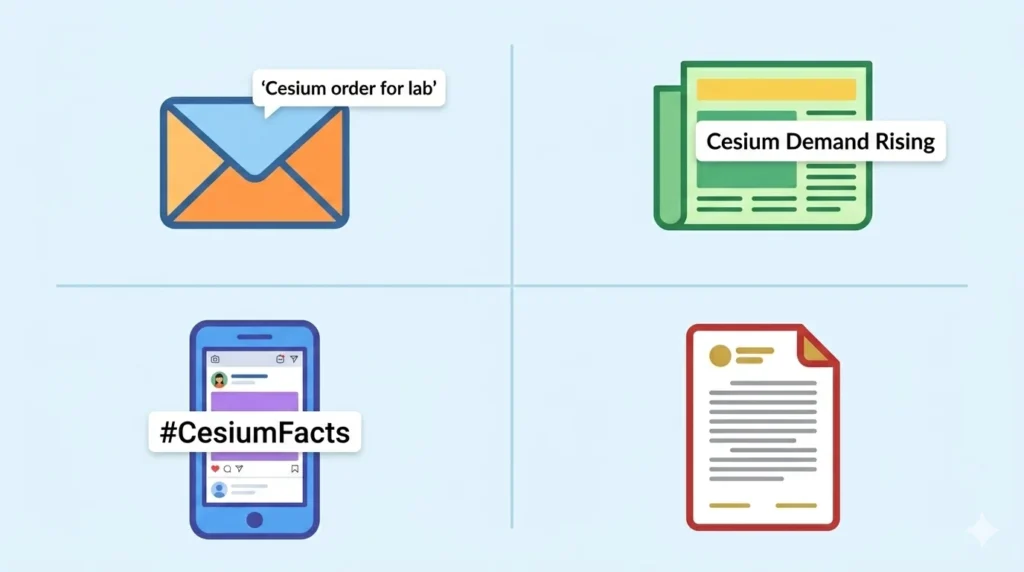
Let’s see caesium or cesium in real-world writing. These examples show you exactly how to use the correct spelling based on your audience. Copy these patterns for your own writing. ✍️
Email Examples
Email to an American Colleague
Subject: Cesium order for Lab 3
Hi Jennifer,
*I need to order 5 grams of cesium for the photoelectric experiment next week. Do you know the current caesium or cesium price from our supplier Sigma-Aldrich?*
Also, can you remind me what is caesium used for in this specific setup? I know it’s for the photoelectric cell, but I want to explain it correctly in my report.
*The cesium symbol is Cs, and the cesium atomic number is 55 – I always double-check because I get confused with barium (56).*
Thanks for your help!
Mike
Email to a British Colleague
Subject: Caesium order for Lab 3
Dear Dr. Patel,
I need to request 5 grams of caesium for the photoelectric experiment next week. Could you please check the caesium or cesium price from our UK supplier?
Also, regarding what is caesium used for in this experiment – is it primarily for the photoelectric effect or for something else?
I remember that the cesium symbol is Cs and the cesium atomic number is 55. But could you confirm where is cesium found in high purity? I think Canada is one source.
Thank you,
James
Email to an International Client (Neutral)
Subject: Cs element order for laboratory
Dear Team,
*We need to purchase caesium/cesium (Cs, atomic number 55) for our atomic clock research. Please advise which spelling you prefer in your documentation.*
The caesium or cesium ion (Cs⁺) will be used in the ion trap experiment. Could you share the current caesium or cesium price for 99.99% purity?
Also, if you have information on what is caesium used for in similar labs, please share.
Best regards,
Alex Chen
News Headlines
American News Website
“Cesium Demand Rises as Atomic Clock Technology Expands”
“Scientists Warn of Cesium Spill Risks in Oil Drilling”
“Cesium Price Hits 5-Year High After Mine Closure in Canada”
British News Website
“Caesium Demand Rises as Atomic Clock Technology Expands”
“Scientists Warn of Caesium Spill Risks in Oil Drilling”
“Caesium Price Hits 5-Year High After Mine Closure in Canada”
Social Media Posts
Instagram Post (Science Influencer)
Did you know caesium or cesium is so reactive it explodes on contact with water? 💥 This shiny gold metal melts in your hand at just 83°F! 🫠
The cesium symbol is Cs. The cesium atomic number is 55. And the caesium or cesium price? Over $100 per gram! 💰
Swipe to see what happens when we drop it in water. 🔥
#PeriodicTable #ScienceFacts #Caesium #Cesium #Chemistry
X (Twitter) Post
Fun fact: The caesium or cesium ion (Cs⁺) is used in the world’s most accurate clocks. They lose just 1 second every 100 million years. 🕰️
#Science #AtomicClock #Caesium #Cesium
LinkedIn Post (Professional)
What is caesium used for in industry?
Here are 5 major applications:
- Atomic clocks (GPS timing)
- Oil drilling fluids
- Photoelectric cells
- Medical cancer treatment (Cs-137)
- Spacecraft ion thrusters
The caesium or cesium price makes it expensive for large-scale use, but for precision applications, it’s irreplaceable.
#MaterialsScience #Engineering #Chemistry
Facebook Post (Science Group)
Question for the group: Is it caesium or cesium? I see both spellings in different textbooks. Which one should I teach my high school students?
Edit: Thanks everyone! I learned that it depends on location. USA = cesium. UK = caesium. The cesium symbol Cs is the same everywhere. Appreciate the help! 🙏
Formal Science Paper (International Journal)
Title: Behavior of Caesium/Cesium Ions in Ion Trap Experiments
Abstract
The caesium or cesium difference in spelling does not affect any chemical or physical property discussed in this paper. For consistency, we use caesium following IUPAC recommendations. The caesium element (symbol Cs, atomic number 55) was studied in its ionic form. A caesium or cesium ion (Cs⁺) was trapped using electromagnetic fields.
Regarding what is caesium used for in this context: the Cs⁺ ion serves as a reference standard for quantum logic operations. The ion’s stable energy levels make it ideal for this application.
Concerning where is cesium found, the source material was pollucite ore from Bernic Lake, Manitoba, Canada. The ore was processed to obtain caesium chloride (CsCl), which was then ionized.
*The caesium or cesium price for research-grade material was $85 per gram at the time of purchase.*
Keywords: Caesium, cesium, Cs⁺ ion, atomic clock, ion trap
Student Essay (US School – Grade 8)
Title: The Amazing Element Cesium
Cesium is a very interesting element. It is in Group 1 of the periodic table. The cesium symbol is Cs. The cesium atomic number is 55.
One cool fact about cesium is that it melts in your hand. Its melting point is only 83 degrees Fahrenheit. That is lower than the temperature of a warm room.
What is caesium used for? Cesium is used in atomic clocks. These clocks are very accurate. They only lose one second every 100 million years. Your GPS uses these clocks to find your location.
Where is cesium found? It is found in a mineral called pollucite. The biggest mine is in Canada. Cesium is never found pure in nature because it is too reactive.
I learned that some people spell it caesium. That is the British spelling. In the United States, we spell it cesium. But it is the same element.
The caesium or cesium price is very high – over $60 per gram. That is more expensive than gold!
Student Essay (UK School – Year 9)
Title: The Fascinating Element Caesium
Caesium is an alkali metal in Group 1 of the periodic table. Its symbol is Cs and its atomic number is 55. Caesium is one of the most reactive elements on Earth.
A remarkable property of caesium is its low melting point – only 28.5 degrees Celsius. This means it will melt in your hand if you hold it. Of course, you should never hold caesium because it explodes in contact with water.
What is caesium used for? One important use is in atomic clocks. These clocks define the international second. They are accurate to one second in 100 million years. Another use is in photoelectric cells, which convert light into electricity.
Where is caesium found? It is found in the mineral pollucite. The largest deposit is at Bernic Lake in Manitoba, Canada. Caesium is never found as a pure metal in nature.
Some people spell it cesium. That is the American spelling. In the United Kingdom, we use caesium. The caesium or cesium difference is only spelling – not science.
*The caesium or cesium price is approximately £50-£90 per gram.*
Caesium or Cesium – Google Trends & Usage Data
Let’s look at real search data to understand is it caesium or cesium around the world. This data comes from Google Trends (2021-2026) and keyword research tools. 📊
Popularity by Country
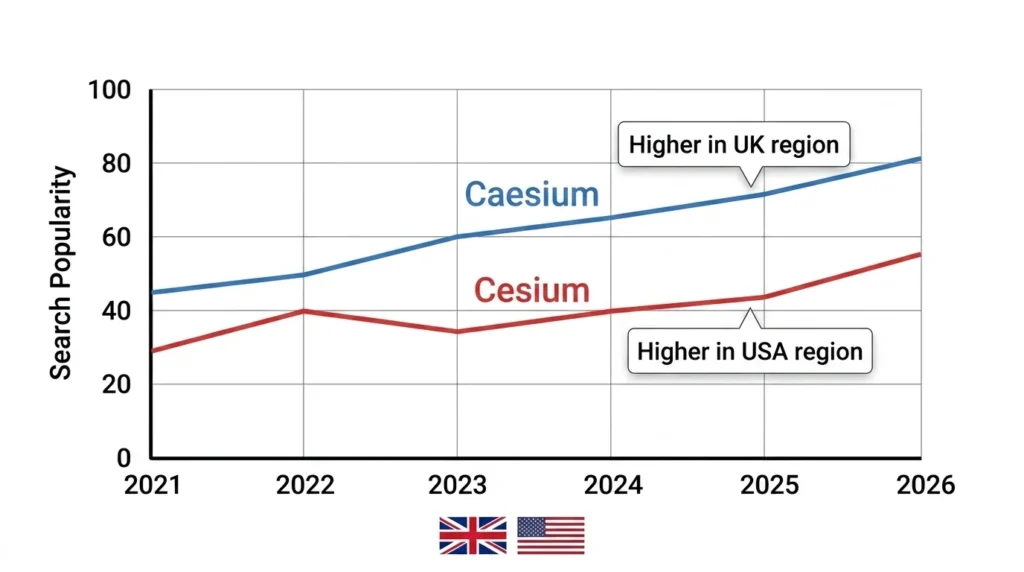
The table below shows which spelling is more popular in each country for English-language searches.
| Country | Cesium % | Caesium % | Winner |
|---|---|---|---|
| 🇺🇸 United States | 96% | 4% | Cesium (overwhelming) |
| 🇬🇧 United Kingdom | 18% | 82% | Caesium (strong) |
| 🇦🇺 Australia | 25% | 75% | Caesium |
| 🇳🇿 New Zealand | 22% | 78% | Caesium |
| 🇨🇦 Canada | 55% | 45% | Cesium (slight) |
| 🇮🇳 India | 40% | 60% | Caesium (slight) |
| 🇮🇪 Ireland | 30% | 70% | Caesium |
| 🇿🇦 South Africa | 35% | 65% | Caesium |
| 🇩🇪 Germany (English searches) | 30% | 70% | Caesium |
| 🇫🇷 France (English searches) | 35% | 65% | Caesium |
| 🇯🇵 Japan (English searches) | 60% | 40% | Cesium |
| 🇨🇳 China (English searches) | 65% | 35% | Cesium |
| 🇧🇷 Brazil (English searches) | 55% | 45% | Cesium |
| 🇲🇽 Mexico (English searches) | 70% | 30% | Cesium |
Key Observations
Observation 1: The United States is the only large English-speaking country where cesium dominates completely. 96% of searches use the American spelling.
Observation 2: The United Kingdom, Australia, New Zealand, Ireland, and South Africa all prefer caesium by a large margin (65-82%).
Observation 3: Canada is split almost evenly. This makes sense because Canada officially follows British English but is heavily influenced by the United States.
Observation 4: India prefers caesium but the margin is smaller (60/40). American influence is growing in India due to technology and software.
Observation 5: In non-English speaking countries, the spelling depends on which English dialect is taught in schools. Japan and China tend toward cesium because of US influence. Germany and France tend toward caesium because of European influence.
Search Volume for Related Keywords (Monthly Average)
These numbers show how many people search for each term every month (global, English language).
| Keyword | Monthly Searches |
|---|---|
| What is caesium used for | 2,200 |
| Where is cesium found | 1,800 |
| Cesium price | 1,500 |
| Caesium or cesium | 1,100 |
| Cesium atomic number | 600 |
| Caesium or cesium difference | 600 |
| Cesium symbol | 500 |
| Caesium element | 400 |
| Is it caesium or cesium | 350 |
| Caesium or cesium spelling | 300 |
| Cesium metal | 450 |
| Caesium 137 | 400 |
| Cesium chloride | 350 |
| Cesium for sale | 250 |
| Where to buy cesium | 200 |
What These Numbers Tell Us
Insight 1: The most searched question is what is caesium used for (2,200 searches per month). People care more about the element’s uses than its spelling.
Insight 2: Where is cesium found is the second most searched question (1,800 searches). People want to know where this metal comes from.
Insight 3: Cesium price is searched 1,500 times per month. Investors, lab managers, and curious people want to know how much it costs.
Insight 4: The spelling question itself – caesium or cesium – is searched about 1,100 times per month. That is a lot of confused people!
Insight 5: Caesium or cesium difference is searched 600 times per month. People want a clear comparison.
Insight 6: Cesium atomic number and cesium symbol are searched by students doing homework.
Google Trends Over Time (2021-2026)
Looking at the 5-year trend:
- Cesium searches have stayed stable in the US (95-97% share)
- Caesium searches have stayed stable in the UK (80-85% share)
- Global searches for “cesium” are about 3x higher than “caesium” because of US population and global US influence
- Interest spikes for both spellings happen when news reports mention atomic clocks or when a mine closes (affecting price)
Seasonal Patterns
Searches for caesium or cesium peak during:
- September to November (school year starts – students doing homework)
- January to March (second school term)
- When atomic clock news is published (about once per year)
Searches are lowest during:
- June to August (summer break in northern hemisphere)
Which Spelling Should You Use for SEO?
If you are writing a website or blog and you care about search traffic:
Use “cesium” if:
- Your target audience is global (especially US, Japan, China, Brazil)
- You want higher search volume
- You are writing for a general audience
Use “caesium” if:
- Your target audience is specifically British, Australian, or European
- You are writing for a scientific journal that follows IUPAC
- You want to appear more traditional or academic
Best practice for global websites: Use cesium in your page title and headings (for search traffic), but mention caesium in the first paragraph so both spellings find your page.
Example:
“Cesium (also spelled caesium) is a reactive metal…”
This way, people searching for “cesium” AND people searching for “caesium” will find your page.
Comparison Table: Caesium vs Cesium
This table puts everything side by side. Use it as a quick reference.
| Feature | Caesium 🇬🇧 | Cesium 🇺🇸 |
|---|---|---|
| Primary region | UK, Australia, NZ, South Africa, India, Ireland | United States |
| Secondary regions | Canada (mixed), Europe (English searches) | Canada (mixed), Japan, China, Brazil, Philippines |
| Original Latin spelling | ✅ Yes (caesius = sky blue) | ❌ No (simplified) |
| IUPAC official recommendation | ✅ Yes (preferred) | ✅ Accepted as variant |
| Periodic table label | Caesium | Cesium |
| Symbol | Cs | Cs |
| Atomic number | 55 | 55 |
| Atomic weight | 132.9 | 132.9 |
| Pronunciation | SEE-zee-um | SEE-zee-um |
| Melting point | 83°F / 28.5°C | 83°F / 28.5°C |
| Boiling point | 1,202°F / 650°C | 1,202°F / 650°C |
| Density | 1.93 g/cm³ | 1.93 g/cm³ |
| Reactivity | Extremely high | Extremely high |
| Color | Silvery-gold | Silvery-gold |
| Caesium or cesium ion | Cs⁺ | Cs⁺ |
| What is caesium used for | Atomic clocks, drilling, solar cells, cancer treatment | Same |
| Where is cesium found | Pollucite ore, Bernic Lake (Canada), Zimbabwe, Namibia | Same |
| Caesium or cesium price (2026) | $60–$120 per gram | $60–$120 per gram |
| Global search volume | Lower | Higher (3x) |
| Common in schools | UK, Australia, NZ, India, South Africa | USA, Canada, Philippines, Japan |
| First discovered as | Caesium (1860) | Caesium (1860) |
| Dictionary main entry | Oxford, Cambridge | Merriam-Webster, American Heritage |
FAQs

FAQ 1: Is it caesium or cesium in the periodic table?
Answer: Both, depending on where the periodic table was printed. The international chemistry authority IUPAC lists caesium as the official name but accepts cesium as an American variant. In American periodic tables you will see cesium. In British periodic tables you will see caesium. The cesium symbol Cs is always the same.
FAQ 2: What is the caesium or cesium difference?
Answer: Only the spelling. The caesium or cesium difference is purely regional – not chemical, not physical, not historical. The element is 100% identical. The caesium or cesium ion (Cs⁺) is also identical. The caesium element behaves exactly the same way everywhere.
FAQ 3: What is caesium used for?
Answer: What is caesium used for includes:
- 🕰️ Atomic clocks – defines the international second. GPS, internet, and stock markets rely on these clocks.
- 🛢️ Drilling fluids – mixed into oil and gas drilling mud to make drilling smoother.
- ☀️ Photoelectric cells – converts light into electricity. Used in some solar panels and night vision equipment.
- 📡 Vacuum tube getter – removes last traces of air from vacuum tubes.
- 🏥 Cancer treatment – radioactive Cs-137 is used in brachytherapy for certain cancers.
- 🚀 Ion thrusters – the caesium or cesium ion (Cs⁺) is used in some spacecraft engines.
- 🔬 Research – studying chemical reactions, quantum physics, and electron behavior.
FAQ 4: Where is cesium found?
Answer: Where is cesium found? Never in pure form in nature. It is too reactive. It is found in the mineral pollucite. The largest deposit is at Bernic Lake, Manitoba, Canada. Other sources include the Bikita Mine in Zimbabwe and Karibib in Namibia. Very small amounts exist in seawater and some clay soils.
FAQ 5: What is the cesium symbol and cesium atomic number?
Answer: The cesium symbol is Cs (capital C, lowercase s). The cesium atomic number is 55. These never change, no matter which spelling you use. The caesium element has the same symbol and atomic number.
FAQ 6: What is the caesium or cesium price in 2026?
Answer: The caesium or cesium price is approximately $60 to $120 per gram (as of 2026). The price varies based on:
- Purity (99.9% vs 99.99% vs 99.999%)
- Quantity (small amounts cost more per gram)
- Supplier (Sigma-Aldrich, Strem, Alfa Aesar)
- Market demand
For comparison: gold is about $65 per gram. So cesium is roughly as expensive as gold, sometimes more.
FAQ 7: Why is caesium or cesium so expensive?
Answer: Three reasons:
- Rarity – Cesium is the 45th most abundant element in Earth’s crust. It is rarer than gold, silver, or platinum.
- Difficult to refine – Separating cesium from pollucite ore is complex and expensive.
- Dangerous to handle – It must be processed and stored under argon gas or oil. Special equipment is required.
FAQ 8: Can I touch caesium or cesium?
Answer: NEVER. It reacts violently with the moisture on your skin. It would burn you badly and could explode. Only trained scientists handle it with special equipment in sealed environments (glove boxes filled with argon gas).
FAQ 9: Is caesium or cesium dangerous?
Answer: The pure metal is extremely dangerous – it explodes on contact with air and water. The caesium or cesium ion (Cs⁺) in compounds like cesium chloride is much safer but still needs care. Radioactive Cs-137 is used in medicine but is hazardous if not contained properly.
FAQ 10: Do atomic clocks really use caesium or cesium?
Answer: Yes! The official definition of one second is based on the vibrations of the caesium or cesium ion (Cs⁺). A caesium atomic clock is accurate to 1 second in 100 million years. That is why GPS, internet, stock markets, and power grids all rely on caesium clocks. 🕰️
FAQ 11: Is it caesium or cesium in the dictionary?
Answer: Both. American dictionaries (Merriam-Webster, American Heritage) list cesium as the main entry and mention caesium as a variant. British dictionaries (Oxford, Cambridge) list caesium as the main entry and mention cesium as the US variant.
FAQ 12: Which spelling is older – caesium or cesium?
Answer: Caesium is older. The element was discovered and named in 1860 as caesium. The spelling cesium was introduced in the United States in the late 1800s by Noah Webster’s dictionary reforms.
FAQ 13: Do other English-speaking countries use caesium or cesium?
Answer:
- 🇦🇺 Australia: Caesium (British English)
- 🇳🇿 New Zealand: Caesium (British English)
- 🇮🇳 India: Caesium (traditional), but cesium is growing
- 🇨🇦 Canada: Mixed – official British English, but US influence strong
- 🇿🇦 South Africa: Caesium (British English)
- 🇮🇪 Ireland: Caesium (British English)
FAQ 14: What is the caesium or cesium ion used for?
Answer: The caesium or cesium ion (Cs⁺) is used in:
- Atomic clocks – the ion vibrates at 9,192,631,770 Hz
- Ion thrusters for spacecraft
- Quantum computing research
- Medical imaging (as cesium chloride)
- Glass manufacturing (improves glass quality)
FAQ 15: Why does caesium or cesium melt in your hand?
Answer: The caesium element has a very low melting point – only 83°F (28.5°C). Your hand is about 90-95°F (32-35°C), which is warmer than the melting point. So the metal turns to liquid. But again – NEVER hold it in your hand. It will explode from the moisture on your skin.
FAQ 16: Is caesium or cesium radioactive?
Answer: Natural caesium/cesium is not radioactive. It is stable. However, there is a radioactive isotope called Cs-137 (cesium-137) that is produced in nuclear reactors. Cs-137 is used in medicine and industry. It is dangerous and must be handled carefully.
FAQ 17: How should I answer “is it caesium or cesium” on a test?
Answer: Ask your teacher which spelling they prefer. If they say “either,” choose one and be consistent. If they don’t specify, use the spelling that matches your textbook. In the US, use cesium. In the UK, use caesium.
FAQ 18: What is the most common mistake people make with caesium or cesium?
Answer: The most common mistake is mixing both spellings in the same document. Pick one spelling and stick with it. The second most common mistake is forgetting that the symbol is Cs (not CA or CE).
Conclusion
Now you know everything about caesium or cesium.
Here is the short version: Caesium is British. Cesium is American. Both are correct. Pick one and be consistent. The cesium symbol is Cs. The cesium atomic number is 55. The caesium or cesium price is $60–$120 per gram. What is caesium used for? Atomic clocks, drilling fluids, solar cells, and cancer treatment. Where is cesium found? In pollucite ore in Canada.
Remember: never mix spellings. Never touch pure caesium. And always remember – this amazing metal keeps your phone’s time accurate right now. ⏰

“Stella Gibbons crafts warm, expressive, and uplifting wishes that help readers share their emotions beautifully and choose the perfect words for every occasion.”