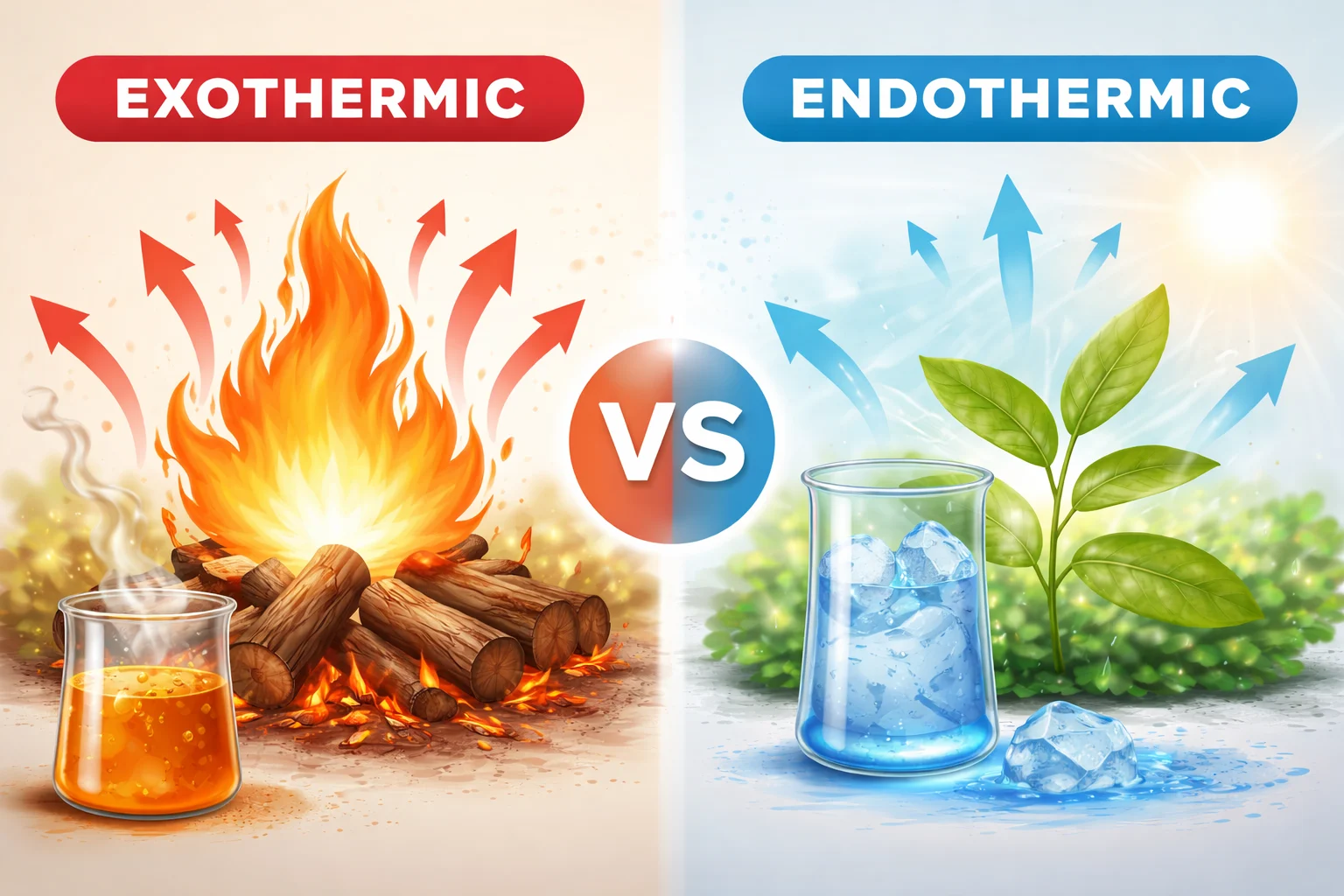
Why does burning wood feel hot while an ice pack feels cold? Why does your body release energy during respiration, but plants need sunlight to make food? These everyday observations all connect to one important concept: exothermic or endothermic reactions.
Many students and learners search for “exothermic or endothermic” because the concepts seem similar but behave in opposite ways. Questions like “Is exothermic hot or cold?”, “Delta H is negative exothermic or endothermic?”, and “Photosynthesis is exothermic or endothermic?” often create confusion. The problem usually comes from unclear explanations, lack of real-life examples, or difficulty remembering energy flow.
This guide solves that confusion completely. You’ll learn clear definitions, memory tricks, formulas, real-life applications, physics connections, and common mistakes—all explained in a simple and structured way. By the end, you’ll not only understand exothermic vs endothermic reactions, but you’ll also be able to identify them confidently in exams and everyday life.
Exothermic or Endothermic
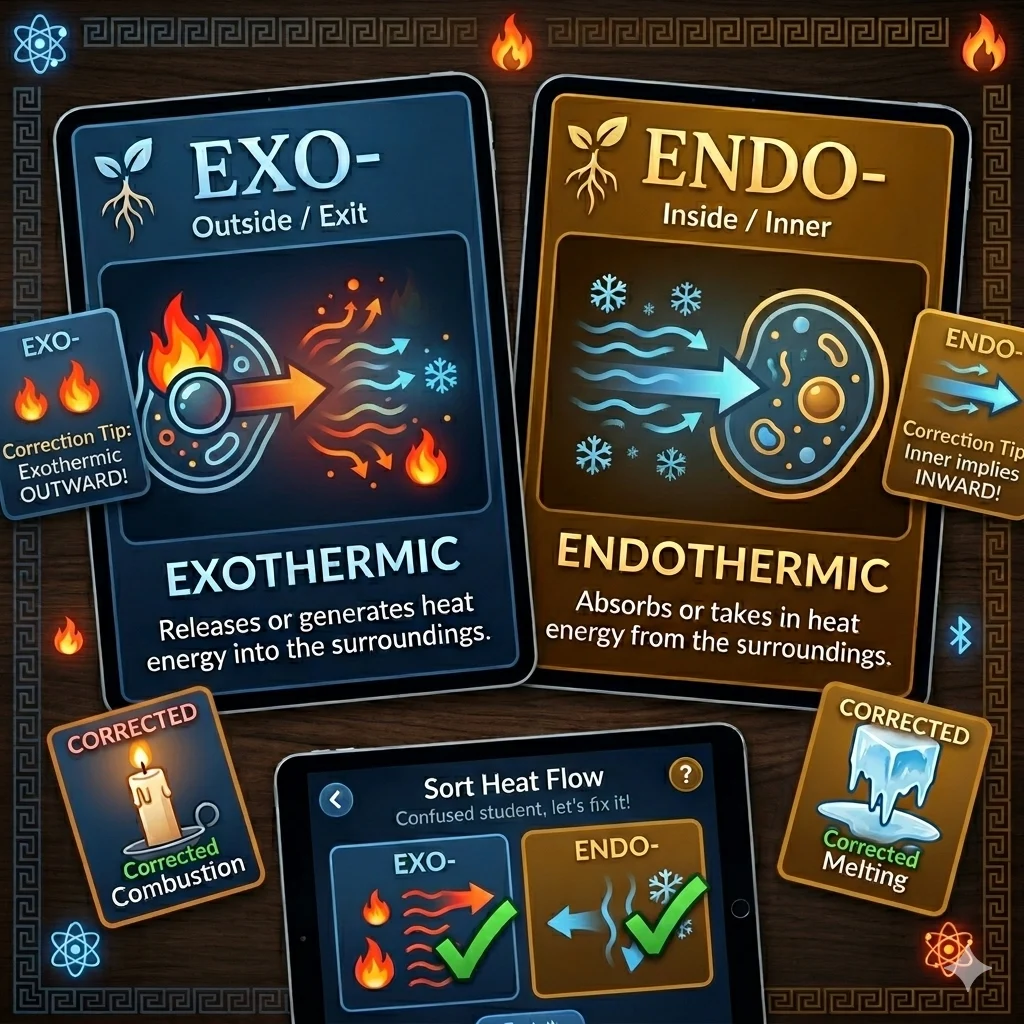
- Exothermic reactions release heat into the surroundings → surroundings get warmer
- Endothermic reactions absorb heat from the surroundings → surroundings get cooler
Examples:
- Burning fuel → Exothermic
- Respiration → Exothermic
- Photosynthesis → Endothermic
- Melting ice → Endothermic
👉 Memory Trick:
- Exo = Exit (heat leaves)
- Endo = Enter (heat enters)
The Origin of Exothermic or Endothermic
The terms exothermic and endothermic come from Greek:
- Exo (ἔξω) = outside
- Endo (ἔνδον) = inside
- Therme (θέρμη) = heat
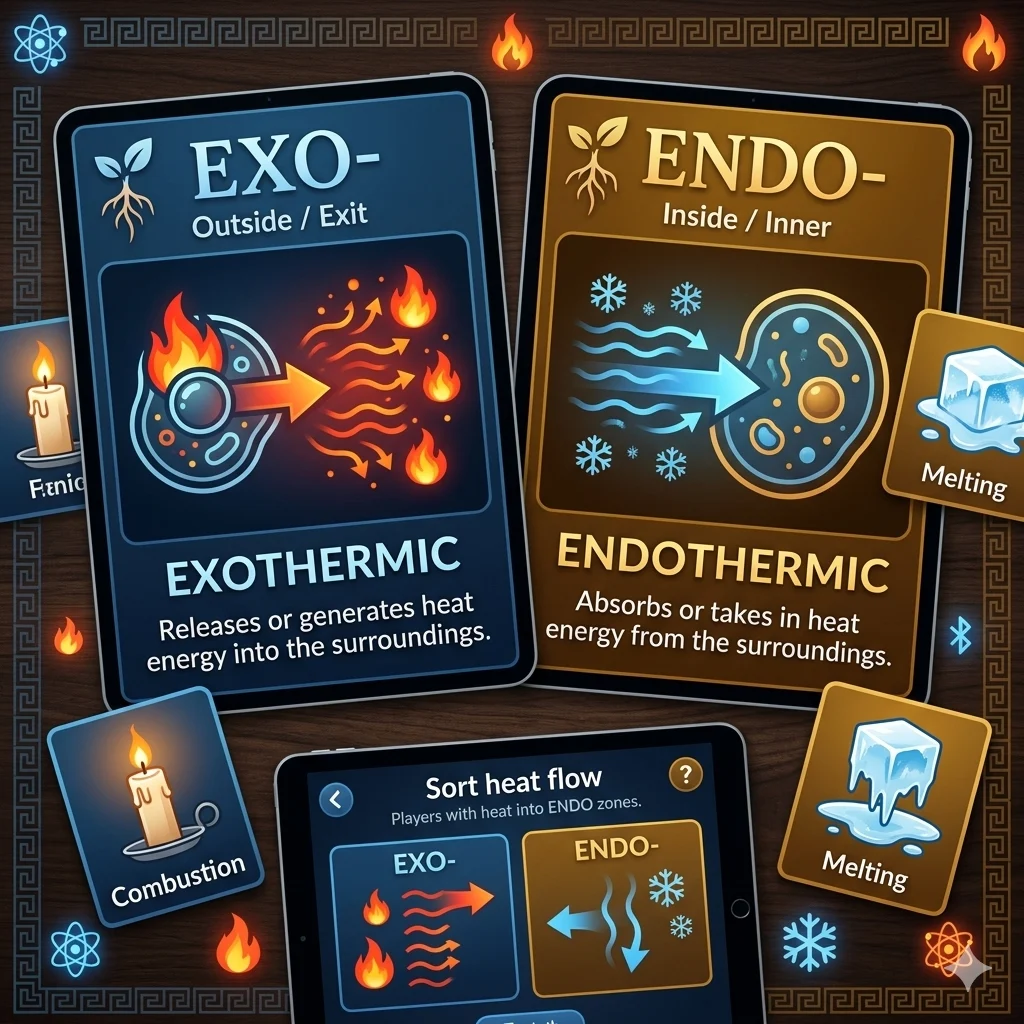
These terms became widely used in thermodynamics, a branch of science that studies energy changes. Scientists introduced them to clearly describe whether heat flows out of or into a system during a reaction.
Unlike many English words, these terms do not have spelling variations. However, confusion arises because:
- They sound similar
- Both involve heat
- Students often mix up energy direction
Understanding their origin helps you remember:
- Exothermic → heat goes out
- Endothermic → heat goes in
British English vs American English Spelling
There is no spelling difference between British and American English.
Comparison Table
| Term | British English | American English | Meaning |
|---|---|---|---|
| Exothermic | Exothermic | Exothermic | Releases heat |
| Endothermic | Endothermic | Endothermic | Absorbs heat |
This consistency makes it easier for students worldwide to learn and use these terms correctly.
Which Spelling Should You Use?
Since there is no variation, you can use exothermic and endothermic universally.
Best Usage by Audience:
- Students: Focus on understanding energy flow
- Academic Writing: Use precise definitions and equations
- Global Communication: Use simple explanations
👉 Tip: Always explain the concept briefly when writing for beginners.
Exothermic or Endothermic in Physics and Chemistry
Understanding exothermic or endothermic reactions is not limited to chemistry—it also plays a key role in physics.
In Physics:
These reactions relate to the First Law of Thermodynamics, which states:
Energy cannot be created or destroyed, only transferred.
- Exothermic → Energy is transferred to surroundings
- Endothermic → Energy is absorbed from surroundings
In Chemistry:
Reactions involve breaking and forming bonds:
- Breaking bonds → Requires energy (Endothermic)
- Forming bonds → Releases energy (Exothermic)
Delta H: Negative or Positive?
- ΔH < 0 (Negative) → Exothermic reaction
- ΔH > 0 (Positive) → Endothermic reaction
👉 Simple understanding:
- Negative ΔH = energy released
- Positive ΔH = energy absorbed
Common Mistakes with Exothermic or Endothermic
❌ Mistake 1: Thinking exothermic means cold
✔️ Exothermic reactions feel hot because heat is released
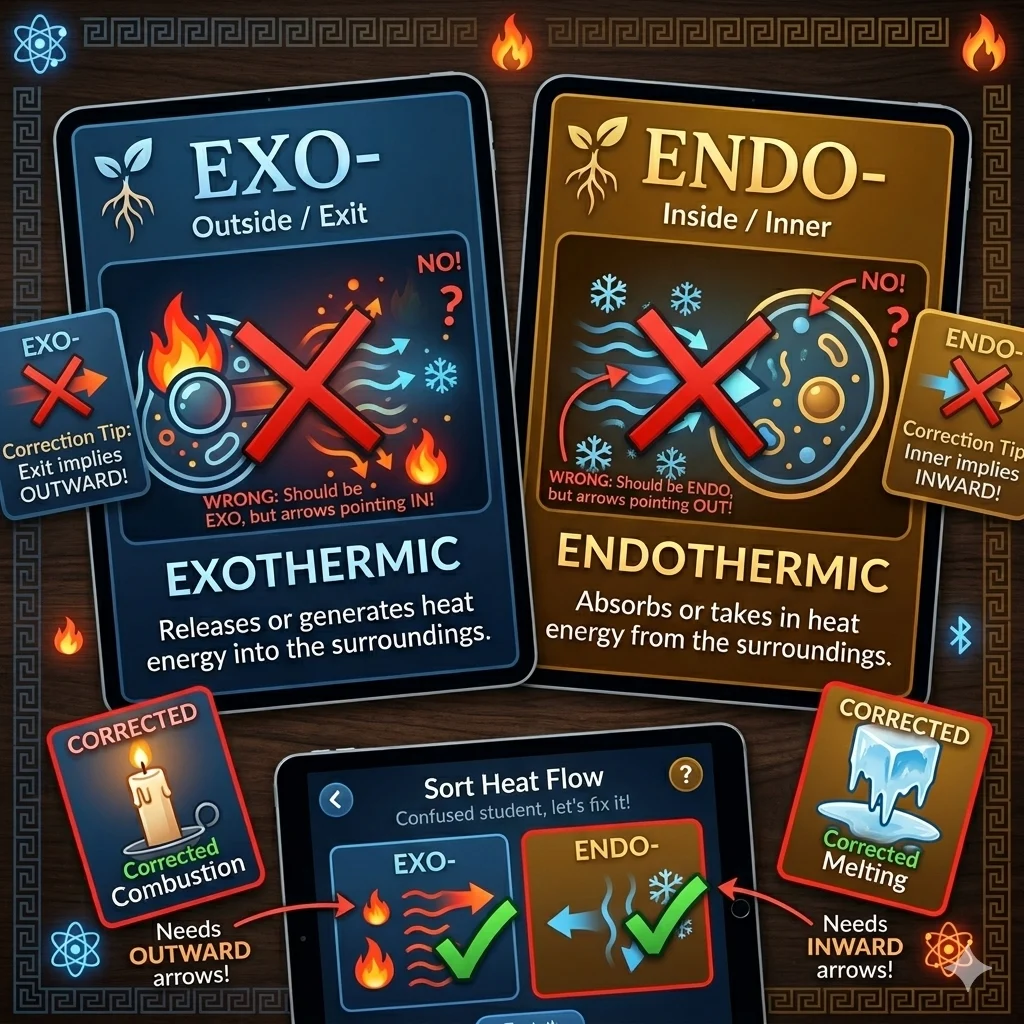
❌ Mistake 2: Confusing ΔH signs
✔️ Negative = exothermic, Positive = endothermic
❌ Mistake 3: Mixing examples
✔️ Respiration = exothermic
✔️ Photosynthesis = endothermic
❌ Mistake 4: Assuming all reactions involve heat release
✔️ Some absorb heat (endothermic)
❌ Mistake 5: Writing incorrect formulas
✔️ Correct forms:
- Exothermic: Reactants → Products + Heat
- Endothermic: Reactants + Heat → Products
❌ Mistake 6: Confusing “exothermic vs exothermic”
✔️ Correct comparison is exothermic vs endothermic
Exothermic or Endothermic in Everyday Examples
Daily Life:
- Burning wood → Exothermic
- Ice melting → Endothermic
- Hot packs → Exothermic
- Cold packs → Endothermic
Biology:
- Respiration is exothermic or endothermic? → Exothermic
- Photosynthesis is exothermic or endothermic? → Endothermic
Communication Examples:
Email:
“The reaction is exothermic, as it releases heat during the process.”
Social Media:
“Fun fact: Instant cold packs work using endothermic reactions!”
Formal Writing:
“The process demonstrates an endothermic energy change requiring heat input.”
Differences Between Endothermic and Exothermic Reaction
| Feature | Exothermic | Endothermic |
|---|---|---|
| Heat Flow | Released | Absorbed |
| Temperature | Increases | Decreases |
| ΔH Value | Negative | Positive |
| Energy Direction | Outward | Inward |
| Example | Combustion | Photosynthesis |
Examples of Endothermic Reactions with Equations
- Photosynthesis
6CO₂ + 6H₂O + light → C₆H₁₂O₆ + 6O₂ - Thermal decomposition of calcium carbonate
CaCO₃ → CaO + CO₂ - Electrolysis of water
2H₂O → 2H₂ + O₂ - Formation of nitric oxide
N₂ + O₂ → 2NO - Dissolving ammonium nitrate in water
- Decomposition of ammonium chloride
NH₄Cl → NH₃ + HCl - Evaporation of water
- Sublimation of dry ice
- Photosplitting of water in plants
- Barium hydroxide + ammonium chloride reaction
Exothermic or Endothermic Formula
- Exothermic Reaction:
Reactants → Products + Heat - Endothermic Reaction:
Reactants + Heat → Products
Exothermic or Endothermic – Google Trends & Usage Data
The keyword “exothermic or endothermic” is highly searched globally, especially in:
- Pakistan
- India
- United Kingdom
- United States
Why Popular:
- Exam preparation
- Homework help
- Concept clarity
When Searches Increase:
- During exam seasons
- Assignment deadlines
- Science test preparation
Keyword Variations Table:
| Variation | Usage Context |
|---|---|
| Exothermic vs endothermic | Comparison searches |
| Endothermic examples | Homework |
| ΔH negative exothermic | Concept clarity |
| Reaction heat types | General learning |
What is Endothermic and Exothermic with an Example?
An exothermic reaction releases heat.
👉 Example: Burning fuel
An endothermic reaction absorbs heat.
👉 Example: Photosynthesis
Is Exothermic Hot or Cold?
Exothermic reactions are hot because they release heat into the surroundings.
Is Exothermic Positive or Endothermic?
- Exothermic → Negative ΔH
- Endothermic → Positive ΔH
Conclusion
Understanding exothermic or endothermic reactions is essential for explaining how energy changes occur in both natural and chemical processes. Exothermic reactions release heat, making their surroundings warmer, while endothermic reactions absorb heat, often creating a cooling effect. This simple distinction helps explain everything from burning fuels and respiration to photosynthesis and melting ice.
Many learners initially find these concepts confusing due to similar terminology and overlapping examples. However, by remembering key ideas—such as Exo means exit (heat leaves) and Endo means enter (heat enters)—the topic becomes much easier to understand. Recognizing the role of ΔH values, real-life examples, and reaction formulas further strengthens your understanding.
Once you master this concept, identifying energy changes in reactions becomes straightforward. Whether for exams or real-world knowledge, this is a concept you’ll use again and again with confidence.

“Wilkie Collins writes heartfelt and expressive wishes that help readers convey emotions with clarity and find the perfect words for every special moment today.!”