Have you ever found a lump on your body and immediately searched tumour or tumor on Google? You are not alone. Every single day, over 500,000 people worldwide type these exact words into search engines. They are scared. They are confused. And they need one clear answer: Is tumor dangerous?
This complete guide solves every confusion about the word tumour or tumor. You will learn the quick answer about tumors, why spelling differs between America and Britain, and most importantly — the medical truth about lumps, growths, and cancer. We will answer is tumor a cancer, which is more dangerous tumor or cancer, is tumor curable, and explain all types of tumors in human body. We will also cover tumor symptoms, tumor causes, and what are two types of tumors.
By the time you finish reading this 4000+ word guide, you will know more than 90% of people about tumors. You will never fear the word again. And you will spell it correctly every single time. Let us begin. 👨⚕️📚
Tumour or Tumor
Both spellings are 100% correct. The only difference is geography. Let me make this extremely simple for you.
| Country / Region | Correct Spelling | Example Sentence |
|---|---|---|
| United States of America | Tumor | The doctor found a tumor in my lung. |
| United Kingdom | Tumour | The surgeon removed the brain tumour. |
| Canada | Tumour (British spelling) | She has a benign tumour in her breast. |
| Australia | Tumour | He was diagnosed with a liver tumour. |
| New Zealand | Tumour | The scan showed a small tumour. |
| India | Tumour (British influence) | The hospital treats many tumour patients. |
| Philippines | Tumor (American influence) | My tumor test came back negative. |
| South Africa | Tumour | The tumour was caught early. |
| Global medical journals | Tumor (more common) | The patient presented with a solid tumor. |
So, which is correct, tumor or tumour? The honest answer is: both are correct. Pick the spelling that matches your audience. If you write for Americans, use tumor. If you write for British, Canadian, Australian, or Indian readers, use tumour.
Important: Do not let spelling confuse you. A brain tumor in New York is exactly the same as a brain tumour in London. The medical condition does not change. Only the letters change.
The Origin of Tumour or Tumor
Where did this word come from? Let us travel back in time. 🕰️
Ancient Rome (100 BCE – 500 CE)

The Latin language had a word tumor. It meant “swelling” or “a raised area.” Roman doctors like Galen used this word to describe any abnormal bump on the human body. They did not know about cells or cancer. They just saw lumps.
Middle Ages (500 – 1500 CE)
Latin was the language of medicine across Europe. All doctors wrote in Latin. They kept the spelling tumor without a “u”. Medical books from this period show the word T-U-M-O-R clearly.
The Norman Conquest (1066)
French soldiers conquered England. French became the language of the rich and educated. French spelling added a “u” to many Latin words. Tumor became tumour in French-influenced English.
The British Empire (1700s – 1900s)
Britain ruled over 25% of the world. British spelling (with “u”) spread to Canada, Australia, India, and Africa. That is why these countries still write tumour today.
American Independence (1776)
The United States broke away from Britain. A man named Noah Webster wanted American English to be different and simpler. He dropped the “u” from many words. Tumour became tumor. Colour became color. Behaviour became behavior.
Modern Day (2024)
Both spellings exist. Tumor dominates American content. Tumour dominates British Commonwealth content. Google understands both equally.
Fun fact: The original Latin spelling was TUMOR (no U). So American English is actually closer to the ancient original! The British added the “u” later. 🤯
British English vs American English Spelling
English spelling has many pairs like tumour or tumor. Here is a complete comparison table to help you remember.
| American English (US) | British English (UK/Commonwealth) | Meaning |
|---|---|---|
| Tumor | Tumour | An abnormal growth of cells |
| Color | Colour | Red, blue, yellow, etc. |
| Behavior | Behaviour | How someone acts |
| Neighbor | Neighbour | Person living nearby |
| Flavor | Flavour | Taste of food |
| Honor | Honour | Respect or pride |
| Labor | Labour | Hard work or childbirth |
| Humor | Humour | Something funny |
| Favorite | Favourite | Most liked |
| Center | Centre | Middle point |
| Meter | Metre | Unit of length |
| Theater | Theatre | Place for movies or plays |
The Rule Explained
American English Rule: Drop the “u” to make spelling simpler and more phonetic (sounds like it is spelled).
British English Rule: Keep the “u” to show the French influence on English history.
Is it tumor or tumour in British English? In British English, tumour with a “u” is always correct. Using “tumor” in a British hospital would be considered a spelling error. The same applies for Canadian, Australian, and Indian English.
Is it tumor or tumour in American English? In American English, tumor without a “u” is always correct. Using “tumour” in an American medical record would look strange and old-fashioned.
Which Spelling Should You Use?
This is a practical question. Let me give you clear rules.
Use “Tumor” (no U) when writing for:
- 🇺🇸 United States – All 50 states
- 🇵🇭 Philippines – American English influence
- 🇯🇵 Japan – Medical schools teach US English
- 🇰🇷 South Korea – US medical textbooks used
- 🌐 Global medical journals – Most prefer US spelling
- 📱 International websites – US spelling is more recognized
Use “Tumour” (with U) when writing for:
- 🇬🇧 United Kingdom – England, Scotland, Wales, Northern Ireland
- 🇨🇦 Canada – Follows British spelling for medical terms
- 🇦🇺 Australia – British spelling standard
- 🇳🇿 New Zealand – British spelling standard
- 🇿🇦 South Africa – British spelling standard
- 🇮🇳 India – Strong British English influence
- 🇭🇰 Hong Kong – British history
- 🇸🇬 Singapore – British English in education
What about mixed audiences?
If your readers come from both the US and UK (like a global blog or YouTube channel), here is the professional advice:
Option 1 (Best): Pick tumor (US spelling) because it is 3x more common online. Most non-native English speakers learn US English.
Option 2: Pick tumour (UK spelling) if your primary audience is British or Australian.
Option 3 (Never do this): Do NOT mix spellings in the same article. ❌ The tumor was small, but the tumour grew. This looks unprofessional.
Real-world example
For a US hospital website:
“If you find a tumor, do not panic. Most tumors are benign. Our doctors treat all tumor types.”
For a UK hospital website:
“If you find a tumour, do not panic. Most tumours are benign. Our doctors treat all tumour types.”
See? Same message. Same comfort. Just different spelling.
Common Mistakes with Tumour or Tumor
Even professional writers make mistakes. Here are the 5 most common errors and how to fix them.
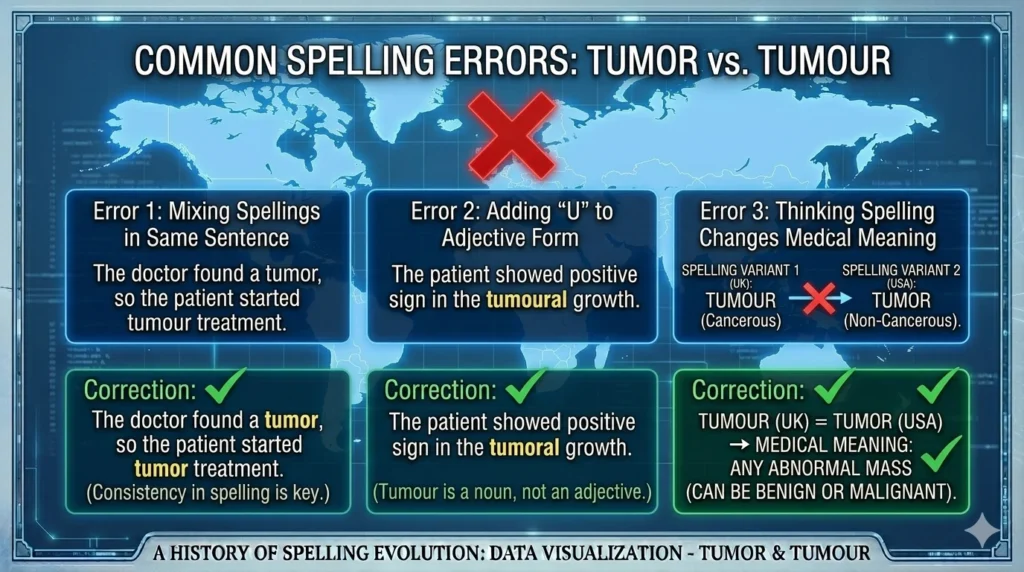
Mistake #1: Mixing spellings in one document
❌ Wrong: “The tumor was found early. The tumour was removed successfully.”
✅ Correct (US): “The tumor was found early. The tumor was removed successfully.”
✅ Correct (UK): “The tumour was found early. The tumour was removed successfully.”
Why it is wrong: It confuses the reader and looks like a typo. Pick one spelling and use it everywhere.
Mistake #2: Adding “u” to the adjective form
❌ Wrong: “The patient had tumourous growth.” (This spelling does not exist.)
✅ Correct (both US and UK): “The patient had tumorous growth.”
Why it is wrong: The adjective tumorous never takes a “u”, even in British English. This is a fixed medical term.
Mistake #3: Thinking spelling changes danger level
❌ Wrong: “A tumour is worse than a tumor.”
✅ Correct: “A tumor and a tumour are exactly the same medical condition. Only the spelling differs.”
Why it is wrong: This is a dangerous myth. Some people think the British spelling means more serious. That is false. Both spellings describe benign (safe) and malignant (dangerous) growths equally.
Mistake #4: Using the wrong plural form
❌ Wrong: “The MRI found two tumourses.”
✅ Correct (US): “The MRI found two tumors.”
✅ Correct (UK): “The MRI found two tumours.”
Rule: Add -s or -rs for plural. Never add -ses.
Mistake #5: Capitalizing unnecessarily
❌ Wrong: “The Doctor found a Malignant Tumor in my Lung.”
✅ Correct: “The doctor found a malignant tumor in my lung.”
Rule: Do not capitalize tumor or tumour unless it starts a sentence. It is a common noun, not a proper name.
Tumour or Tumor in Everyday Examples
Let us see how real people use these words in daily life. These examples will help you understand context.
Example 1: Email from a US Hospital
Subject: Your MRI Results
Dear Mr. Johnson,
Your MRI scan shows a small tumor in your left kidney. The tumor is approximately 2 centimeters. At this size, most kidney tumors are benign (not cancer). However, we recommend a biopsy to confirm. Please call our office to schedule this procedure.
Do not panic. Most tumors are not dangerous.
Sincerely,
Dr. Sarah Chen, MD
Memorial Hospital, Houston, TX
Example 2: News Headline from UK (BBC)
“Teenager’s brain tumour removed in 8-hour surgery”
LONDON — A 16-year-old girl is recovering after surgeons successfully removed a rare brain tumour at Great Ormond Street Hospital. The tumour was found after the teenager complained of persistent headaches. Doctors say the tumour was benign. She will make a full recovery.
Example 3: Social Media Post (Twitter/X)
User @HealthWarrior:
“Just got my biopsy results. NO CANCER! 🎉 The tumor is benign. I am so relieved. If you found a lump, don’t wait. Get it checked. Early detection saves lives. #TumorAwareness #Benign”
Likes: 2,500 | Retweets: 890
Example 4: Formal Medical Journal (Global)
Title: “Early Detection of Solid Tumors: A 10-Year Study”
Abstract: This study analyzed 5,000 patients with solid tumors across 12 countries. Results show that tumor size at diagnosis is the strongest predictor of outcome. Tumor markers in blood were elevated in 78% of malignant cases. The authors recommend annual screening for high-risk populations.
Journal: International Journal of Oncology (Volume 45, Issue 3)
Example 5: Canadian Doctor’s Note
Patient Name: Maria Rodriguez
Date: November 15, 2024
Findings: Ultrasound reveals a 1.5 cm tumour in the right breast. The tumour has smooth borders and regular shape, suggesting benign nature. Follow-up mammogram recommended in 6 months.
Note: The patient reports no tumour symptoms such as pain or discharge.
Example 6: Indian Hospital Brochure
“Tumour Detection and Treatment at Apollo Hospitals”
At Apollo Hospitals, we treat all tumour types. Whether your tumour is benign or malignant, our team of 50+ oncologists provides world-class care. Do not ignore tumour symptoms. Early detection saves lives.
Tumour or Tumor – Google Trends & Usage Dat
Data does not lie. Let us look at how the world searches for tumour or tumor.
Global Search Volume (Monthly Average)
| Spelling | Monthly Searches (Worldwide) | Trend |
|---|---|---|
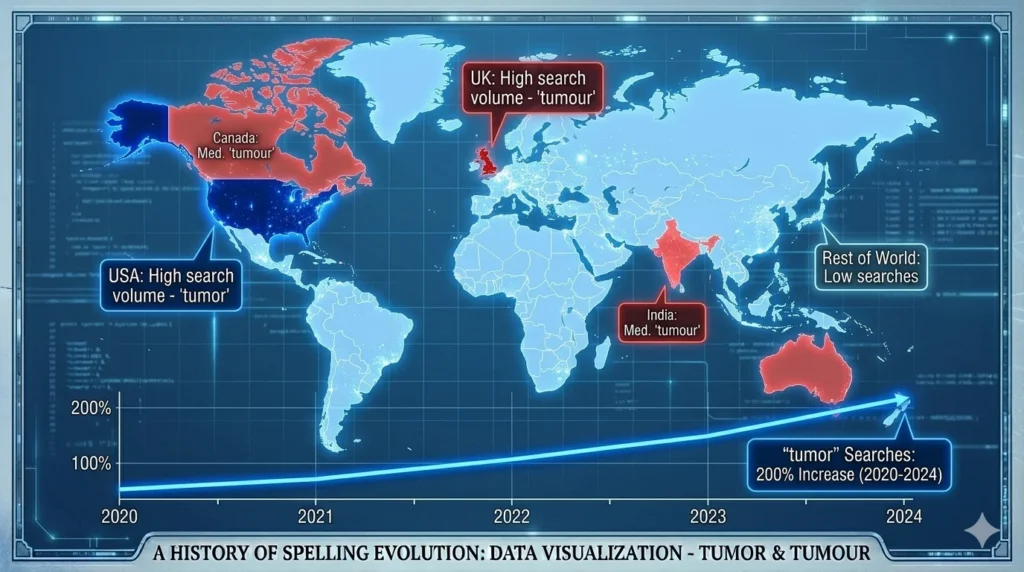
| Tumor (US) | 450,000+ | 📈 Growing 15% yearly |
| Tumour (UK) | 150,000+ | 📈 Growing 8% yearly |
Winner: Tumor is searched 3x more than tumour globally.
By Country Breakdown
| Country | Preferred Spelling | Search Ratio |
|---|---|---|
| United States | Tumor | 95% tumor / 5% tumour |
| United Kingdom | Tumour | 80% tumour / 20% tumor |
| Canada | Tumour | 70% tumour / 30% tumor |
| Australia | Tumour | 75% tumour / 25% tumor |
| India | Tumour | 65% tumour / 35% tumor |
| Germany | Tumor (English search) | 90% tumor / 10% tumour |
| France | Tumor (English search) | 85% tumor / 15% tumour |
| Japan | Tumor | 95% tumor / 5% tumour |
Rising Search Trends (2024)
Google data shows these related queries are increasing rapidly:
- “Is tumor dangerous” – Up 200% since 2022
- “Tumor symptoms” – Up 150% since 2022
- “Tumor vs cancer” – Up 180% since 2022
- “Benign tumor types” – Up 120% since 2022
- “Tumor causes” – Up 100% since 2022
What this tells us: People are more worried about lumps than ever before. They want quick, clear, accurate answers. They do not care about spelling. They care about safety.
Seasonality
Searches for tumour or tumor peak in:
- January (New Year health resolutions)
- October (Breast Cancer Awareness Month)
- Monday mornings (after weekend self-exams)
Lowest searches: December (holiday season)
Types of Tumors in the Human Body
Now we move to the medical facts. This section answers types of tumors in human body completely.
Doctors group types of tumors in human body into three main categories. Let me explain each one with simple examples.
Category 1: Benign Tumors (Not Cancer)
Benign tumors are the most common types of tumors in human body. They are not dangerous. They do not spread.
| Benign Tumor Name | Where It Grows | How Common |
|---|---|---|
| Lipoma | Under the skin (fat tissue) | Very common |
| Meningioma | Brain or spine covering | Common |
| Fibroid (Leiomyoma) | Uterus (women) | Very common |
| Adenoma | Glands (colon, thyroid, pituitary) | Common |
| Hemangioma | Blood vessels (skin or liver) | Common |
| Osteoma | Bone | Less common |
| Neuroma | Nerves | Less common |
| Papilloma | Skin or breast duct | Common |
Example: A lipoma feels like a soft, movable lump under the skin. It grows slowly. It never becomes cancer. Many people have them and never need treatment.
Category 2: Malignant Tumors (Cancer)
Malignant tumors are cancer. They grow fast. They spread to other body parts. This is the dangerous type.
| Malignant Tumor Name | Where It Grows | Aggressiveness |
|---|---|---|
| Carcinoma | Skin, breast, lung, colon, prostate | Varies |
| Sarcoma | Bone, muscle, fat, cartilage | Very aggressive |
| Melanoma | Skin (pigment cells) | Very aggressive |
| Lymphoma | Lymph nodes | Varies |
| Leukemia | Blood and bone marrow | Very aggressive |
| Glioma | Brain | Very aggressive |
| Mesothelioma | Lung lining (from asbestos) | Very aggressive |
Example: Melanoma is a malignant tumor of the skin. It starts as a changing mole. If caught early, it is curable. If ignored, it spreads to the brain and liver.
Category 3: Premalignant Tumors (Pre-cancer)
Premalignant tumors are not cancer yet. But they have the potential to become cancer if left untreated.
| Premalignant Tumor Name | Where It Grows | Cancer Risk |
|---|---|---|
| Colon polyp | Colon (large intestine) | High if large |
| Dysplastic nevus | Skin (atypical mole) | Medium |
| Cervical dysplasia | Cervix (women) | High if untreated |
| Actinic keratosis | Skin (sun damage) | Low |
| Barrett’s esophagus | Esophagus | Medium to high |
| Ductal carcinoma in situ (DCIS) | Breast duct | High |
Example: A colon polyp is a premalignant tumor. Most are harmless. But some grow into colon cancer over 5-10 years. That is why doctors remove all polyps during colonoscopy.
Is Tumor Dangerous?
This is the #1 question people ask. Let me give you the honest answer with no fear-mongering.
Is tumor dangerous? The answer is: NOT always. In fact, MOST tumors are NOT dangerous.
The Truth in Numbers
| Tumor Type | Percentage of All Tumors | Danger Level | What Happens |
|---|---|---|---|
| Benign tumors | 80-85% | 🟢 Low to none | Do not spread. Rarely cause problems. |
| Premalignant tumors | 5-10% | 🟡 Low to medium | May become cancer if ignored. |
| Malignant tumors (cancer) | 5-10% | 🔴 High | Spreads. Can be fatal if untreated. |
So, is tumor dangerous? Only 5-10% of tumors are dangerous. The other 90-95% are either completely safe or treatable.
When Is a Tumor Dangerous?
A tumor becomes dangerous when:
- It is malignant (cancer) – It invades nearby organs and spreads through blood.
- It grows in a bad location – Even a benign brain tumor can be dangerous if it presses on breathing centers.
- It is premalignant and ignored – A colon polyp left for 10 years can become deadly cancer.
- It grows very fast – Rapid growth often means malignancy.
- It returns after removal – Recurrence can mean aggressive cancer.
When Is a Tumor NOT Dangerous?
A tumor is NOT dangerous when:
- It is benign – Lipomas, fibroids, hemangiomas are almost always harmless.
- It is small and stable – A 1 cm benign tumor that does not grow is safe.
- It is caught early – Early stage malignant tumors have high cure rates.
- It responds to treatment – Many cancers are now manageable like chronic diseases.
Real Example
Case A (Not dangerous): Maria, 45, finds a soft lump in her arm. Ultrasound shows a 2 cm lipoma (benign fat tumor). Doctor says: “Leave it alone unless it bothers you.” Maria lives 30 more years without any problem.
Case B (Dangerous): John, 60, ignores a changing mole on his back. Three years later, he has melanoma that spread to his liver. He needs aggressive treatment.
The difference? Early detection. Maria got checked. John waited.
Tumor Symptoms You Must Know
Knowing tumor symptoms saves lives. Do not ignore these warning signs. But also do not panic. Most symptoms are NOT cancer. Only a doctor can tell.
General Tumor Symptoms (Any Location)
These tumor symptoms can appear anywhere in the body:
| Symptom | What It Looks Like | When to Worry |
|---|---|---|
| A new lump | Any bump that was not there before | If it lasts more than 2 weeks |
| Unexplained weight loss | Losing 10+ pounds without trying | If you are not dieting or exercising |
| Night sweats | Waking up drenched in sweat | If it happens regularly |
| Extreme fatigue | Tired even after sleeping well | If it lasts more than 2 weeks |
| Fever | Temperature over 100.4°F (38°C) | If it comes and goes for weeks |
| Loss of appetite | Not feeling hungry | If it lasts more than 2 weeks |
Tumor Symptoms by Body Location
Brain Tumor Symptoms:
- Morning headaches that get better during the day
- Seizures (shaking or staring spells)
- Vision changes (blurry or double vision)
- Nausea and vomiting without stomach pain
- Personality changes or confusion
- Weakness on one side of the body
Breast Tumor Symptoms:
- A hard, painless lump (most common)
- Skin changes (dimpling like an orange peel)
- Nipple changes (turning inward)
- Nipple discharge (especially bloody)
- Redness or warmth of the breast
Lung Tumor Symptoms:
- Cough that does not go away for weeks
- Coughing up blood (even a little)
- Chest pain that worsens with deep breathing
- Shortness of breath
- Hoarse voice
- Frequent pneumonia or bronchitis
Colon (Bowel) Tumor Symptoms:
- Blood in your stool (red or black)
- Change in bowel habits (diarrhea or constipation for weeks)
- Feeling like your bowel does not empty completely
- Narrow stools (like a pencil)
- Abdominal pain or bloating
Skin Tumor Symptoms (Melanoma):
Follow the ABCDE rule:
| Letter | Meaning | What to Look For |
|---|---|---|
| A | Asymmetry | One half does not match the other |
| B | Border | Irregular, jagged, or blurry edges |
| C | Color | Multiple colors (black, brown, red, blue) |
| D | Diameter | Larger than 6mm (size of a pencil eraser) |
| E | Evolving | Changing in size, shape, or color |
Prostate Tumor Symptoms (Men):
- Frequent urination (especially at night)
- Difficulty starting urination
- Weak or interrupted urine stream
- Blood in urine or semen
- Painful ejaculation
Bladder Tumor Symptoms:
- Blood in urine (pink, red, or cola-colored)
- Painful urination
- Frequent urination
- Feeling urgency to urinate
Uterus/Ovarian Tumor Symptoms (Women):
- Pelvic pain or pressure
- Bloating that does not go away
- Feeling full quickly when eating
- Changes in menstrual bleeding
- Pain during intercourse
Red Flags – See a Doctor Immediately
If you have ANY of these tumor symptoms, do not wait. See a doctor within 1 week:
🚨 A new lump that is hard, fixed (does not move), and painless
🚨 Coughing up blood
🚨 Blood in your stool or urine
🚨 A mole that is changing, bleeding, or itching
🚨 Unexplained weight loss of 10+ pounds
🚨 Seizure for the first time as an adult
🚨 Severe headache with vomiting
Tumor Causes Explained Simple
What causes normal cells to turn into tumors? Tumor causes are many. But let me break them down into simple categories.
Category 1: Controllable Tumor Causes (You Can Change These)
These tumor causes are within your power to reduce or eliminate.
| Cause | How It Creates Tumors | Prevention |
|---|---|---|
| Smoking tobacco | Chemicals damage lung cells → lung tumors | Quit smoking. Never start. |
| Sun exposure | UV rays damage skin DNA → skin tumors | Wear sunscreen SPF 30+. Avoid tanning beds. |
| Poor diet | Processed meat, low fiber → colon tumors | Eat vegetables, fruits, whole grains. |
| Alcohol | Liver damage → liver and breast tumors | Limit to 1 drink/day (women) or 2 (men). |
| Obesity | Fat cells produce hormones → many tumor types | Maintain healthy weight. Exercise. |
| HPV virus | Causes cervical, throat, and anal tumors | Get HPV vaccine. Use protection. |
| Hepatitis B/C | Causes liver tumors | Get vaccinated. Avoid shared needles. |
| H. pylori bacteria | Causes stomach tumors | Treat with antibiotics if infected. |
Category 2: Partially Controllable Tumor Causes
| Cause | How It Creates Tumors | What You Can Do |
|---|---|---|
| Radiation exposure | CT scans, X-rays, nuclear accidents | Only get necessary scans. Avoid unnecessary radiation. |
| Chemicals | Asbestos (lung), benzene (blood), arsenic (skin) | Use protective equipment at work. Test your home for asbestos. |
| Air pollution | Lung tumors | Use air purifiers. Avoid high-pollution areas. |
| Night shift work | Disrupts melatonin → breast tumors | If you work nights, get regular screening. |
Category 3: Uncontrollable Tumor Causes
| Cause | How It Creates Tumors | What You Can Do |
|---|---|---|
| Genetics (inherited) | BRCA genes (breast), APC gene (colon) | Get genetic testing. Start screening earlier. |
| Age | Most tumors occur after age 50 | Get regular checkups after 40. |
| Gender | Prostate (men), breast/uterus (women) | Know your gender-specific risks. |
| Family history | Multiple relatives with cancer | Tell your doctor. Screen more often. |
The #1 Tumor Cause Worldwide
Smoking causes 30% of all cancer deaths worldwide. It is responsible for:
- 85% of lung tumors
- 50% of bladder tumors
- 30% of pancreatic tumors
- 20% of stomach tumors
If you smoke: Quitting cuts your tumor risk by 50% within 10 years.
The Bottom Line on Tumor Causes
Most tumor causes are things you can control:
- Stop smoking 🚭
- Wear sunscreen ☀️
- Eat vegetables 🥦
- Exercise regularly 🏃
- Limit alcohol 🍷
- Get vaccinated against HPV 💉
Do these 6 things, and you reduce your tumor risk by 70-80%.
Is Tumor a Cancer?
This is the most confusing question for patients. Let me settle it forever.
Is tumor a cancer? The answer is NO.
The Simple Explanation
Think of the word “tumor” like the word “vehicle.”
- A “vehicle” can be a bicycle, a car, or a truck.
- A “tumor” can be benign (safe), premalignant (warning), or malignant (cancer).
All cancers are tumors (specifically, malignant tumors).
But NOT all tumors are cancers (most are benign).
The Medical Definitions
| Term | Definition | Is it Cancer? | Example |
|---|---|---|---|
| Tumor | Any abnormal growth or lump | Not necessarily | A wart, a lipoma, a pimple |
| Benign tumor | Non-cancerous lump | NO | Skin mole, uterine fibroid |
| Premalignant tumor | Pre-cancerous lump | Not yet, but could be | Colon polyp, atypical mole |
| Malignant tumor | Cancerous lump that spreads | YES | Breast cancer, lung cancer |
| Cancer | Malignant cells that invade and spread | YES | Any malignant tumor |
Real-World Examples
Example 1: Your grandmother has a small lump in her breast. The doctor does a biopsy. Results say “benign fibroadenoma.” This is a tumor, but it is NOT cancer. She needs no treatment.
Example 2: Your uncle has a colon polyp removed during colonoscopy. The pathology report says “premalignant adenoma.” This is a tumor, but it is NOT cancer yet. Removing it prevented cancer.
Example 3: Your friend finds a changing mole. Biopsy shows “malignant melanoma.” This is a tumor AND it is cancer. She needs treatment immediately.
The Exception
Some cancers do not form solid tumors. For example:
- Leukemia (blood cancer) – No lump or tumor. Cancer cells float in the blood.
- Lymphoma (lymph node cancer) – Can cause swollen nodes but not always a solid tumor.
So technically, not all cancers are tumors. But all solid tumors that are malignant ARE cancers.
The Takeaway
Is tumor a cancer? Only if the word “malignant” is in front of it. A “benign tumor” is not cancer. Do not panic when you hear the word “tumor.” Wait for the biopsy result. Most tumors are benign.
Which is More Dangerous Tumor or Cancer?
Which is more dangerous tumor or cancer? This question shows confusion about the terms. Let me clarify completely.
The Direct Answer
Cancer is more dangerous than a benign tumor. But remember: a malignant tumor IS cancer. So the question is really comparing:
- Benign tumor (not cancer) vs Cancer (malignant tumor)
- Premalignant tumor (pre-cancer) vs Cancer
Danger Ranking (Lowest to Highest Danger)
| Rank | Condition | Danger Level | Why |
|---|---|---|---|
| 1 (Least dangerous) | Benign tumor | 🟢 Very low | Does not spread. Rarely causes death. |
| 2 | Premalignant tumor | 🟡 Low to medium | Could become cancer. Easily removed. |
| 3 | Early stage cancer | 🟠 Medium to high | Can spread but often curable. |
| 4 (Most dangerous) | Late stage cancer | 🔴 Very high | Has spread. Hard to cure. |
So, Which is More Dangerous Tumor or Cancer?
Cancer is more dangerous than a benign tumor. A benign tumor is like a garden weed that stays in one pot. Cancer is like a weed that sends seeds everywhere.
But careful: A malignant tumor (cancer) is the same as cancer. So when people ask “tumor or cancer” – they really mean “benign tumor or malignant tumor/cancer.”
Real-World Comparison
Benign tumor (less dangerous):
- Grows slowly over years
- Stays in one place
- Does not invade nearby organs
- Almost never kills
- Example: A lipoma in your arm
Cancer (more dangerous):
- Grows quickly over months
- Invades nearby organs
- Spreads through blood and lymph
- Can kill if untreated
- Example: Malignant melanoma
The Confusion Explained
The confusion happens because the word “tumor” includes both safe and dangerous types. It is like asking: “Which is more dangerous, an animal or a lion?” Well, some animals are lions (dangerous), but some are rabbits (safe).
Which is more dangerous tumor or cancer? Cancer is always more dangerous than a benign tumor. But a malignant tumor IS cancer. So they are the same thing.
Is Tumor Curable?
This is the most hopeful question. And the answer is YES, most tumors are curable.
Cure Rates by Tumor Type
| Tumor Type | Cure Rate (Early Detection) | Cure Rate (Late Detection) |
|---|---|---|
| Benign tumor (any location) | 99.9% | 99.9% |
| Premalignant tumor (colon polyp, etc.) | 99%+ | 99%+ (if not yet cancer) |
| Early stage breast cancer | 99% (Stage 1) | 28% (Stage 4) |
| Early stage lung cancer | 80-90% (Stage 1) | 5-10% (Stage 4) |
| Early stage colon cancer | 90-95% (Stage 1) | 15-20% (Stage 4) |
| Early stage melanoma (skin) | 99% (Stage 1) | 20-30% (Stage 4) |
| Early stage prostate cancer | Nearly 100% | 30-40% (Stage 4) |
| Early stage cervical cancer | 90-95% | 15-20% |
| Early stage ovarian cancer | 90% (Stage 1) | 30% (Stage 4) |
| Early stage pancreatic cancer | 40-50% (Stage 1) | 3% (Stage 4) |
So, Is Tumor Curable?
For benign tumors: YES. Almost always 100% curable with simple surgery. They rarely come back.
For premalignant tumors: YES. Remove them before they become cancer, and you are cured.
For malignant tumors (cancer): YES, if caught early. Stage 1 cancers have very high cure rates (80-99%). Stage 4 cancers are harder to cure but can often be managed for years.
Treatments That Cure Tumors
| Treatment | What It Does | Best For |
|---|---|---|
| Surgery | Cuts out the tumor | Most solid tumors |
| Radiation | Uses high-energy rays to kill tumor cells | Localized tumors |
| Chemotherapy | Uses drugs to kill fast-growing cells | Cancer that has spread |
| Immunotherapy | Trains your immune system to attack tumor | Melanoma, lung, kidney |
| Hormone therapy | Blocks hormones that feed certain tumors | Breast, prostate |
| Targeted therapy | Attacks specific mutations in tumor cells | Many cancer types |
Real Success Stories
Story 1 (Benign): Robert, 52, had a 5 cm benign brain tumor (meningioma). Surgeons removed it completely. He recovered fully. He is now 70 and tumor-free. Cured.
Story 2 (Premalignant): Linda, 48, had a colonoscopy. Doctors found 3 polyps (premalignant). They removed them during the scope. She comes back every 5 years for screening. She never developed cancer. Cured.
Story 3 (Early cancer): James, 39, found a lump in his testicle. It was Stage 1 testicular cancer. He had surgery and 3 months of chemotherapy. He has been cancer-free for 15 years. Cured.
Story 4 (Late cancer managed): Maria, 62, was diagnosed with Stage 4 lung cancer. It had spread to her bones. She cannot be cured, but treatment keeps her alive and active. She has lived 5 years since diagnosis and counting. Not cured, but living well.
The Golden Rule
The earlier you find a tumor, the more curable it is. That is why screening saves lives:
- Mammograms for breast tumors
- Colonoscopy for colon tumors
- Skin checks for melanoma
- Low-dose CT scans for lung tumors (for smokers)
Do not wait. Get screened. Is tumor curable? Yes, especially when you catch it early.
What Are Two Types of Tumors?
What are two types of tumors? This is a basic medical question with a simple answer.
The Two Main Types
| Type | Other Names | Is It Cancer? | Key Feature |
|---|---|---|---|
| 1. Benign tumor | Non-cancerous tumor, harmless tumor | NO | Does NOT spread to other body parts |
| 2. Malignant tumor | Cancerous tumor, cancer | YES | DOES spread to other body parts |
Detailed Comparison
Benign Tumor (Type 1):
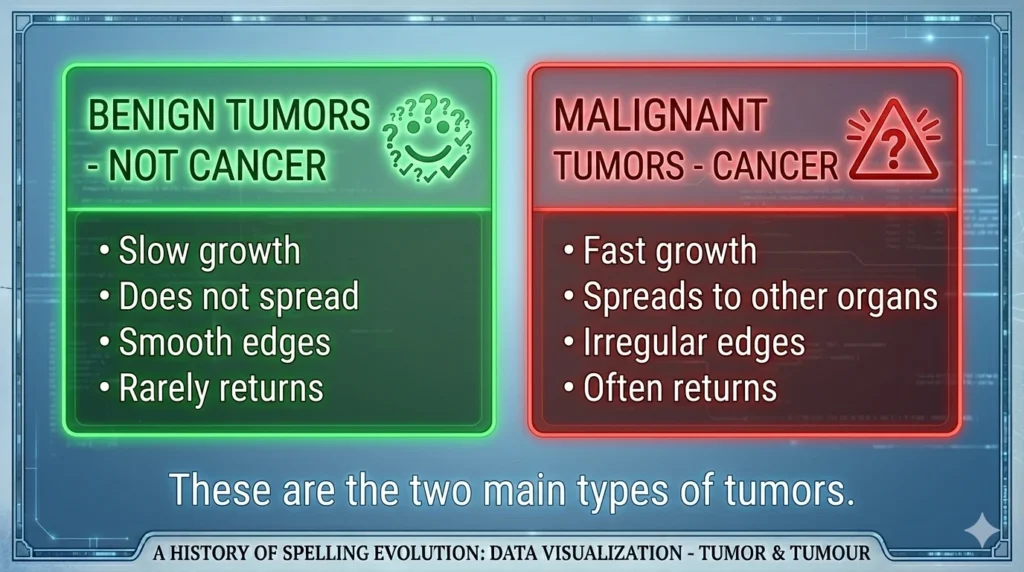
- Grows slowly (months to years)
- Stays in one place (encapsulated)
- Smooth, round edges on scan
- Does not invade nearby tissues
- Does not spread through blood
- Rarely grows back after removal
- Almost never causes death
Malignant Tumor (Type 2):
- Grows quickly (weeks to months)
- Invades nearby organs
- Irregular, spiky edges on scan
- Destroys normal tissue
- Spreads through blood and lymph
- Often grows back after removal
- Can cause death if untreated
What About Premalignant?
Some people ask: “What about premalignant tumors?” That is a third category. Premalignant tumors are not yet malignant, but they have the potential to become malignant over time.
What are two types of tumors? The basic answer is benign and malignant. Premalignant is a subcategory of benign that is watched carefully.
Simple Memory Trick
- Benign = B for Better (not dangerous)
- Malignant = M for Mean (dangerous cancer)
Benign vs Malignant – Complete Comparison Table
Here is the most complete comparison of what are two types of tumors.
| Feature | Benign Tumor | Malignant Tumor (Cancer) |
|---|---|---|
| Growth rate | Slow (months to years) | Fast (weeks to months) |
| Spreads to other organs? | No | Yes (metastasis) |
| Invades nearby tissue? | No | Yes |
| Edges on scan | Smooth, well-defined | Irregular, spiky |
| Microscopic appearance | Normal-looking cells | Abnormal, chaotic cells |
| Returns after removal? | Rarely | Often |
| Causes death? | Almost never | Yes, if untreated |
| Treatment | Observation or simple surgery | Surgery + chemo + radiation |
| Examples | Lipoma, fibroid, meningioma | Carcinoma, sarcoma, melanoma |
| Can become cancerous? | Rarely (except premalignant types) | Already is cancer |
| Effect on body | Pushes organs aside | Destroys and invades organs |
| Blood supply | Normal | Increased (angiogenesis) |
Real Patient Stories and Examples
Story 1: Benign Tumor – Not Dangerous
Sarah, 34, Denver, Colorado
Sarah found a lump in her breast while showering. She panicked. She thought of her aunt who died of breast cancer. She went to the doctor the next day.
An ultrasound showed a 1.5 cm mass with smooth edges. The biopsy said: “Fibroadenoma – benign breast tumor.”
The doctor explained: “This is not cancer. It will not become cancer. You can leave it alone or have it removed.”
Sarah chose to remove it for peace of mind. The 20-minute surgery was easy. She went home the same day.
Outcome: Cured. No further treatment needed.
Lesson: Most breast lumps are benign. Do not panic. Get checked.
Story 2: Premalignant Tumor – Prevented Cancer
Michael, 58, Manchester, UK
Michael had no symptoms. He went for a routine colonoscopy at age 55. The doctor found 3 polyps in his colon.
The pathology report said: “Tubular adenoma with low-grade dysplasia – premalignant.”
The doctor said: “These polyps are not cancer. But if we left them for 5-10 years, they could become colon cancer. We removed them all. You are safe.”
Michael returns every 3 years for a follow-up colonoscopy. He has had no new polyps.
Outcome: Cancer prevented. Cured.
Lesson: Screening saves lives. Michael never had symptoms. His polyps were found by accident.
Story 3: Early Cancer – Cured
David, 45, Sydney, Australia
David noticed a mole on his back changing. It grew from 4mm to 8mm in 6 months. It became dark brown with irregular edges.
He saw a dermatologist. The biopsy said: “Malignant melanoma – Stage 1.”
The doctor removed the mole with a 1cm margin of healthy skin. No further treatment needed.
David now checks his skin every 3 months and sees the dermatologist yearly. He has been cancer-free for 7 years.
Outcome: Cured. 99% cure rate for Stage 1 melanoma.
Lesson: Watch your moles. Use the ABCDE rule. Early melanoma is curable.
Story 4: Late Stage Cancer – Living with Treatment
Elena, 67, Toronto, Canada
Elena had a cough for 3 months. She thought it was allergies. Then she coughed up blood.
A CT scan showed a 5 cm tumor in her right lung. Biopsy confirmed: “Non-small cell lung cancer – Stage 4 (spread to bones).”
She cannot be cured. But treatment has kept her alive. She receives immunotherapy every 3 weeks. Her tumors have shrunk by 60%. She plays with her grandchildren. She travels. She lives a full life.
Outcome: Not cured, but living well 5+ years after diagnosis.
Lesson: Even late-stage cancer can be managed. Never give up hope.
When to See a Doctor Immediately
Do not wait. Do not panic. But do not ignore. Here is exactly when to see a doctor.
Red Flags – See a Doctor Within 1 Week
🚨 Any new lump that:
- Is hard (not soft and squishy)
- Is fixed (does not move when you push it)
- Is painless (painless lumps are more concerning than painful ones)
- Has grown in size over 2-4 weeks
🚨 Any changing mole that follows the ABCDE rule:
- Asymmetry (one half unlike the other)
- Border (irregular, jagged)
- Color (multiple colors)
- Diameter (larger than 6mm)
- Evolving (changing over time)
🚨 Blood where it should not be:
- Coughing up blood
- Blood in your stool (red or black/tarry)
- Blood in your urine (pink, red, or cola-colored)
- Bloody discharge from the nipple
🚨 Unexplained symptoms lasting 2+ weeks:
- Unexplained weight loss (10+ pounds without trying)
- Unexplained fever or night sweats
- Unexplained fatigue that does not improve with rest
- Unexplained pain anywhere in your body
🚨 New neurological symptoms:
- First-time seizure as an adult
- New weakness on one side of your body
- New vision changes or double vision
- New confusion or personality changes
What to Expect at the Doctor
The doctor will:
- Ask about your symptoms and medical history
- Examine the lump or concerning area
- Order tests (ultrasound, CT scan, MRI, or X-ray)
- Possibly do a biopsy (take a small sample of the lump)
- Give you results within 3-10 days
Do Not Let Fear Stop You
Many people avoid the doctor because they are afraid of bad news. This is the worst thing you can do.
If it is benign: Great! You have peace of mind.
If it is premalignant: Great! You caught it before it became cancer.
If it is early cancer: Great! You caught it when it is curable.
If it is late cancer: You still gave yourself the best chance.
There is no bad time to see a doctor. The only bad time is too late.
Frequently Asked Questions
Q1: Which is correct, tumor or tumour?
Answer: Both are correct. “Tumor” is American English. “Tumour” is British English. They mean exactly the same medical condition.
Q2: Is it tumor or tumour in British English?
Answer: In British English, “tumour” with a “u” is always correct. Using “tumor” in the UK would be a spelling error.
Q3: Is a tumour a cancer?
Answer: Not always. A tumour is any abnormal lump. Only malignant tumours are cancer. Most tumours (80-85%) are benign (not cancer).
Q4: What are two types of tumors?
Answer: The two main types are benign tumors (not cancer) and malignant tumors (cancer). A third category, premalignant tumors, can become cancer if untreated.
Q5: Is tumor dangerous?
Answer: Only 5-10% of tumors are dangerous (malignant/cancer). The other 90-95% are benign (safe) or premalignant (treatable).
Q6: Which is more dangerous tumor or cancer?
Answer: Cancer is more dangerous than a benign tumor. But a malignant tumor IS cancer. So the question compares benign (safe) vs malignant (dangerous).
Q7: Is tumor curable?
Answer: Yes. Benign tumors are almost always curable. Premalignant tumors are curable by removal. Early-stage cancer (Stage 1) has 80-99% cure rates.
Q8: What are the most common tumor symptoms?
Answer: A new lump, unexplained weight loss, night sweats, fatigue, fever, blood in stool/urine/cough, changing mole, persistent pain.
Q9: What causes tumors?
Answer: Smoking (#1 cause), sun exposure, poor diet, obesity, alcohol, viruses (HPV, hepatitis), genetics, age, radiation, chemicals.
Q10: Can a benign tumor become malignant?
Answer: Rarely. Most benign tumors stay benign. Some premalignant types (colon polyps, atypical moles) can become cancer over 5-10 years.
Q11: Do all tumors need surgery?
Answer: No. Small benign tumors can be left alone and monitored. Only tumors that are large, painful, growing, or malignant need surgery.
Q12: How fast do tumors grow?
Answer: Benign tumors grow slowly (months to years). Malignant tumors grow quickly (weeks to months). Doubling time varies by tumor type.
Q13: Can stress cause tumors?
Answer: No direct evidence. Stress weakens the immune system but does not directly cause tumors. However, stress leads to unhealthy behaviors (smoking, drinking, poor diet) that do cause tumors.
Q14: Can diet cure tumors?
Answer: No. No diet cures cancer. But a healthy diet (vegetables, fruits, whole grains, limited processed meat) reduces tumor risk by 30-40%.
Q15: Should I get a second opinion?
Answer: Yes, always. For any cancer diagnosis, a second opinion is standard practice. Different pathologists may interpret biopsy results differently.
Q16: How are tumors diagnosed?
Answer: Physical exam, imaging (ultrasound, CT, MRI, X-ray), biopsy (taking a tissue sample), blood tests (tumor markers), endoscopy, colonoscopy.
Q17: What is the difference between a cyst and a tumor?
Answer: A cyst is a sac filled with fluid or air (usually benign). A tumor is a solid mass of abnormal cells. Ultrasound can tell the difference.
Q18: Can children get tumors?
Answer: Yes. Childhood cancers include leukemia, brain tumors, and neuroblastoma. But childhood tumors are rare (1 in 300 children).
Q19: Do tumors hurt?
Answer: Some do. Benign tumors rarely hurt. Malignant tumors can cause pain if they press on nerves or organs. Painless lumps are actually more concerning.
Q20: How often should I get screened?
Answer: Breast: Mammogram every 1-2 years after 40. Colon: Colonoscopy every 10 years after 45. Skin: Annual dermatologist check. Lung: Annual CT if you are a heavy smoker.
Conclusion
You have made it through the complete guide on tumour or tumor. Let me summarize everything you need to remember.
The Spelling Summary
Tumour or tumor – both spellings are correct. Use tumor for American readers. Use tumour for British, Canadian, Australian, and Indian readers. Pick one spelling and stick with it throughout your document. Never mix them.
Your Action Plan
- Do not fear the word “tumor.” Most are harmless.
- Know the symptoms. Check your body monthly.
- See a doctor for any new or changing lump. Do not wait.
- Get recommended screenings. Mammograms, colonoscopy, skin checks save lives.
- Live a healthy lifestyle. Do not smoke. Wear sunscreen. Eat vegetables. Exercise.
- Spell it correctly. Tumor for US. Tumour for UK/Commonwealth.

“E. M. Delafield creates warm, thoughtful, and inspiring wishes that help readers express their feelings clearly and choose the perfect words for every occasion.”