Have you ever felt a strange, powerful pull to pack your bags and disappear into the unknown? That restless feeling in your chest when you see photos of faraway beaches, ancient cities, or misty mountains? That deep ache to explore places you’ve never been? There’s a word for that feeling. It’s called wanderlust.
Every single day, thousands of people type this word into Google. Some are writing travel blogs and want to spell it right. Others are planning dream trips. Many are getting tattoos and need to be absolutely certain before ink meets skin. And honestly? A lot of people are just confused. They see “wanderlust” written one way and “wonderlust” another, and they don’t know which is correct.
Here’s the truth: “Wanderlust” is the only correct spelling. This guide gives you everything – origin, pronunciation, common mistakes, and creative uses. No more confusion. Let’s dive in!
Wanderlust 🎯
Wanderlust is the correct spelling. It means a strong, deep desire to travel and explore the world. 🌍
Pronunciation:
American English: WAN-der-lust (sounds like “wan” + “der” + “lust”)
German: VAN-der-loost (with a “V” sound)
Simple Examples:
“After watching that travel documentary, she was filled with wanderlust.”
“His wanderlust wouldn’t let him stay in one place for long.”
“The travel blog inspired a wave of wanderlust in its readers.”
Remember This Trick:
“Wander” = walking → “Wanderlust” = desire to walk/travel 🚶 “Wonder” = amazement → “Wonderlust” = NOT standard ❌
Every day, thousands of people type “wanderlust” into Google. Here’s why:
📝 They’re writing something – A blog, social media post, or essay about travel
❓ They’re unsure about spelling – Is it “wander” or “wonder”?
🌏 They feel the urge to travel – They want a word to describe their restless feeling
📚 They’re learning English – Non-native speakers want to use the word correctly
🎨 They’re getting a tattoo – They want to make sure the spelling is right before ink meets skin
The confusion it solves: Many people mix up “wander” (to roam) with “wonder” (to be amazed). This guide clears up that confusion once and for all. ✅
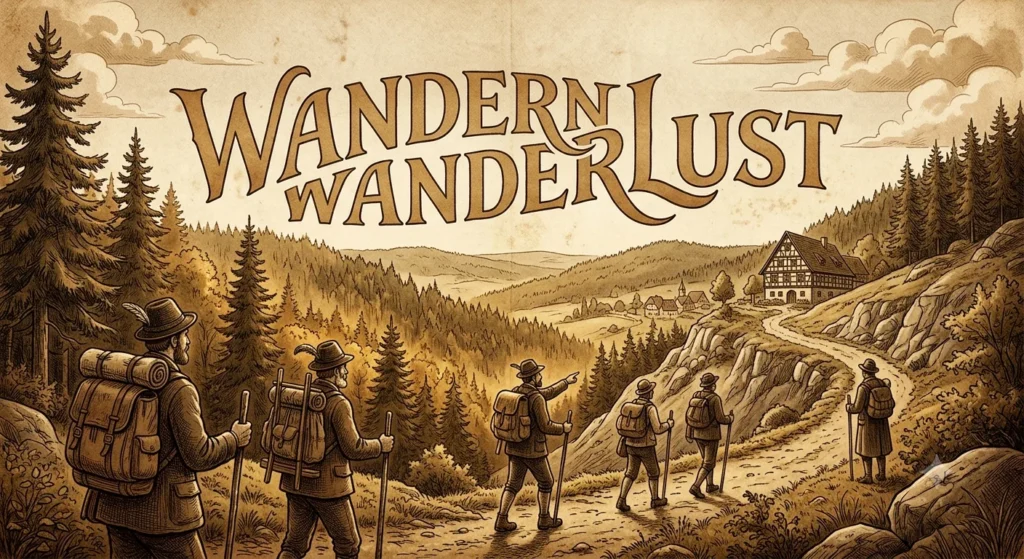
The Origin of Wanderlust – A German Gift to the World 🇩🇪
The word “wanderlust” comes directly from the German language. It’s a combination of two simple words:
German Word
Meaning
Wandern
To hike, to roam, to wander
Lust
Desire, pleasure, enjoyment
Literal Translation: “Desire for hiking” or “Enjoyment of wandering”
A Brief History 📜
1850s: The word first appears in English literature. British
travelers and writers borrowed it from German romantic culture.
19th Century Germany: During this time, hiking became a popular activity. Germans believed that wandering through nature was good for the soul.
Romantic Movement: Writers and poets used “wanderlust” to describe the romantic idea of traveling to find yourself.
Wanderlust vs Fernweh – The German Connection
Modern Germans don’t actually use “wanderlust” very often. Instead, they say:
German Word
Meaning
Fernweh
“Longing for far-away places” (opposite of homesickness)
Heimweh
Homesickness
Fernweh is the more common word in Germany today. It describes the ache you feel when you want to be somewhere else. Wanderlust is seen as more old-fashioned and romantic.
Why Did English Adopt It? 🏴
English borrowed “wanderlust” because it had no single word that captured the same feeling. “Travel bug” and “itchy feet” were close, but not as poetic. Wanderlust filled that gap perfectly.
British English vs American English Spelling – Surprise! 🇬🇧🇺🇸
Here’s the truth: There is NO difference between British and American spelling of “wanderlust.” ✅
Both dialects spell it the exact same way. The word is a global traveler itself!
Complete Spelling Comparison Table
Variation
Spelling
Correct?
Usage Context
Wanderlust
W-A-N-D-E-R-L-U-S-T
✅ Yes
Standard in all English dialects
Wonderlust
W-O-N-D-E-R-L-U-S-T
❌ No
Common misspelling (error)
Wander-Lust
W-A-N-D-E-R – L-U-S-T
✅ Yes
Hyphenated (less common but acceptable)
Wanderluste
W-A-N-D-E-R-L-U-S-T-E
✅ Yes
German plural form
Wanderlusting
W-A-N-D-E-R-L-U-S-T-I-N-G
✅ Yes
Verb form (modern usage)
Wanderlusty
W-A-N-D-E-R-L-U-S-T-Y
✅ Yes
Adjective form (informal)
Wanderluster
W-A-N-D-E-R-L-U-S-T-E-R
✅ Yes
Person who has wanderlust (rare)
Pronunciation Comparison
English Type
Pronunciation
Example
American
WAN-der-lust
“I have WAN-der-lust”
British
WON-der-lust
Slightly different vowel sound
German
VAN-der-loost
“V” sound, “oo” sound for “u”
Which Spelling Should You Use? – Professional Advice 📝
For US and Canadian Audiences 🇺🇸🇨🇦
Always use: Wanderlust
This is the standard in American English dictionaries
It’s recognized and understood by everyone
For UK, Australia, and Commonwealth 🇬🇧🇦🇺🇳🇿
Always use: Wanderlust
Same spelling, no variation
British English accepts it fully
For Global/International English 🌏
Always use: Wanderlust
It’s the same worldwide
No need to adapt for different markets
For Creative or Informal Writing ✍️
You can experiment with:
Wanderlusting – “She’s wanderlusting across Europe”
Wanderlusty – “He has a wanderlusty spirit”
But always default to “wanderlust” for formal writing.
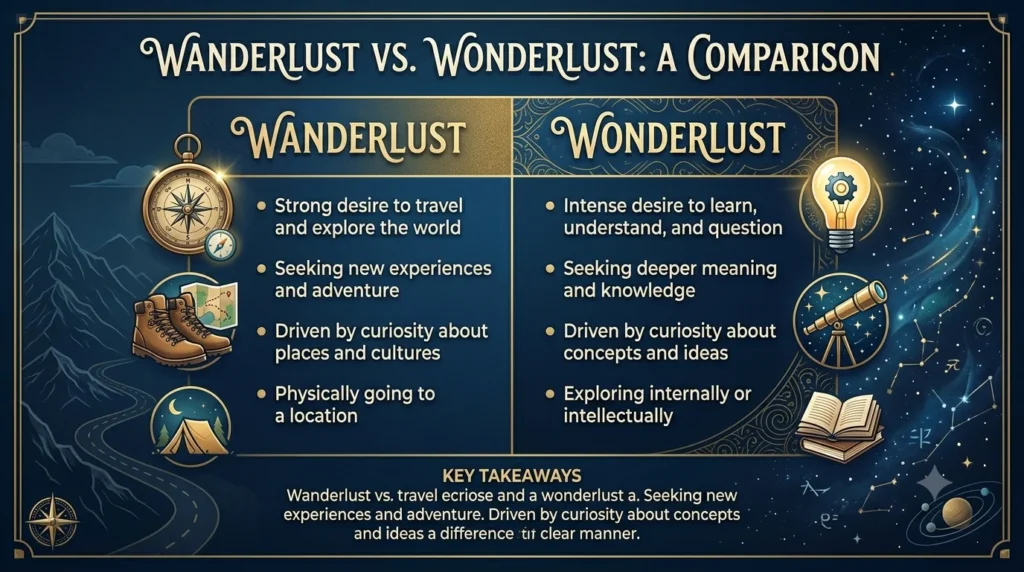
What About “Wonderlust”? 🤔
Never use it in formal writing. It will be marked as a spelling error.
However, some creative writers use “wonderlust” intentionally to mean:
“A desire for wonder, curiosity, and amazement”
Example: “Her wonderlust for the universe led her to study astronomy.”
But this is not a dictionary word. It’s a creative invention. Use it only if you know your audience will understand it as wordplay.
Common Mistakes with Wanderlust – And How to Fix Them ❌✅
Mistake 1: The “Wonder” Confusion
❌ Wrong
✅ Right
“I have serious wonderlust for Paris.”
“I have serious wanderlust for Paris.”
“My wonderlust is taking over.”
“My wanderlust is taking over.”
“She suffers from wonderlust.”
“She suffers from wanderlust.”
Why it happens: “Wonder” is a more common word in daily English. People type what they know.
Fix: Remember “wander” = walk, “wonder” = think. You want to walk, not think.
Mistake 2: Using It for Small Trips
❌ Wrong
✅ Right
“I have wanderlust for the grocery store.”
“I have wanderlust for exploring new countries.”
“My wanderlust is taking me to the mall.”
“My wanderlust is taking me to Thailand.”
Why it happens: People overuse the word.
Fix: Wanderlust is for deep, powerful feelings about travel. Save it for big adventures.
Mistake 3: Mispronunciation
❌ Wrong
✅ Right
“WON-der-lust” (soft “o”)
“WAN-der-lust” (short “a”)
“Wander-LOOST”
“Wander-LUST” (short “u”)
Fix: Listen to native speakers on YouTube or dictionary apps.
Mistake 4: Using It as a Verb Incorrectly
❌ Wrong
✅ Right
“I wanderlust to travel.”
“I have wanderlust.” or “I’m wanderlusting.”
Fix: It’s primarily a noun. Use it as a noun first.
Mistake 5: Plural Confusion
❌ Wrong
✅ Right
“We all have wanderlusts.”
“We all have wanderlust.” (uncountable)
Fix: Wanderlust is usually uncountable. Don’t add an “s.”
Correction Table
Common Error
Correction
Tip
Wonderlust
Wanderlust
Think “wander” = roam
Wunderlust
Wanderlust
Mix of German and English
Wander-lust
Wanderlust
Hyphen is acceptable but not needed
Wanderlusts
Wanderlust
No plural needed
Wanderlusting
Correct as verb
Only in informal writing
Wanderlust in Everyday Examples – See It in Action 📚
In Emails (Professional)
“Dear Team, I’m writing to request two weeks of vacation in July. My wanderlust has been growing, and I’d love to explore the temples of Southeast Asia. I’ll ensure all projects are complete before I leave.”
“Hi Manager, I’ve been feeling a strong sense of wanderlust lately and would like to take advantage of our remote work policy to travel for a month.”
In News Articles
“The travel industry is experiencing a remarkable boom as post-pandemic wanderlust reaches record levels. Airlines report a 45% increase in bookings compared to last year.”
“Millennials are fueling a new wave of wanderlust, with 67% saying travel is their top spending priority.”
On Social Media (Instagram, X, TikTok)
“Feeling a serious case of wanderlust! 🌍✈️ Where should I go next? Drop your recommendations below! 👇” (With photo of traveler at airport)
“My wanderlust soul is calling me to the mountains. Time to pack my bags and disappear for a while. 🏔️”
“Wanderlust: the only cure for a restless heart. Save this if you feel the same! ❤️” (With video montage of travel clips)
In Formal Writing (Essays, Books)
“The protagonist’s wanderlust is a central theme, driving him to abandon his comfortable life in pursuit of adventure and meaning.”
“Throughout history, wanderlust has inspired explorers, artists, and dreamers to push beyond their boundaries and discover the unknown.”
In Songs and Poetry 🎵
“The wanderlust is calling me, I hear it in the wind. The open road, the endless sky, where my life begins.”
Famous song: “Wanderlust” by Björk, “Wanderlust” by Paul McCartney
In Everyday Conversation 🗣️
Person A: “You’re always traveling! Don’t you get tired?” Person B: “Never. It’s my wanderlust. I can’t stay in one place too long.”
Person A: “Why are you quitting your job?” Person B: “My wanderlust is too strong. I need to see the world.”
In Tattoo Culture 🎨
Many people get “wanderlust” tattoos. Common designs include:
The word written in elegant script
A compass with “wanderlust” around it
A world map with the word across it
A plane or bird with the word underneath
Meaning: The tattoo represents a commitment to travel and adventure. It’s a reminder to keep exploring.
“Wanderlust” vs “Wonderlust” – A Deeper Look 🔎
The Creative Use of “Wonderlust”
While “wonderlust” is technically a misspelling, some writers use it on purpose to create a new meaning.
“Wonderlust” = A hunger for wonder, awe, and curiosity
Examples of Creative Use:
“The child’s wonderlust made every discovery magical.”
“Astronauts have a wonderlust for the cosmos.”
“Her wonderlust for art took her to museums around the world.”
When to use it:
In poetry or creative writing
As a brand name or product name
As wordplay in advertising
When NOT to use it:
In academic writing
In professional emails
In news articles
In IELTS, TOEFL, or other English exams
Wanderlust – Google Trends & Usage Data 📊
Global Popularity 🌍
Country
Search Volume
Context
United States
Very High
Travel blogs, social media
United Kingdom
High
Travel writing, essays
India
High
English learners, travel content
Australia
Moderate
Travel industry
Germany
Low
They use “Fernweh” instead
Pakistan
Growing
English learners, travel content
Philippines
High
Social media, travel accounts
Seasonal Trends 📈
Summer (June-August): Peak search – people planning vacations
Winter (December-February): Second peak – holiday travel planning
1. What is the difference between wanderlust and wonderlust?
Wanderlust is the correct dictionary word meaning a desire to travel. Wonderlust is a common misspelling. However, some creative writers use “wonderlust” intentionally to mean “a desire for wonder and awe.” Always use “wanderlust” in formal writing. ✍️
2. What does wanderlust mean in love? ❤️
In romantic contexts, wanderlust can mean:
A desire to travel the world with your partner
A restless person who can’t settle down in relationships
A shared love for adventure in a couple
Example: “Their shared wanderlust brought them together and took them to 30 countries.”
Dating apps: Many profiles say “Looking for a partner with wanderlust.”
3. Is wanderlust a good word? 👍
Yes! It’s a very positive word. It suggests:
💪 Courage to explore
🌟 Curiosity about the world
🏃 Freedom and adventure
😊 Joy and excitement
Tone: Romantic, inspiring, adventurous. Never negative.
4. What is a wanderlust person? 🧑✈️
A wanderlust person is someone who:
Constantly wants to travel
Feels restless staying in one place
Plans their next trip as soon as one ends
Reads travel blogs and watches travel content
Has a passport full of stamps
Other names: Globetrotter, nomad, traveler, adventurer.
5. Can wanderlust be cured? 💊
Wanderlust isn’t a disease – it’s a personality trait! But if you can’t travel, you can:
Watch travel documentaries on Netflix
Read travel books and blogs
Cook food from different countries
Learn a new language
Plan future trips (even if you can’t go yet)
Connect with travelers online
Tip: Wanderlust doesn’t need a cure – it needs an outlet! 🌍
6. Why do I have wanderlust? 🧠
Reasons include:
Personality: You’re naturally curious and adventurous
Upbringing: You traveled as a child
Restlessness: You get bored easily
Escape: You want to leave problems behind
Growth: You love learning about new cultures
Social media: You’re inspired by travel content
It’s completely normal! Millions of people feel the same.
7. What are wanderlust synonyms? (Complete List) 📖
Synonym
Meaning
Context
Itchy feet
Restlessness, urge to travel
Informal
Travel bug
Love for traveling
Casual
Globetrotting
Traveling widely
Professional
Nomadism
Wandering lifestyle
Academic
Vagabonding
Unsettled travel
Literary
Roaming
Wandering freely
General
Odyssey
Long journey
Dramatic
Peregrination
Traveling from place to place
Formal
Rambling
Walking for pleasure
Old-fashioned
Wayfaring
Traveling on foot
Poetic
8. How do you pronounce wanderlust? 🔊
Dialect
Pronunciation
American
WAN-der-lust (rhymes with “run” + “dust”)
British
WON-der-lust (slightly different vowel)
German
VAN-der-loost (V sound, long “oo”)
Listen online: Use Google’s pronunciation tool or YouTube.
9. What does wanderlust tattoo mean? 🎨
A wanderlust tattoo means:
You love to travel
Adventure is important to you
You commit to exploring the world
You’re free-spirited and restless
You never want to be tied down
Popular designs:
Compass + “wanderlust”
World map + quote
Airplane + word
Mountains + word
10. What is a wanderlust soul? 👼
A wanderlust soul is someone who:
Feels deeply connected to the world
Isn’t satisfied with a routine life
Finds peace in movement and change
Believes life is meant to be explored
Has a restless heart that seeks new experiences
Quote: “A wanderlust soul has a passport full of stamps and a heart full of memories.”
11. Is it “waiving a fee” or “waving a fee”? 🤔
This is a common mix-up!
Phrase
Meaning
Correct?
Waiving a fee
Removing or canceling a fee
✅ Correct
Waving a fee
Moving your hand at a fee
❌ Wrong
Example: “The bank is waiving the annual fee for new customers.”
Tip: Think “WAIVE” = “WAIT” – you’re waiting for the fee to go away. “WAVE” = hand movement.
12. Can you use wanderlust in a sentence? (More Examples) 📝
Formal:
“The CEO’s wanderlust inspired the company’s global expansion strategy.”
“Her academic research explores the psychological benefits of wanderlust.”
Informal:
“I’ve got a serious case of wanderlust – I need to book a flight!”
Creative:
“Wanderlust runs through my veins like a restless river.”
“The mountains whispered to my wanderlust soul.”
13. What is the origin of wanderlust in English? 📚
1850s: First appears in English writing
Borrowed from German: Romantic travelers brought it back
Popularized by: British explorers and writers
Modern use: Travel blogs, Instagram, advertising
14. Is wanderlust a noun or verb? 📖
Primarily: A noun
“I have wanderlust.”
Can be a verb: Informal
“I’m wanderlusting across Europe.”
“She wanderlusts every summer.”
Tip: Use it as a noun in formal writing.
15. What’s the opposite of wanderlust? 🔄
Word
Meaning
Heimweh
Homesickness (German)
Homesickness
Missing home
Settledness
Contentment with staying put
Rootedness
Strong connection to one place
Stability
No desire to move
The Psychology of Wanderlust – Why We Crave Travel 🧠
Emotional Benefits 💖
Happiness: Travelers report higher satisfaction
Growth: You learn about yourself and others
Connection: Bonding with new people
Perspective: Seeing the bigger picture
Escapism: Temporary relief from daily stress
Psychological Triggers 🔔
Boredom: You need stimulation
Curiosity: You want to know more
Restlessness: You feel trapped
Self-discovery: You’re seeking identity
Is It Normal? ✅
Yes! About 60-70% of people report feeling wanderlust at some point. It’s a natural human desire for exploration and growth.
Fun Fact: Some scientists believe wanderlust is in our DNA – our ancestors migrated to survive!
Wanderlust in Popular Culture 🎬
Movies
Movie
Wanderlust Theme
Eat, Pray, Love
Woman travels to find herself
Into the Wild
Man abandons everything for adventure
The Secret Life of Walter Mitty
Dreamer explores the world
Wild
Woman hikes the Pacific Crest Trail
The Motorcycle Diaries
Young Che Guevara discovers South America
Books
Book
Theme
On the Road by Kerouac
Classic American wanderlust
The Alchemist by Coelho
Journey to find your purpose
A Walk in the Woods by Bryson
Appalachian Trail adventure
Vagabonding by Potts
Guide to long-term travel
Songs 🎵
Song
Artist
“Wanderlust”
Björk
“Wanderlust”
Paul McCartney
“Wanderlust”
The Weeknd
“King of the World”
Songs about wanderlust feeling
Wanderlust Travel Tips – How to Feed Your Urge 🌏
If You Have Money 💰
🌍 Book a round-the-world ticket
🏝️ Visit a new country every year
🧳 Take month-long trips abroad
✈️ Use travel credit cards for points
🏨 Stay in luxury resorts
If You Have Time ⏰
🚗 Take a road trip across your country
🚲 Cycle through a new region
🏕️ Camp for a weekend in nature
🚆 Take a train journey
🛣️ Explore places near you
If You Have Neither (Money or Time) ⏳
🎬 Watch travel documentaries (YouTube, Netflix)
📖 Read travel memoirs and blogs
🍜 Cook food from different countries
🌐 Learn a new language (Duolingo)
🗺️ Plan dream trips (even if you can’t go)
📱 Follow travel accounts on social media
🧘 Practice mindfulness and appreciate home
Pro Tip 💡
The “One Trip a Year” Rule: Even if you’re busy and broke, save up for ONE meaningful trip each year. It keeps your wanderlust alive and gives you something to look forward to.
Wanderlust vs Other Travel Words – Comparison Table
Word
Meaning
Emotion
Wanderlust
Deep desire to travel
Romantic, adventurous
Fernweh
Longing for faraway places (German)
Aching, melancholic
Itchy feet
Restlessness, urge to move
Casual, informal
Travel bug
Love for travel
Fun, lighthearted
Homesickness
Missing home
Sad, longing
Exploration
Discovering new places
Scientific, curious
Adventure
Exciting, risky travel
Thrilling, daring
Globetrotting
Frequent travel
Professional, worldly
Final Verdict – Summary of Key Takeaways 📌
The Essentials
Spelling: Always use WANDERLUST
Meaning: A strong desire to travel
Origin: German – “wandern” (to hike) + “lust” (desire)
Mistake to avoid: Never use “wonderlust” in formal writing
Usage Tips
✅ Use it to describe deep travel desires
✅ Use it in travel blogs, social media, essays
❌ Don’t use it for small trips (like going to the mall)
❌ Don’t use “wonderlust” unless you’re being creative
For Writers and Professionals
Formal writing: Always use “wanderlust”
Creative writing: You can play with “wonderlust” as wordplay
Social media: Use “wanderlust” with emojis and photos
SEO: Target long-tail keywords like “wanderlust meaning”
My Final Word 💬
Wanderlust isn’t just a word – it’s a feeling. It’s the restless heart, the curious mind, the adventurous soul that wants to see the world.
Whether you’re writing a blog, planning a trip, or getting a tattoo, now you know the correct spelling and usage. No more wondering about “wander” vs “wonder.”
Remember this forever:
“Wander” is movement. “Wonder” is amazement. Wanderlust is the desire to move and be amazed.
So go ahead – embrace your wanderlust. The world is waiting for you. 🌍✈️
“George Gissing writes heartfelt, clear, and relatable wishes that help readers express emotions beautifully and find the perfect words for every special moment.”