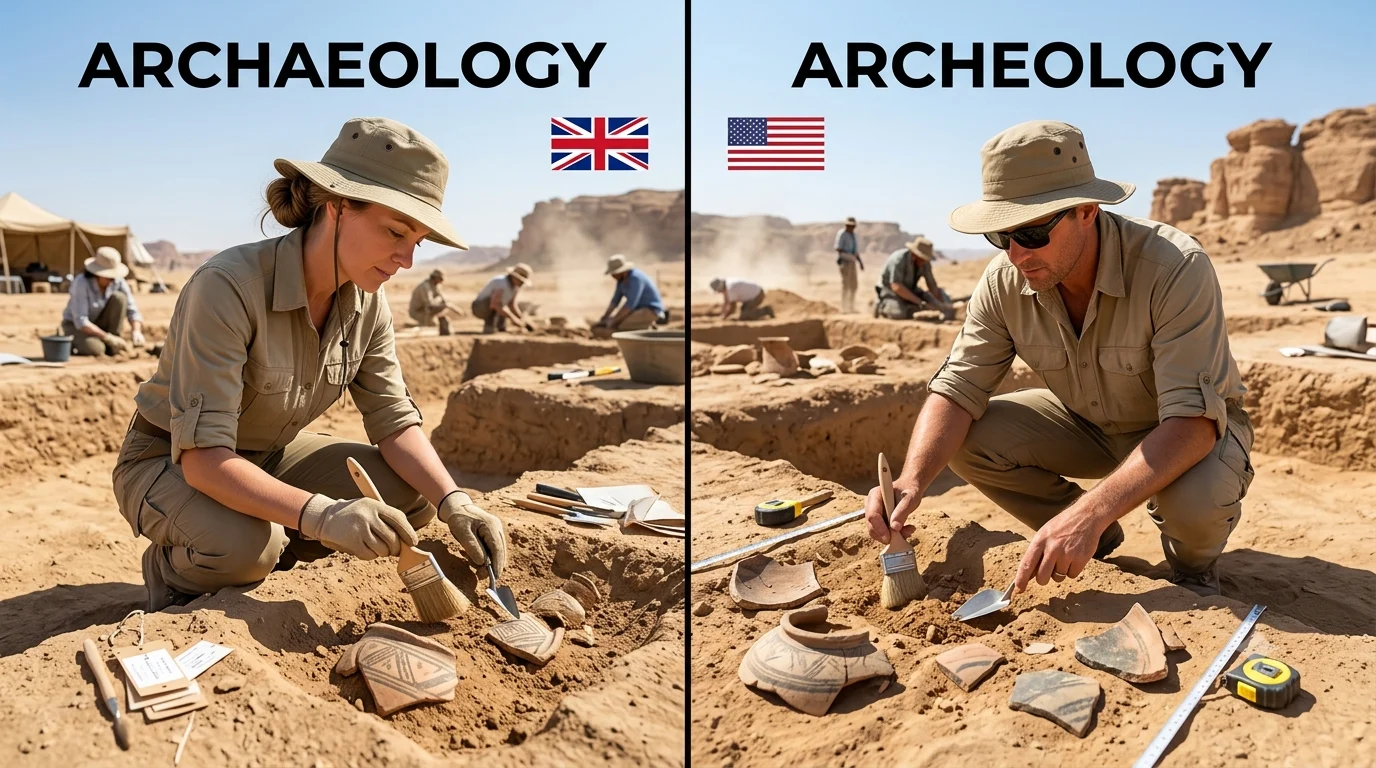
Do you spell it archaeology with an extra “a” or archeology without it? This simple spelling question confuses millions of people worldwide. The short answer? Both spellings are correct. The difference depends entirely on where you live and who you are writing for.
People search for this topic because they see both versions everywhere – in books, news articles, social media, and academic papers. They worry about making spelling mistakes in important documents. Students panic before submitting assignments. Professionals want to sound credible in their reports. This article solves all that confusion once and for all.
You will learn the exact difference, when to use each spelling, and why both exist. No more guessing. No more second-guessing yourself.
Archaeology
Archaeology is the scientific study of past human cultures and societies through physical remains. Researchers examine old buildings, tools, pottery, bones, jewelry, and other objects left behind by ancient peoples. Both “archaeology” and “archeology” mean exactly the same thing and are pronounced identically: “ar-kee-OL-uh-jee.”
Simple Example: The archaeology team discovered a 2,000-year-old Roman coin during their summer excavation.
Key Point: The spelling with “ae” is traditional and more common in British English and academic writing worldwide. The shorter spelling without “a” is an American variant that simplifies the original Greek word.
The Origin of Archaeology
The word archaeology traces back to ancient Greek. It combines two Greek words: archaios meaning “ancient” and logia meaning “study of.” Together, they form “the study of ancient things.”
The term entered the English language during the early 1600s. Initially, it referred to “ancient history” in a very general sense. By the mid-1800s, the meaning narrowed to its modern definition – studying past cultures through physical objects and remains.

The Greek spelling used the letters “ai” which became “ae” when Latin adopted the word. This is precisely why the traditional English spelling includes the “ae” combination. Later, during the 19th century, some English speakers in America dropped the “a” to make the spelling simpler and match how the word sounds when spoken aloud.
Interesting Fact: The first recorded use of “archaeology” in English appeared in 1607. The shorter “archeology” first appeared in American publications around 1820.
British English vs American English Spelling
The primary difference between archaeology and archeology comes from spelling traditions in different English-speaking regions.
British English preserves the traditional spelling with “ae.” This follows the same pattern as other Greek and Latin loanwords such as “aesthetic,” “paediatric,” and “manoeuvre.” The Oxford English Dictionary lists “archaeology” as the primary spelling and notes “archeology” as a North American variant.
American English frequently simplifies words containing “ae” to just “e.” This reflects the broader spelling reform movement championed by Noah Webster in the early 1800s. Webster believed American English should have simpler, more phonetic spellings. This is why Americans write “color” instead of “colour” and “center” instead of “centre.”
Complete Spelling Comparison Table
| Spelling | Main Region | Where You’ll See It | Global Preference |
|---|---|---|---|
| Archaeology | UK, Australia, Canada, Europe | Academic journals, BBC, Oxford publications, UNESCO | Most common worldwide |
| Archeology | United States | US newspapers, American websites, informal writing | Common in North America |
| Archaeological | UK and most countries | Describing discoveries, sites, research papers | Preferred globally |
| Archeological | United States | US media, American government sites | Mostly US usage |
| Archaeologist | UK and most countries | Person who studies archaeology | Used internationally |
| Archeologist | United States | American job postings, US news | Primarily American |
| Archaeologically | UK and most countries | Adverb form in academic writing | Standard worldwide |
| Archeologically | United States | Adverb form in US publications | Rarely used outside US |
Which Spelling Should You Use?
Your choice depends entirely on your audience, context, and purpose. Here is clear guidance for every situation.
Use “archaeology” when:
- Writing for a British, Australian, Canadian, or European audience
- Submitting to academic journals (most require this spelling)
- Creating content for international readers (this spelling is recognized everywhere)
- Following formal style guides like Oxford, Cambridge, or Chicago Manual of Style
- Writing for government or heritage organizations
- Publishing in scientific or historical publications
Use “archeology” when:
- Writing specifically for an American audience
- Following US style guides like APA (though many now accept both)
- Writing for US newspapers or general American publications
- Your organization’s style guide prefers the shorter version
- Writing informal content for American readers
For global audiences, “archaeology” is the safer and more professional choice. It is more widely used, more recognized, and carries greater academic credibility. Most international organizations, United Nations agencies, and educational websites use this spelling to reach the broadest possible audience.
Pro Tip: Once you choose a spelling, stick with it throughout your entire document. Mixing both versions in the same piece looks unprofessional and confuses readers.
Common Mistakes with Archaeology
Even native English speakers make mistakes with these spellings. Here are the most frequent errors and how to avoid them.
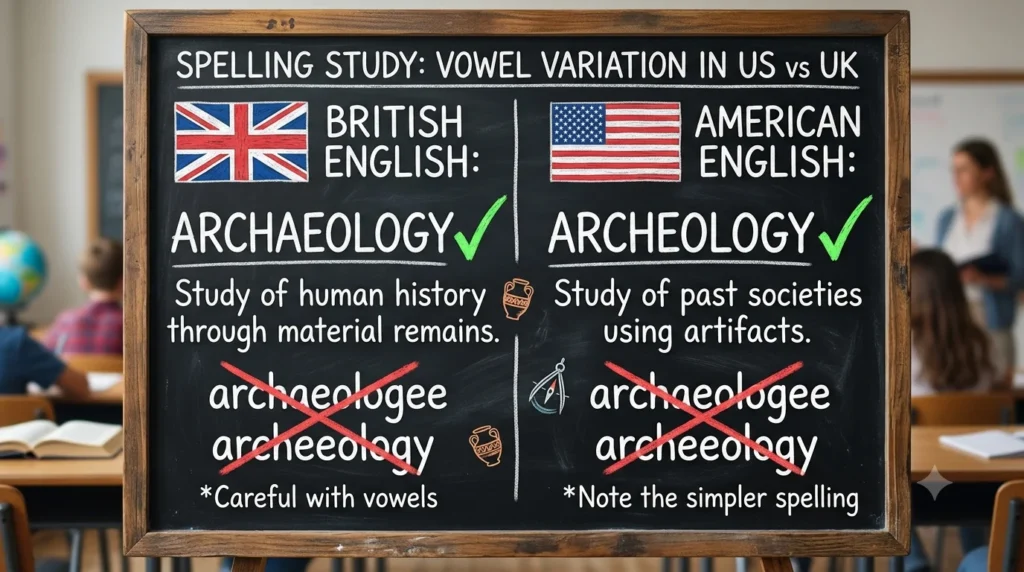
Mistake 1: Believing one spelling is wrong
Many people incorrectly think only one version is correct. Both “archaeology” and “archeology” are valid. The longer version is simply more traditional and widely used.
Correction: Accept both as correct and choose based on your audience.
Mistake 2: Mixing spellings in the same document
Using “archaeology” in one paragraph and “archeology” in another looks sloppy and unprofessional.
Correction: Pick one spelling and use it consistently throughout your writing.
Mistake 3: Misspelling related words differently
Some writers use “archaeology” but then write “archeological” in the same text. This inconsistency damages credibility.
Correction: Keep all related terms consistent. Use “archaeological” if you use “archaeology.” Use “archeological” if you use “archeology.”
Mistake 4: Incorrect pronunciation
Both spellings are pronounced exactly the same way: “ar-kee-OL-uh-jee.” The extra “a” is silent and does not change how you say the word.
Correction: Pronounce both versions identically. No one will know which spelling you use from your speech.
Mistake 5: Confusing archaeology with other fields
Archaeology vs anthropology – archaeology studies past peoples through physical remains. Anthropology studies human societies, cultures, and development more broadly. Archaeology is considered a branch of anthropology in the United States, but they are distinct fields with different methods and focuses.
Correction: Understand the difference between these fields to use the correct terminology.
Mistake 6: Using the wrong spelling in formal contexts
Writing “archeology” in a British academic journal will mark you as an American writer. Writing “archaeology” in a US newspaper might look overly formal.
Correction: Know your audience and choose accordingly.
Archaeology in Everyday Examples
Seeing how words are used in real contexts helps you remember the correct usage. Here are examples from various settings.
Formal Academic Writing:
“The archaeology of ancient Egypt reveals sophisticated burial practices, complex social hierarchies, and extensive trade networks spanning three continents.”
News Headline:
“Major archaeology discovery in Greece rewrites history of ancient Olympic Games.”
Social Media Post:
“Day 15 of my archaeology field school in Peru! We just unearthed a complete ceremonial vessel from the Inca period. ️☠️ This is why I love archaeology! #archaeology #ancienthistory #Peru”
Professional Email:
“Dear Professor Williams, I am writing to express my interest in your graduate program in archaeology at Cambridge University. My undergraduate research focused on Roman settlement patterns in Britain.”
Business Context:
“The development company commissioned an archaeology survey before breaking ground on the new shopping center. The survey ensured no historical sites would be damaged during construction.”
Everyday Conversation:
“My neighbor studies archaeology. She spends her summers working on excavation sites in Italy and Greece. Last year she found ancient pottery fragments from the Etruscan civilization.”
Government Report:
“The Department of Archaeology and Heritage oversees all excavation permits and ensures proper preservation of historical sites.”
Children’s Education:
“Archaeology is like being a history detective. Archaeologists dig in the ground to find clues about how people lived thousands of years ago.”
Archaeology – Google Trends & Usage Data
Real-world data shows clear patterns in how people search for and use these spellings.
Global Usage: “Archaeology” is significantly more popular worldwide. Google Trends data reveals that the longer spelling dominates searches in every region except the United States.
United Kingdom: “Archaeology” is used almost exclusively. British newspapers, universities, and government websites never use the shorter spelling. It would be considered incorrect in British English.
United States: Both spellings appear regularly. “Archaeology” is more common in academic contexts and university departments. “Archeology” appears more frequently in general newspapers, magazines, and informal online content.
Australia and Canada: Both countries follow British spelling traditions and predominantly use “archaeology.” The shorter spelling is rarely seen in official or educational contexts.
Academic Publications: Scientific journals strongly prefer “archaeology” regardless of the author’s country of origin. This is the standard in peer-reviewed research worldwide. Over 90% of academic papers use the longer spelling.

Online Content: Most educational websites, government portals, and international organizations use “archaeology.” UNESCO, the BBC, National Geographic, and major museums all use the traditional spelling.
Search Volume: “Archaeology” receives approximately 3-4 times more monthly searches globally than “archeology.” The shorter spelling peaks in searches from the United States.
Social Media: On Twitter, Instagram, and TikTok, “archaeology” appears about 5 times more frequently than “archeology” in hashtags and posts.
People Also Ask About Archaeology
What does archaeology mean in simple words?
Archaeology means studying ancient people by looking at the things they left behind. Archaeologists dig up old tools, buildings, pottery, and bones to understand how people lived thousands of years ago.
Is archaeology a science or an art?
Archaeology is a science. It uses scientific methods like carbon dating, soil analysis, and DNA testing to study ancient remains. However, it also requires creativity and interpretation, which gives it artistic elements too.
Who is called the father of archaeology?
Many historians consider William Flinders Petrie the “father of archaeology.” He developed systematic excavation methods in Egypt during the late 1800s. However, some credit earlier figures like Johann Joachim Winckelmann or Thomas Jefferson.
What are the main types of archaeology?
The main types include prehistoric archaeology (before written records), historical archaeology (with written records), underwater archaeology, biblical archaeology, and industrial archaeology. Each focuses on different time periods and environments.
How long does it take to become an archaeologist?
Becoming a professional archaeologist typically requires 4 years for a bachelor’s degree, plus 2-3 years for a master’s degree. Many archaeologists also complete doctoral programs lasting 4-5 more years. Field experience is essential throughout this training.
What skills do archaeologists need?
Archaeologists need patience, attention to detail, physical stamina for fieldwork, research skills, writing ability, and knowledge of history and science. Foreign language skills and photography experience are also valuable.
Can you be an archaeologist without a degree?
You can work on excavations as a volunteer or field assistant without a degree. However, professional archaeology positions, academic roles, and leadership of excavations typically require formal university education and advanced degrees.
FAQs About Archaeology
Is it spelled archeology or archaeology?
Both spellings are completely correct. Archaeology with the “ae” is the traditional spelling used in British English and most academic writing worldwide. Archeology without the “a” is an American variant. They mean the same thing and are pronounced identically. Choose based on your audience.
How do you spell archeology in the UK?
In the United Kingdom, the spelling is archaeology with the “ae.” This is the only acceptable spelling in British English. UK schools, universities, newspapers, and government publications all use this version. The shorter “archeology” is considered incorrect in British English.
What is called archeology?
Archaeology (or archeology) is the scientific study of past human cultures through examining physical remains. These remains include buildings, tools, weapons, pottery, jewelry, bones, and other objects left behind by ancient peoples. Archaeologists study both prehistoric and historic time periods.
What is the archaeology of Michel Foucault?
Michel Foucault used “archaeology” in a unique philosophical sense. For Foucault, archaeology meant studying the hidden, unconscious rules that shape how people think and speak in different historical periods. He developed this method in books like The Archaeology of Knowledge. It is not about digging up physical objects but uncovering deep structures of thought.
What is archaeology meaning in history?
In historical context, archaeology means using physical evidence to understand past societies. Historical archaeology specifically examines periods with written records too. Archaeology helps historians fill gaps in written accounts and understand everyday life for ordinary people who left few personal records.
How to become an archaeologist?
To become an archaeologist, you typically need a university degree in archaeology or a related field. Most professionals hold at least a Bachelor’s degree. Many complete Master’s or Doctoral degrees. Field experience through excavations and digs is essential. You can find training programs, scholarships, and field schools worldwide.
Archaeologist salary expectations?
Archaeologist salaries vary significantly by country, experience level, and work setting. Entry-level positions often pay modestly. Experienced archaeologists at universities, government agencies, or consulting firms earn higher salaries. Cultural resource management offers the most job opportunities.
What are some archaeology examples?
Archaeology examples include studying Egyptian pyramids, Roman ruins, Viking settlements, ancient Chinese tombs, Greek temples, and Mayan cities. Archaeologists excavate sites to find pottery, tools, weapons, jewelry, and human remains. They analyze these objects to learn about diet, trade, religion, social structure, and daily life.
Is archaeology a good career?
Archaeology is an excellent career for people passionate about history, discovery, and working outdoors. It offers travel opportunities, hands-on work, and the chance to contribute to human knowledge. However, competition for permanent positions can be strong. Many archaeologists work in heritage management, museums, or education.
What is the difference between archaeology and paleontology?
Archaeology studies human history and culture through artifacts. Paleontology studies ancient life through fossils of plants and animals. Archaeologists dig up human-made objects like tools and buildings. Paleontologists dig up dinosaur bones and other fossils. They are related but completely different sciences.
What are the best universities for archaeology?
Top archaeology universities include the University of Cambridge, University of Oxford, University College London, Harvard University, and Stanford University. Many excellent programs exist in Europe, the United States, Australia, and Canada. Research specific programs based on your geographic and historical interests.
Can archaeology prove the Bible?
Archaeology can provide historical context for biblical events and confirm the existence of people and places mentioned in the Bible. However, archaeology alone cannot prove or disprove religious beliefs. It offers evidence about historical settings but does not address theological questions.
Conclusion
The spelling archaeology with the “ae” is the traditional and most widely accepted form worldwide. Archeology without the “a” is a valid American variant that simplifies the original Greek spelling. Both versions refer to the same fascinating field – understanding past human cultures through physical remains.
For most writers and content creators, the choice is straightforward. If you write for international, academic, or British audiences, use “archaeology.” If you write primarily for Americans and prefer simpler spelling, “archeology” works perfectly. What matters most is consistency throughout your writing.
Understanding this spelling difference shows attention to detail and cultural awareness. It helps you communicate clearly and professionally across different English-speaking regions. Whether you choose “archaeology” or “archeology,” what truly matters is the work itself – uncovering the stories of our ancestors, preserving our shared human heritage, and inspiring future generations to explore the mysteries of the past.
Remember, both spellings are correct. Choose wisely based on your audience, stick with your choice, and write with confidence. Your readers will appreciate your clarity and professionalism.

“George Gissing writes heartfelt, clear, and relatable wishes that help readers express emotions beautifully and find the perfect words for every special moment.”