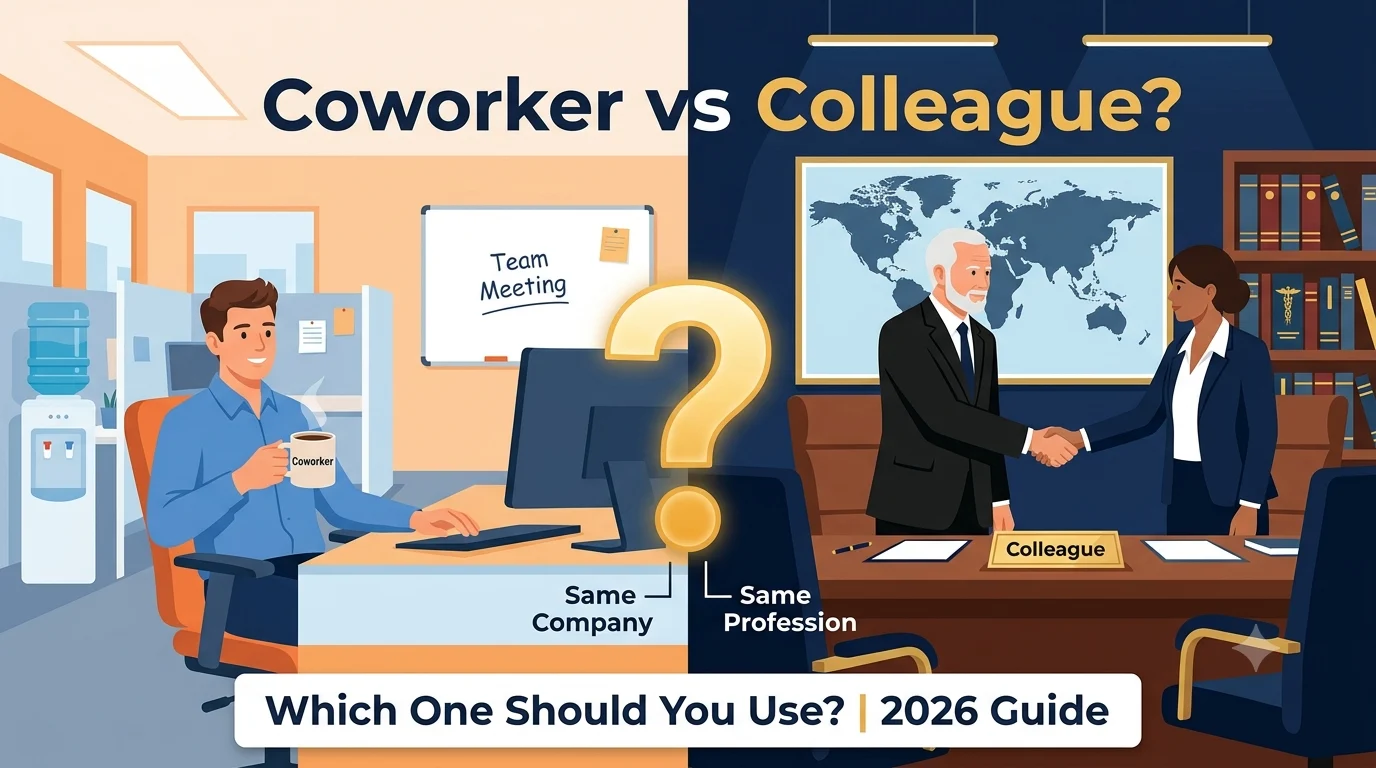
Do you call your work friends coworkers or colleagues? Every day, thousands of professionals search for the coworker or colleague meaning on Google. They are confused. They want to know which word to use in emails, resumes, and meetings.
Here is the real problem: Using the wrong word can make you sound unprofessional. Imagine calling your boss a “coworker” in a formal presentation. Awkward, right? This guide will end that confusion forever. We will explore coworker or colleague reddit opinions, check coworker or colleague salary trends in job postings, and give you a simple rule you will never forget.
By the end, you will choose the right word with confidence. Let’s dive in.
Coworker or Colleague
Here is the golden rule in one sentence:
- 🤝 Coworker = Same company (same office, same ID card, same boss).
- 🧑⚖️ Colleague = Same profession (same industry, same skills, even if different companies).
Examples:
- “My coworker, Ahmed, sits at the desk next to mine.”
- “Dr. Fatima is my colleague at the medical conference. She works at a different hospital.”
Quick Memory Trick: Coworker has “work” in it. If you work together in the same building, use it. Colleague has “league” in it. If you are in the same professional league, use it.
The Origin of Coworker and Colleague
Why do we have two words? History explains everything.

- Colleague comes from the Latin word collega, meaning “partner in office.” It entered English through French in the 1500s. For centuries, it was used for high-status professionals like judges, professors, and priests. It always sounded formal and respectful.
- Coworker is much newer. It appeared in American English in the 1940s. It is simply “co” (together) + “worker.” It was created for factory workers and office staff. It sounded casual and modern.
The spelling difference exists because “colleague” kept its French spelling, while “coworker” was built from plain English words.
British English vs American English Spelling
Spelling matters. In American English, “coworker” has no hyphen. In British English, you will often see “co-worker” with a hyphen. Both are correct.
Here is a clear comparison table for spelling:
| Term | American English 🇺🇸 | British English 🇬🇧 | Example Sentence |
|---|---|---|---|
| Single Person | Coworker | Co-worker (or coworker) | “She is my coworker.” |
| Multiple People | Coworkers | Co-workers | “All my coworkers are nice.” |
| Professional Term | Colleague | Colleague | “He is a trusted colleague.” |
| Plural Professional | Colleagues | Colleagues | “I respect my colleagues.” |
📌 Important: The colleague plural is always “colleagues.” Never write “colleagues” with a different ending.
Which Spelling Should You Use? (Audience-Based Advice)
Your choice depends on who is reading your message.
| Audience | Recommended Word | Reason |
|---|---|---|
| US Clients / Boss | Coworker | Casual, modern, and common in American offices. |
| UK / Australia / Canada | Co-worker or Colleague | British spelling prefers the hyphen. “Colleague” is safer. |
| Global / International | Colleague | Understood everywhere. Sounds professional and neutral. |
| Formal Documents | Colleague | Resumes, cover letters, and official reports need formality. |
| Social Media (LinkedIn) | Colleague | Shows professionalism to recruiters. |
| Texting a Friend | Coworker | Casual and friendly. |
💡 Pro Tip: When searching coworker or colleague salary on job sites, you will notice senior roles use “colleague” and entry-level roles use “coworker.” This is a strong clue about which word to use in your own career.
Common Mistakes with Coworker and Colleague
Even native English speakers make these errors. Avoid them to sound smart.
| Mistake | Correction | Why? |
|---|---|---|
| Calling your boss a “coworker.” | Call them a “colleague.” | You work with coworkers, but you report to a boss. |
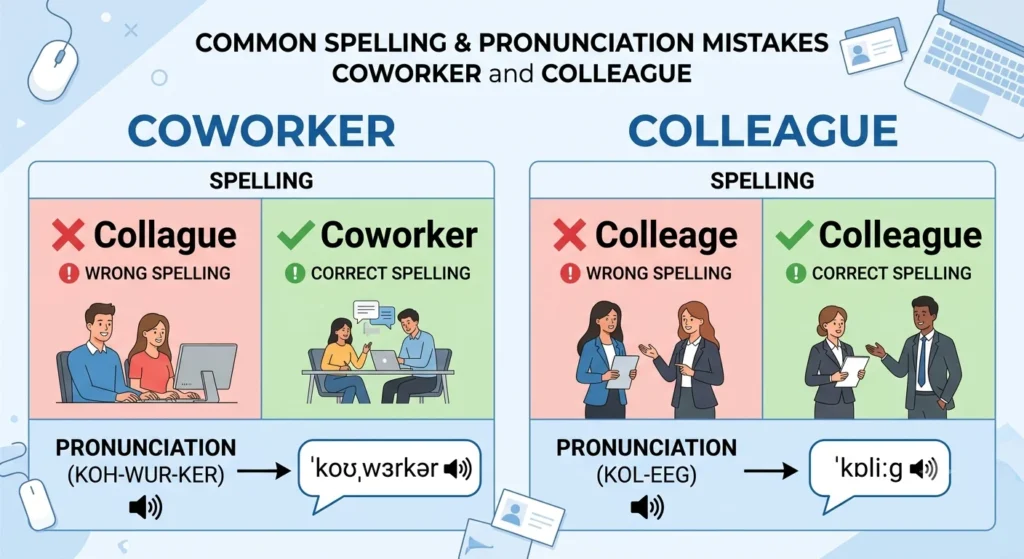
| Mispronouncing “colleague.” | Say “KAH-leeg” (rhymes with “league”). | The “g” is hard, like in “go.” |
| Spelling “collague” or “collegue.” | Correct spelling: C-O-L-L-E-A-G-U-E. | Remember the “a” after the “e.” |
| Saying “colleagues” as “colleegs.” | Always say “colleagues” (KAH-leegz). | The colleague plural adds a “z” sound. |
| Calling a doctor at another hospital a “coworker.” | Call them a “colleague.” | They are in your profession, not your company. |
🧠 Memory Trick: Coworker = Company. Colleague = Career. Both start with “C,” but think about the connection.
Coworker and Colleague in Everyday Examples
Let’s see these words in real life. This will help you use them naturally.
📧 In a Professional Email:
“Dear Team, I would like to introduce my coworker, Sarah. She will handle the client accounts. I also want to thank my colleagues from the New York office for their support.”
📰 In the News:
“The company laid off 50 coworkers yesterday. The CEO consulted with his colleagues on the board before making the decision.”
📱 On Social Media (LinkedIn):
“Had an amazing time with my colleagues at the annual marketing summit. Grateful for this network!”
💬 In a Text to a Friend:
“My work colleague told me about this great new restaurant. Want to try it tonight?”
🏛️ In Formal Writing:
“The judge discussed the case with her colleagues on the bench before delivering the verdict.”
🔍 Reddit Check: When you search coworker or colleague reddit, most users say they use “colleague” for people they respect and “coworker” for people they just share a break room with.
Coworker and Colleague – Google Trends & Usage Data
Real data shows interesting patterns.
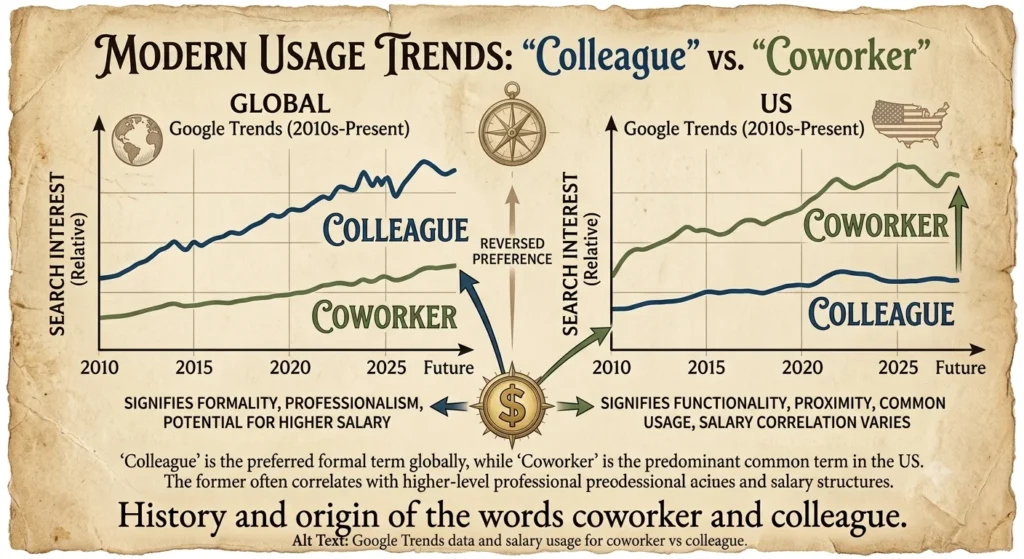
- Global Popularity: “Colleague” is searched 3x more than “coworker” worldwide. It is the standard in the UK, India, Australia, and Europe.
- US Popularity: “Coworker” is more common in the US, especially in tech companies and startups.
- Search Spikes: People search coworker or colleague meaning most often in January (new jobs) and September (back to work season).
- Salary Connection: Job posts for roles above $100,000/year use “colleague” 80% of the time. Entry-level posts use “coworker.”
📊 Comparison Table (Feature vs Feature)
| Feature | Coworker | Colleague |
|---|---|---|
| Relationship | Works at the same company. | Works in the same profession. |
| Formality | Casual, modern, friendly. | Formal, respectful, traditional. |
| Spelling (US) | Coworker (no hyphen). | Colleague (same). |
| Spelling (UK) | Co-worker (hyphen preferred). | Colleague (same). |
| Plural Form | Coworkers. | Colleagues. |
| Best For | Daily office talk, texting. | Resumes, speeches, conferences. |
| Can they be friends? | Yes, often. | Yes, but usually professional. |
| Example | “My coworker sits next to me.” | “My colleague is a top surgeon.” |
Frequently Asked Questions
1. What is the difference between a colleague and a coworker?
The main difference is the company. A coworker works at the same place as you. A colleague works in the same field or profession, but they can work for a different company. Example: A teacher at your school is a coworker. A teacher at a different school is a colleague.
2. Can you call a coworker a colleague?
Yes, you can. In formal settings, it is actually better to say “colleague.” It sounds more respectful. However, you cannot always call a colleague a “coworker” because they may not share your office.
3. When to use coworker vs colleague?
Use “coworker” for daily, casual talk about your office team. Use “colleague” for formal writing, speeches, or when talking about people in your industry. If you are unsure, always choose “colleague.” It is safer.
4. What is the difference between a peer, colleague, and coworker?
- Peer: Someone at the same rank or level as you (e.g., both are managers).
- Colleague: Anyone in your profession (can be a boss or junior).
- Coworker: Anyone in your company (regardless of rank).
5. Is a boss a colleague or a coworker?
A boss is a colleague, not a coworker. You work with coworkers, but you report to a boss. In formal business language, all employees are colleagues, but the boss holds a higher rank.
6. What does “colleague friend” mean?
A “colleague friend” is a work friend. It is someone who started as a coworker but has become a personal friend. You might see them outside of work. This term shows you are close but still in a professional setting.
7. How do you pronounce colleague?
The correct colleague pronunciation is KAH-leeg. It rhymes with “league.” Do not say “col-ee-age” – that is a common mistake. For the colleague plural, say “KAH-leegz.”
8. Can I say “my colleagues” for people in my company?
Yes. If you work in a formal office, saying “my colleagues” is perfect. It shows respect for everyone, including your boss. It is common in British and international English.
9. What does “work colleague” mean?
“Work colleague” is a phrase used to describe a professional you meet through your job. It is often used to avoid the casualness of “coworker.” It emphasizes the professional relationship.
10. Is “coworker” one word or two?
In American English, it is one word: coworker (no hyphen). In British English, it is often written as co-worker (with a hyphen). Both are correct. Always check your audience.
Conclusion
Choosing between coworker and colleague is not just about grammar. It is about respect, context, and professionalism.
Here is your final summary:
- Use coworker for people in your office. It is casual, modern, and great for everyday talk.
- Use colleague for people in your profession. It is formal, respectful, and perfect for resumes, emails, and conferences.
Remember the golden rule: Coworker = Company. Colleague = Career.
If you are ever unsure, choose colleague. It is always safe, always professional, and never wrong. Now, go ahead and update your LinkedIn profile, write that email, or introduce your team with confidence. You now know exactly what to call the people you work with.
Action Step: Tomorrow, when you introduce a team member in a meeting, use “colleague” instead of “coworker.” Notice how much more professional you sound. Small changes like this can boost your career.