Have you ever stared at your screen wondering whether to write “nobody’s” or “nobodies”? You are not alone. This is one of the most common grammar questions that confuses both native English speakers and language learners alike. The confusion happens because these two words look almost identical, but they serve completely different purposes in English grammar.
People search for “nobody’s or nobodies” because they want to avoid embarrassing mistakes in their writing. Whether you are sending a professional email, posting on social media, or writing an important document, using the wrong form can make you look unprofessional. Imagine writing “Nobody’s perfect” as “Nobodies perfect” – it changes the entire meaning and looks like a careless error.
This article will solve your confusion once and for all. We will explain the difference between “nobody’s” and “nobodies” in simple, clear terms. You will learn when to use each form, why the apostrophe matters, and how to avoid common mistakes. We will also cover related grammar rules like why we say “nobody knows” instead of “nobody know,” and whether “everybody” is singular or plural.
By the end of this guide, you will never second-guess yourself again. You will write with confidence and clarity. Let’s begin with the quick answer you need right now.
Nobody’s vs Nobodies ⚡
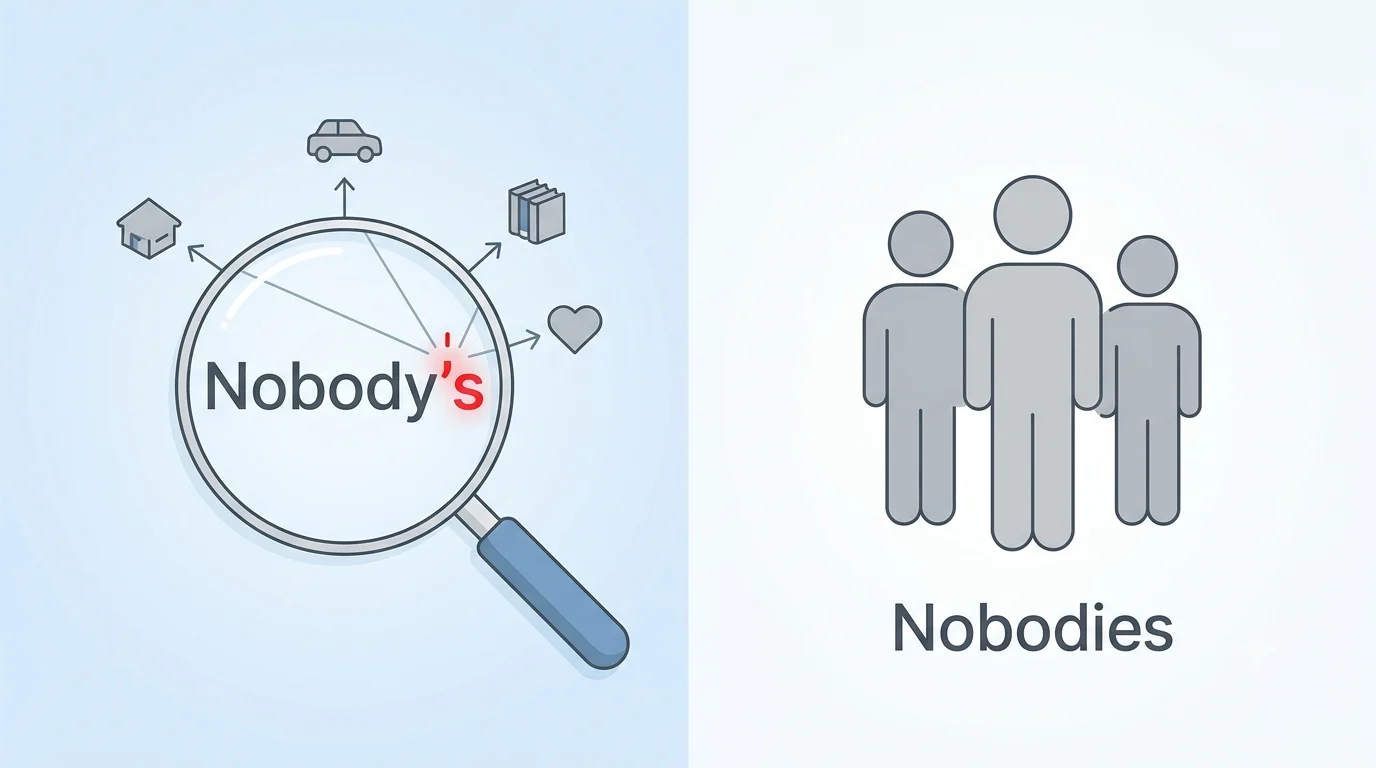
Here is the simple rule that will solve all your confusion in seconds:
- Nobody’s = Possessive form OR contraction of “nobody is” or “nobody has”
- Nobodies = Plural noun meaning “unimportant people”
Quick Examples to Remember:
- “Nobody’s perfect.” (Contraction: Nobody is perfect)
- “In the beginning, they were all nobodies.” (Plural noun)
This is the quick answer most people search for when they type “nobody’s or nobodies” into Google. But let’s dive deeper so you never make a mistake again. The difference is simple once you understand the basic grammar rules.
The Origin of Nobody’s vs Nobodies 📜
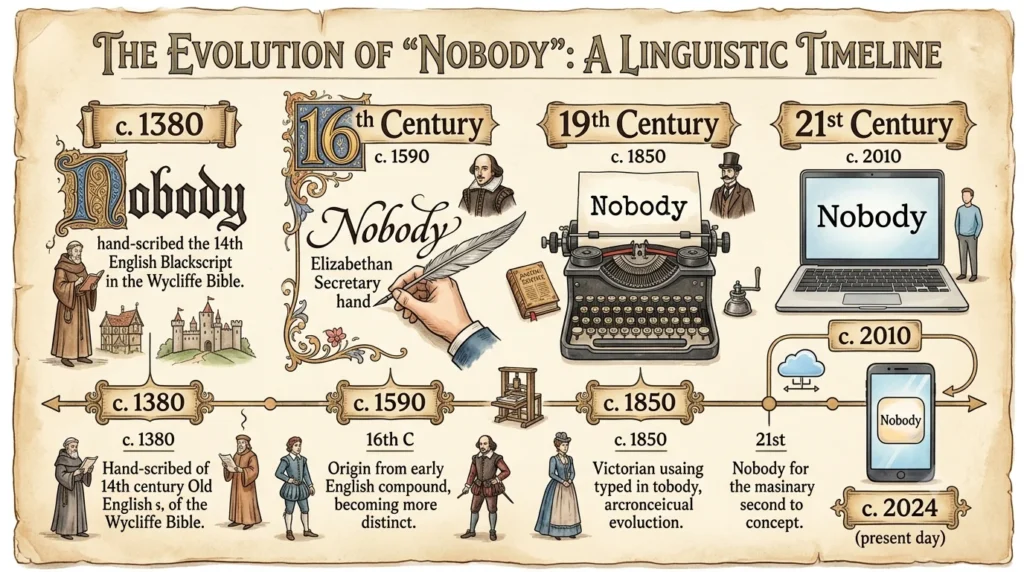
The word “nobody” has been part of English since the 14th century. It combines two simple words: “no” and “body.” Together, they mean “no person” or “not anyone.” This combination created a powerful word that English speakers have used for over 600 years.
For hundreds of years, “nobody” was only a pronoun. People used it to talk about the absence of any person. For example, “Nobody came to the party” was a common sentence. But as English evolved, people started using “nobody” as a noun too.
This is where “nobodies” came from. When you say “nobodies,” you are talking about people who don’t matter in society. These are people without fame, power, or importance. The word took on this new meaning in the 19th century.
The apostrophe in “nobody’s” appeared for two reasons:
- To show possession: “Nobody’s fault” means the fault belongs to nobody
- To show missing letters: “Nobody’s here” means “Nobody is here”
These two different jobs created the confusion we see today. Many English learners and even native speakers mix them up. But once you understand the rule, it becomes simple and natural.
British English vs American English Spelling 🇬🇧🇺🇸
Here is something that will surprise you: There is NO difference between British and American English for these words!
Both countries use the exact same spelling and grammar rules. This makes your job easier. You don’t need to remember separate rules for different audiences. English is consistent on this point.
| Context | British English 🇬🇧 | American English 🇺🇸 |
|---|---|---|
| Possessive | Nobody’s car was damaged. | Nobody’s car was damaged. |
| Contraction | Nobody’s coming to the party. | Nobody’s coming to the party. |
| Plural Noun | The room was full of nobodies. | The room was full of nobodies. |
| Possessive Plural | The nobodies’ voices were ignored. | The nobodies’ voices were ignored. |
As you can see from this comparison table, the rules are identical. Whether you are writing for a UK audience or a US audience, the same grammar applies. Both countries use “nobody’s” for possession and contractions, and both use “nobodies” for the plural noun form.
Which Spelling Should You Use? 🎯
Choosing between “nobody’s” and “nobodies” is easy once you ask yourself one question: What am I trying to say?
Use “Nobody’s” When:
1. You Show Possession
- “Nobody’s opinion matters more than yours.”
- “Nobody’s car was parked here.”
- “Nobody’s fault but mine.”
2. You Use a Contraction for “Nobody Is”
- “Nobody’s home right now.”
- “Nobody’s perfect.” (The most famous example!)
- “Nobody’s going to believe this.”
3. You Use a Contraction for “Nobody Has”
- “Nobody’s seen the new movie yet.”
- “Nobody’s done that before.”
- “Nobody’s ever asked me that.”
Use “Nobodies” When:
1. You Refer to Multiple Unimportant People
- “The movie is about nobodies who become heroes.”
- “In this city, you start as a nobody and build your name.”
- “They treated us like nobodies.”
2. You Talk About People Without Status
- “The party was full of Hollywood nobodies.”
- “He rose from being a nobody to a famous actor.”
For Global Audiences 🌍
The same rules apply everywhere. Whether you are in the US, UK, Australia, Canada, or India, you follow these same simple rules. English is consistent on this point, which makes your writing easier.
Common Mistakes with Nobody’s vs Nobodies ❌
Let me show you the most frequent errors people make. Avoid these, and your writing will be much better and more professional.
Mistake 1: Using “Nobodies” as a Contraction
Incorrect: “Nobodies perfect.”
Correct: “Nobody’s perfect.” (Nobody IS perfect)
Why: You are saying “nobody is perfect,” so you need the contraction.
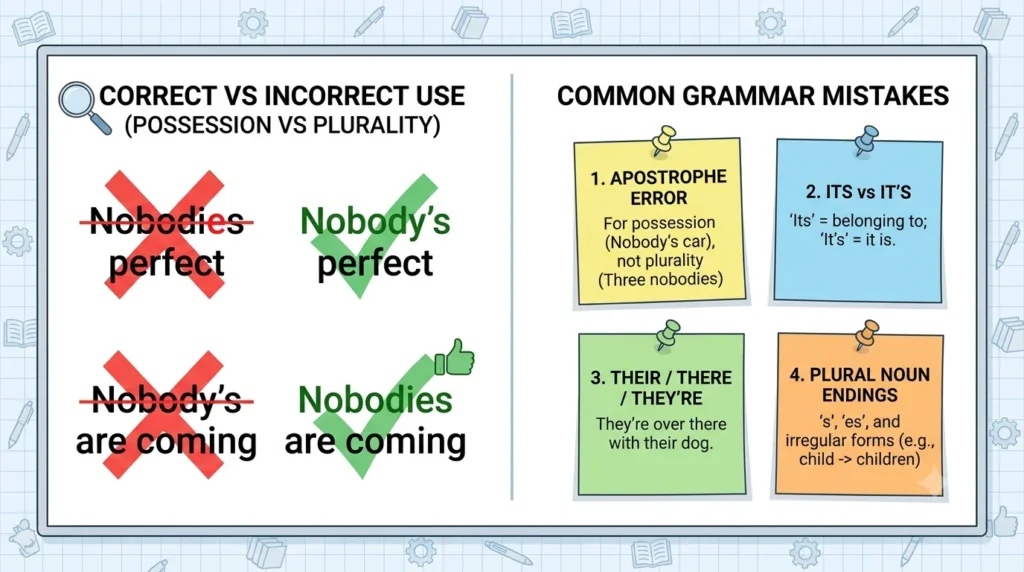
Mistake 2: Using “Nobody’s” as a Plural Noun
Incorrect: “The party was full of nobody’s.”
Correct: “The party was full of nobodies.”
Why: You are talking about multiple people, so you need the plural form.
Mistake 3: Forgetting Subject-Verb Agreement
This is a very common grammar error that many people make.
Incorrect: “Nobody know the truth.”
Correct: “Nobody knows the truth.”
Why: “Nobody” is always singular, so it takes a singular verb.
Mistake 4: Confusing Singular vs Plural
Incorrect: “Nobody are coming to the meeting.”
Correct: “Nobody is coming to the meeting.”
Why: “Nobody” is always singular, even though it might seem plural.
Mistake 5: Using “Nobodies” for Possession
Incorrect: “Nobodies car was parked there.”
Correct: “Nobody’s car was parked there.”
Why: You need the possessive form, which uses an apostrophe.
Nobody’s and Nobodies in Everyday Examples 📖
Let’s see how these words appear in real life. These examples will help you understand proper usage in different contexts.
In Professional Emails 📧
- “Nobody’s response addressed the main issue.”
- “We need to ensure nobody’s work goes unrecognized.”
- “The meeting will continue even if nobody’s available.”
- “Please check that nobody’s name was left off the list.”
In News Headlines 📰
- “Nobody’s Fault: Government Denies Responsibility”
- “From Nobodies to Heroes: The Underdog Story”
- “Nobody’s Prepared for the Upcoming Crisis”
- “Why Nobodies Are Finally Getting Recognition”
On Social Media 📱
- “Nobody’s life is as perfect as it looks on Instagram.”
- “Stop treating people like nobodies.”
- “Nobody’s going to remember your mistakes in 10 years.”
- “The internet has turned nobodies into influencers.”
In Formal Writing 📄
- “Nobody’s contribution should be undervalued.”
- “The study focuses on communities often dismissed as nobodies.”
- “Nobody’s rights are more important than others.”
The Famous Idiom: “Nobody’s Perfect” 🎬
You have probably heard this phrase many times. “Nobody’s perfect” is a contraction of “Nobody is perfect.” People use it to accept mistakes and imperfections. It reminds us that everyone makes errors, and that is completely normal. This phrase appears in movies, books, and everyday conversations around the world.
Grammar Rules You Must Know 📝
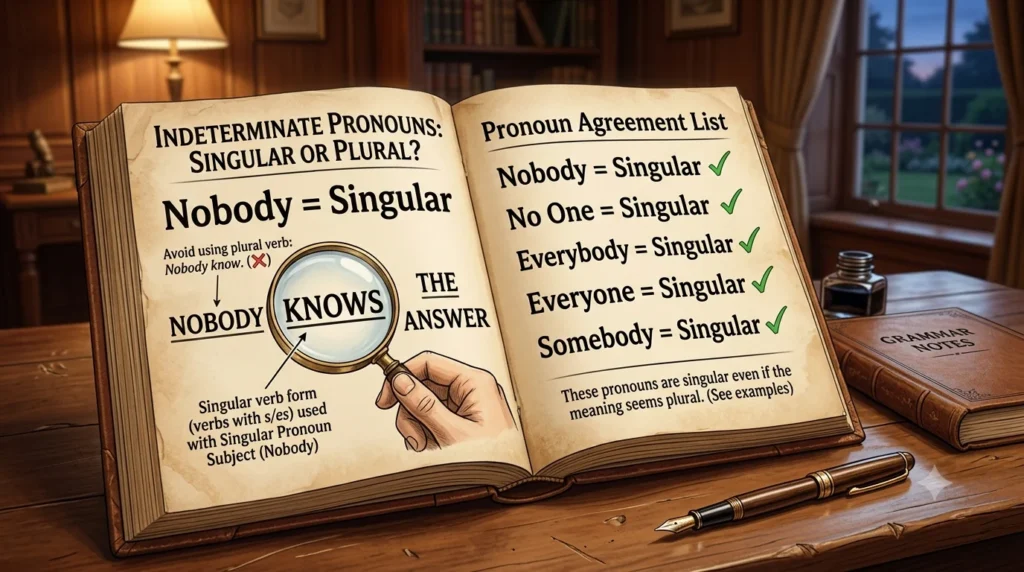
Nobody Plural or Singular? 🤔
“Nobody” is singular. Always. Even though it might seem like it refers to no people, grammar treats it as a single entity. This is why we say “nobody is” and “nobody knows.” The singular nature of “nobody” is a fundamental grammar rule that you must remember.
Is Nobodies a Word? ✅
Yes! “Nobodies” is a real word. It is the plural form of the noun “nobody.” It means unimportant or insignificant people. Many dictionaries list it, and it appears in professional writing, literature, and everyday conversations.
What is the Plural of Nobody?
The plural of nobody is nobodies. This follows the standard English rule of changing “y” to “ies” when forming the plural of words ending in “y.” Examples include “baby” becoming “babies” and “lady” becoming “ladies.”
No One is Singular or Plural?
“No one” is singular, just like “nobody.” They are both singular indefinite pronouns. You say “no one is” and “no one knows.” This is another grammar rule that often confuses English learners.
Everybody is Singular or Plural?
“Everybody” is singular too! This surprises many people. Even though it refers to a group of people, we treat it as singular. We say “everybody is here,” not “everybody are here.” This is a common grammar trap that even native speakers sometimes fall into.
Nobody Know or Knows?
The correct form is “nobody knows.” Always. “Nobody know” is grammatically incorrect because “know” is a plural verb form. Remember, “nobody” is always singular, so it needs a singular verb like “knows.”
Archeology or Archaeology Meaning & Usage Explained
Comparison Table: Nobody’s vs Nobodies at a Glance 📊
| Feature | Nobody’s | Nobodies |
|---|---|---|
| Part of Speech | Possessive pronoun or contraction | Plural noun |
| Meaning | Belonging to nobody OR nobody is/has | Several unimportant people |
| Example | “Nobody’s car was parked here.” | “The party was full of nobodies.” |
| Apostrophe Use | Yes, always includes an apostrophe | No, never uses an apostrophe |
| Verb Agreement | Takes singular verb | Takes plural verb |
| Common Mistake | Confusing with “nobodies” | Confusing with “nobody’s” |
Conclusion 🎯
Understanding the difference between nobody’s and nobodies comes down to one key rule: nobody’s shows possession or is a contraction, while nobodies is the plural noun form. Remember, “nobody” itself is a singular pronoun that should always take a singular verb like “knows” or “is.”
When you write, think about what you want to say. Are you talking about no one possessing something? Use “nobody’s.” Are you talking about no one being something? Use “nobody’s.” Are you referring to a group of insignificant people? Use “nobodies.” This simple check will keep your writing clear and professional every time.
The phrase “Nobody’s perfect” is a contraction of “Nobody is perfect,” and it is a classic reminder that nobody is without mistakes. Even native English speakers sometimes confuse “nobody’s” and “nobodies,” but with these rules, you can write with confidence. Remember, grammar doesn’t have to be complicated. Master these simple rules, and your writing will improve significantly.

“E. M. Delafield creates warm, thoughtful, and inspiring wishes that help readers express their feelings clearly and choose the perfect words for every occasion.”