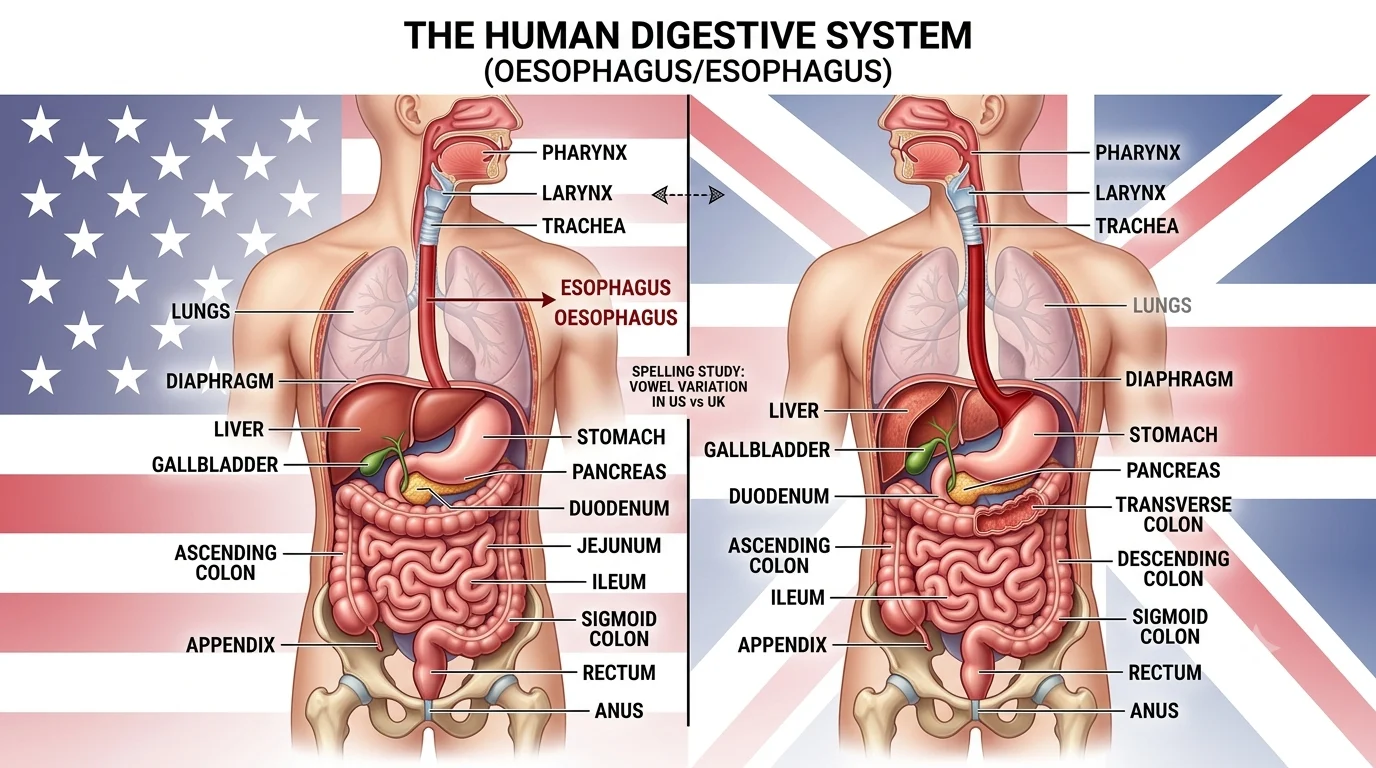
Both spellings are 100% correct! “Esophagus” is American English, while “Oesophagus” is British English. They describe the same muscular tube that moves food from your throat to your stomach through wave-like contractions called peristalsis.
Example:
- 🇺🇸 American: “My doctor says I have esophageal reflux.”
- 🇬🇧 British: “My doctor says I have oesophageal reflux.”
Oesophagus function: This 25cm (10-inch) tube uses powerful muscles to push food downward in about 5-10 seconds for liquids and 15-20 seconds for solids.
Oesophagus anatomy: The tube passes behind your windpipe (trachea) and through your diaphragm before reaching your stomach. Understanding this structure helps explain many esophagus problems.
The Origin of Oesophagus
The word has fascinating ancient roots dating back 2,500+ years!
Greek Origin: The term comes from “oisophagos” (οἰσοφάγος), combining:
- “Oisein” – meaning “to carry”
- “Phagein” – meaning “to eat”
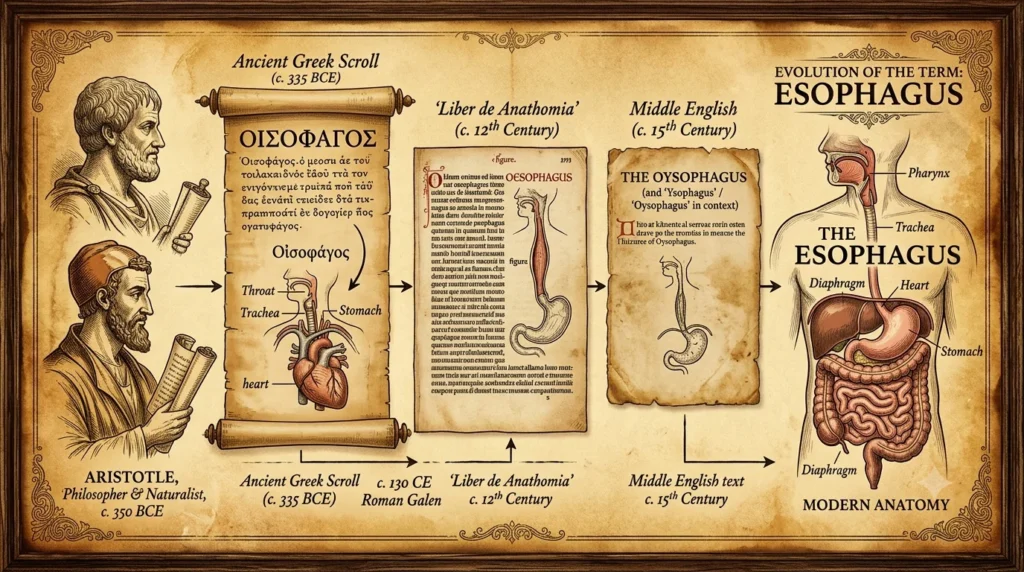
So literally, it means “channel for carrying food” – a perfect description!
Timeline:
- 350 BC: Aristotle uses “oisophagos” in his biological writings
- 100 AD: Roman physician Galen uses “oesophagus” in Latin
- 1350: Middle English adopts “ysophagus”
- 1500s: “Oesophagus” becomes standard in British medical texts
- 1800s: Noah Webster proposes “esophagus” to match pronunciation
- Today: Both versions coexist peacefully worldwide
Fun Fact: The English word “gullet” comes from Old French “goulet” meaning “little throat” – this remains the common everyday term for the esophagus.
British English vs American English Spelling
The spelling difference follows a consistent pattern across many medical terms:
| Word Category | American 🇺🇸 | British 🇬🇧 |
|---|---|---|
| Main term | Esophagus | Oesophagus |
| Adjective | Esophageal | Oesophageal |
| Inflammation | Esophagitis | Oesophagitis |
| Surgery | Esophagectomy | Oesophagectomy |
| Scope view | Esophagoscopy | Oesophagoscopy |
| Muscle layer | Esophageal sphincter | Oesophageal sphincter |
Pronunciation Differences
| Spelling | Pronunciation | Syllables |
|---|---|---|
| Esophagus (US) | “ih-SOF-uh-gus” | 4 |
| Oesophagus (UK) | “ee-SOF-uh-gus” | 4 |
Comparison Table
| Feature | American 🇺🇸 | British 🇬🇧 |
|---|---|---|
| Spelling | Esophagus | Oesophagus |
| Vowel sound | Short ‘e’ | Long ‘e’ |
| Written form | Simplified | Traditional |
| Used in | USA, Canada, Philippines | UK, Australia, NZ, Ireland |
| Medical journals | NEJM, JAMA | BMJ, The Lancet |
| Global popularity | More common | Less common |
Which Spelling Should You Use?
Choose “Esophagus” if you are:
✅ Writing for American, Canadian, or Filipino audiences
✅ Submitting to US medical journals (NEJM, JAMA)
✅ Practicing medicine in the United States
✅ Creating content for US healthcare websites
✅ Writing for international audiences (American English is more common globally)
Choose “Oesophagus” if you are:
✅ Writing for British, Australian, New Zealand, Irish, or South African audiences
✅ Submitting to UK medical journals (BMJ, The Lancet)
✅ Practicing medicine in the UK or Commonwealth countries
✅ Creating content for UK NHS websites
✅ Following traditional British spelling conventions
Global Usage Statistics
| Country | Preferred Spelling | Usage Rate |
|---|---|---|
| 🇺🇸 United States | Esophagus | 100% |
| 🇵🇭 Philippines | Esophagus | 99% |
| 🇨🇦 Canada | Esophagus | 96% |
| 🇱🇷 Liberia | Esophagus | 100% |
| 🇮🇳 India | Esophagus | 59% |
| 🇬🇧 United Kingdom | Esophagus (slightly) | 54% |
| 🇦🇺 Australia | Esophagus | 56% |
| 🇮🇪 Ireland | Esophagus | 53% |
| 🇳🇿 New Zealand | Esophagus | 61% |
📊 Trend Alert: Even in the UK, “esophagus” is becoming more common! In 2000, it was used only 30% of the time. Today, it’s 54% and rising.
Common Mistakes with Oesophagus or Esophagus
Mistake #1: Mixing Spellings
Wrong: “The esophagus passes through the chest. Oesophageal cancer is serious.”
Right: Choose ONE spelling and stick with it throughout.
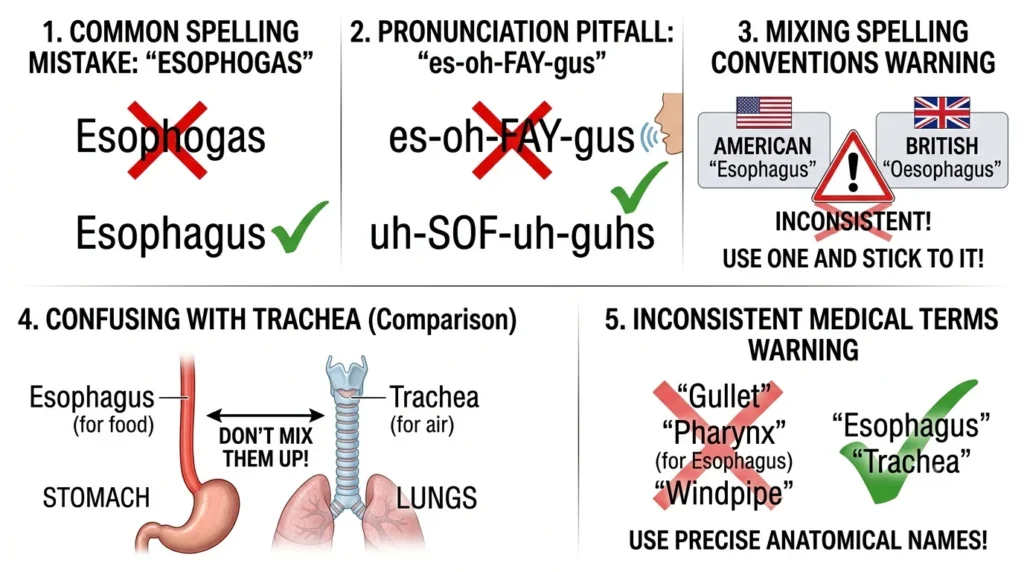
Mistake #2: Misspelling as “Esophogas”
Wrong: “The esophogas connects to the stomach.”
Right: Remember it ends with “agus,” not “ogas.”
Mistake #3: Wrong Pronunciation
Wrong: “es-oh-FAY-gus” (stress on third syllable)
Right: “ih-SOF-uh-gus” (stress on second syllable)
Mistake #4: Confusing with Trachea
Wrong: “Food goes through the trachea.”
Right: “Food goes through the esophagus. Air goes through the trachea.”
Mistake #5: Inconsistent Medical Terms
Wrong: “The esophagus showed signs of oesophagitis.”
Right: “The esophagus showed signs of esophagitis.”
Oesophagus in Everyday Examples
Professional Emails
📧 “Dear Team, please review the patient’s esophageal manometry results before tomorrow’s meeting.”
📧 “I’ve attached the oesophagus images from today’s endoscopy procedure.”
News Headlines
📰 USA: “New Treatment Shows Promise for Esophageal Cancer Patients”
📰 UK: “Oesophageal Cancer Survival Rates Improve with Early Detection”
Social Media Posts
🐦 “Just learned about the 3 parts of the esophagus – cervical, thoracic, and abdominal! #MedicalStudent”
📱 “Understanding oesophagus anatomy helps explain why GERD causes so many symptoms”
Medical Reports
📋 “The patient’s esophagus showed 4 main constrictions on barium swallow study.”
📋 “Oesophageal motility was assessed using high-resolution manometry.”
Patient Education
💬 “Your esophagus has 3 parts that work together to move food to your stomach.”
💬 “The 4 main constrictions of oesophagus are normal anatomical narrowings.”
Oesophagus or Esophagus – Google Trends & Usage Data
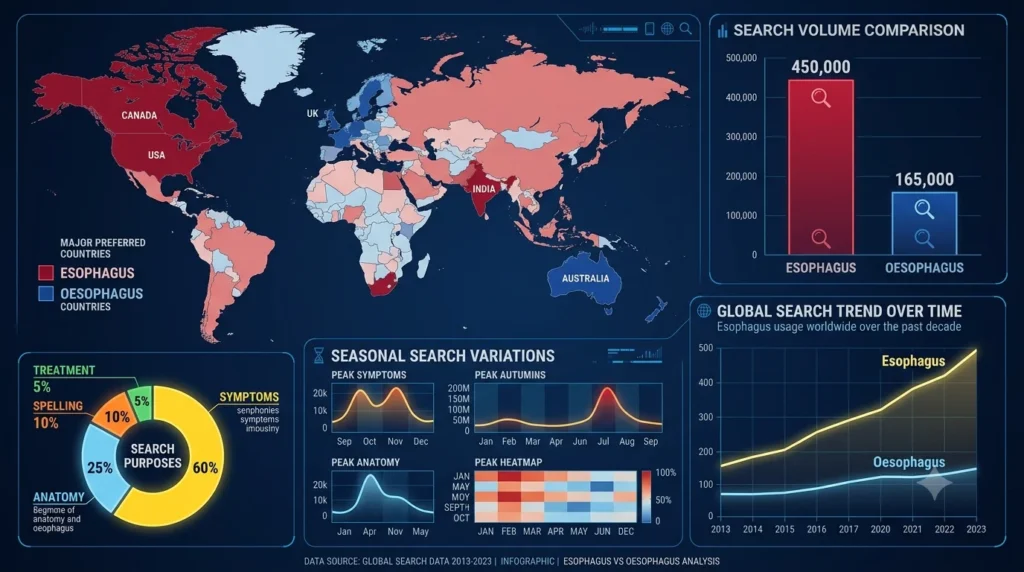
Search Volume Comparison
| Keyword | Monthly Searches (Global) |
|---|---|
| “Esophagus” | 450,000+ |
| “Oesophagus” | 165,000+ |
| “Esophagus problems” | 22,000+ |
| “Oesophagus function” | 14,000+ |
Regional Search Interest
🌎 Global: “Esophagus” is searched 2.7x more than “oesophagus”
🇺🇸 USA: 98% use “esophagus”
🇬🇧 UK: 55% use “esophagus” (up from 40% in 2015)
🇦🇺 Australia: 57% use “esophagus”
🇨🇦 Canada: 94% use “esophagus”
When People Search
- 🔍 60% of searches are for symptoms and problems
- 🔍 25% are for anatomy and function
- 🔍 10% are for spelling clarification
- 🔍 5% are for treatment options
Seasonal Trends
Interest in esophagus problems peaks during:
- 🍂 Autumn (GERD symptoms worsen with heavy meals)
- 🎄 Holiday season (acid reflux spikes after rich foods)
- 💉 Cancer awareness months
Oesophagus Anatomy – Complete Guide
The 3 Parts of the Esophagus
The esophagus has three distinct anatomical sections:
1. Cervical Esophagus (Pars cervicalis)
- Located in the neck
- Begins at the cricopharyngeus muscle
- About 5cm long
- Clinical note: Most common site for Zenker’s diverticulum
2. Thoracic Esophagus (Pars thoracica)
- Located in the chest
- Runs behind the trachea and heart
- About 18cm long
- Clinical note: Most common site for esophageal cancer
3. Abdominal Esophagus (Pars abdominalis)
- Located in the abdomen
- Passes through the diaphragm
- About 2cm long
- Clinical note: Site of the lower esophageal sphincter (LES)
The 4 Main Constrictions of Oesophagus
These are normal narrow points where swallowed objects may get stuck:
| Constriction | Location | Clinical Significance |
|---|---|---|
| 1. Cricoid | At the start, behind cricoid cartilage | Most common site for foreign body impaction |
| 2. Bronchial | Where left main bronchus crosses | Often compressed by enlarged lymph nodes |
| 3. Diaphragmatic | Through the diaphragm | Common site for hiatus hernia |
| 4. Aortic | Where aorta indents the esophagus | Important for surgical planning |
Esophagus Problems – Comprehensive Guide
What Are Symptoms of Esophagus Problems?
Common signs to watch for:
🔥 Heartburn – Burning chest pain (most common symptom)
🍽️ Difficulty swallowing – Feeling food gets stuck (dysphagia)
💔 Chest pain – Often mistaken for heart attack
🔄 Regurgitation – Food comes back up
😤 Chronic cough – Especially at night
🗣️ Hoarse voice – Acid irritating vocal cords
🫁 Wheezing – Reflux affecting airways
📉 Unexplained weight loss – Could indicate serious conditions
🤢 Nausea – Especially after meals
Common Disorders
1. GERD (Gastroesophageal Reflux Disease)
- Most common esophagus problem
- Affects 20% of US adults
- Causes: Weak LES, obesity, pregnancy
- Treatment: Lifestyle changes, medications, sometimes surgery
2. Barrett’s Esophagus
- Precancerous condition
- Affects 1-2% of GERD patients
- Requires regular monitoring
- Risk factor for esophageal cancer
3. Esophageal Cancer
- 8th most common cancer worldwide
- 2 types: Squamous cell (worldwide) and Adenocarcinoma (Western countries)
- 5-year survival: 20% (early detection improves outcomes)
4. Achalasia
- Rare swallowing disorder (1 in 100,000)
- Lower sphincter fails to relax
- Treatment: Pneumatic dilation, surgery, or botox
5. Esophageal Spasms
- Painful muscle contractions
- Can mimic heart pain
- Often stress-related
When to See a Doctor
🚨 Emergency symptoms:
- Severe chest pain (may be heart attack!)
- Vomiting blood
- Black, tarry stools
- Unable to swallow liquids
- Severe abdominal pain
🕒 Non-emergency but see doctor:
- Persistent heartburn (more than 2x/week)
- Difficulty swallowing that gets worse
- Unexplained weight loss
- Symptoms lasting more than 3 weeks
FAQ – Oesophagus or Esophagus
1. Which is correct, esophagus or oesophagus?
Answer: Both are correct! “Esophagus” is American English and “oesophagus” is British English. They mean exactly the same thing – the tube connecting throat to stomach.
2. What is another name for the oesophagus?
Answer: In everyday English, it’s called the “gullet.” In medical contexts, it’s simply the esophagus or oesophagus.
3. What are the first signs of oesophagus cancer?
Answer: Early warning signs include difficulty swallowing solid foods, unexplained weight loss, persistent heartburn, chest pain or discomfort, and a feeling that food gets stuck in your chest.
4. What causes oesophagus problems?
Answer: Common causes include GERD (acid reflux), obesity, smoking, alcohol consumption, certain medications, pregnancy, hiatal hernia, stress, and eating very hot/spicy foods.
5. How do you pronounce oesophagus?
Answer: British pronunciation: “ee-SOF-uh-gus” (stressed on second syllable). American pronunciation: “ih-SOF-uh-gus” (stressed on second syllable). Both are very similar.
6. Where can I find an oesophagus diagram?
Answer: Reputable medical websites like Mayo Clinic, NHS UK, WebMD, Merck Manuals, and medical textbooks all have detailed esophagus/oesophagus diagrams.
7. What are the 4 main constrictions of oesophagus?
Answer: The four normal narrow points are: 1) Cricoid constriction, 2) Bronchial constriction, 3) Diaphragmatic constriction, and 4) Aortic constriction.
8. How long is the esophagus/oesophagus?
Answer: Approximately 25cm (10 inches) in adults. However, this varies with height, age, and individual anatomy.
9. Can esophagus problems be cured?
Answer: Many conditions (like GERD) can be effectively managed. Some (like Barrett’s esophagus) require monitoring. Early-stage esophageal cancer has good treatment outcomes. Always consult your healthcare provider.
10. Which spelling should I use in academic writing?
Answer: Follow your institution’s style guide. American journals use “esophagus.” British/Commonwealth journals use “oesophagus.” Be consistent throughout your work.
Conclusion
So, is it oesophagus or esophagus? Both are perfectly correct. “Esophagus” is American English, “oesophagus” is British English. Choose based on your target audience and stick with it consistently.
What matters more than spelling is understanding oesophagus anatomy – the 3 parts of the esophagus (cervical, thoracic, and abdominal) and the 4 main constrictions where problems can develop. The oesophagus function remains identical worldwide: moving food from mouth to stomach through coordinated muscle contractions.
If you experience any symptoms of esophagus problems like persistent heartburn, difficulty swallowing, or chest pain, consult your doctor promptly. Early detection of conditions like Barrett’s esophagus or esophageal cancer dramatically improves outcomes.
Remember: Whether you write esophagus or oesophagus, consistency is key. Use “esophagus” for American readers and “oesophagus” for British readers. Your medical knowledge and clear communication matter more than the spelling choice!

“Wilkie Collins writes heartfelt and expressive wishes that help readers convey emotions with clarity and find the perfect words for every special moment today.!”