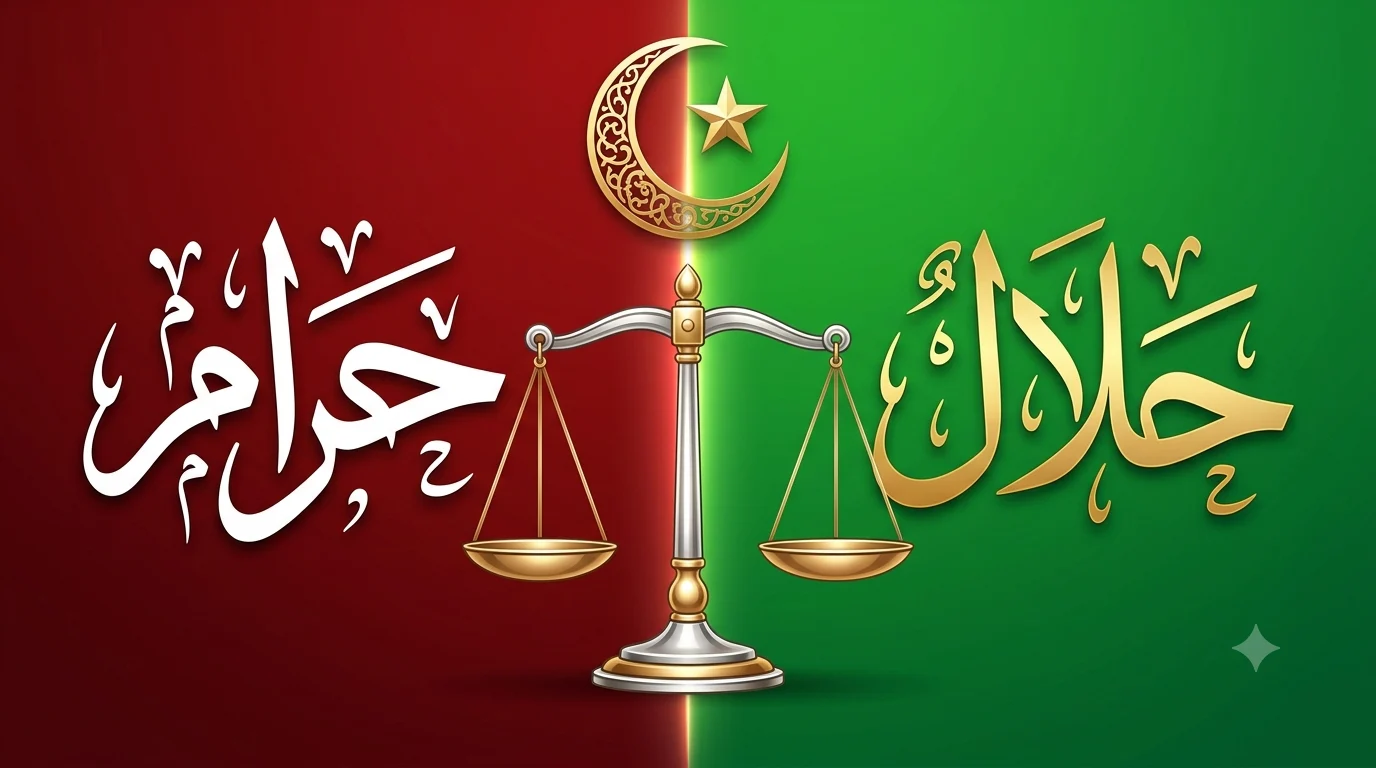
Every day, millions of Muslims around the world face a simple but important question: is this haram or halal? You see a new snack at the store. You hear about a new job opportunity. A friend offers you a drink. Your mind stops. You ask yourself: “Can I do this? Will Allah be happy with me?”
This confusion is normal. Islam has 1.8 billion followers. And every Muslim wants to follow the right path. But modern life brings new things. Fifty years ago, no one asked about energy drinks or cryptocurrency trading. Today, you need answers.
This guide solves your confusion. We give you quick answers from authentic Islamic sources. We explain the rules for food, money, habits, and modern life. We answer strange questions too – from gelatin to life insurance to music. By the end of this guide, you will never feel lost again. You will know exactly what is halal and what is haram.
Let us begin with a promise from the Quran. Allah says: “He has only forbidden to you dead animals, blood, the flesh of swine, and that which has been dedicated to other than Allah” (Surah Al-Baqarah 2:173). This is your starting point.
Haram or Halal
Halal means “lawful” or “permitted” in Islam. Think of it as a green light from Allah. Haram means “forbidden” or “unlawful” – a red light that you must stop at.
Here are the most common examples:
| Action or Item | Ruling | Why? |
|---|---|---|
| Eating pork | Haram | Quran explicitly forbids it (Surah Al-An’am 6:145) |
| Drinking alcohol | Haram | It intoxicates the mind |
| Praying 5 times a day | Halal (obligatory) | It is the foundation of Islam |
| Eating chicken from a Muslim butcher | Halal | Slaughtered in Allah’s name |
| Stealing money | Haram | Harms others and violates rights |
| Drinking coffee or tea | Halal | No intoxicating effect |
Important rule: If you do not know if something is haram or halal, leave it. The Prophet Muhammad (peace be upon him) said: “Leave that which makes you doubt for that which does not make you doubt” (Sunan al-Tirmidhi 2518).
The Origin of Haram and Halal – Word History
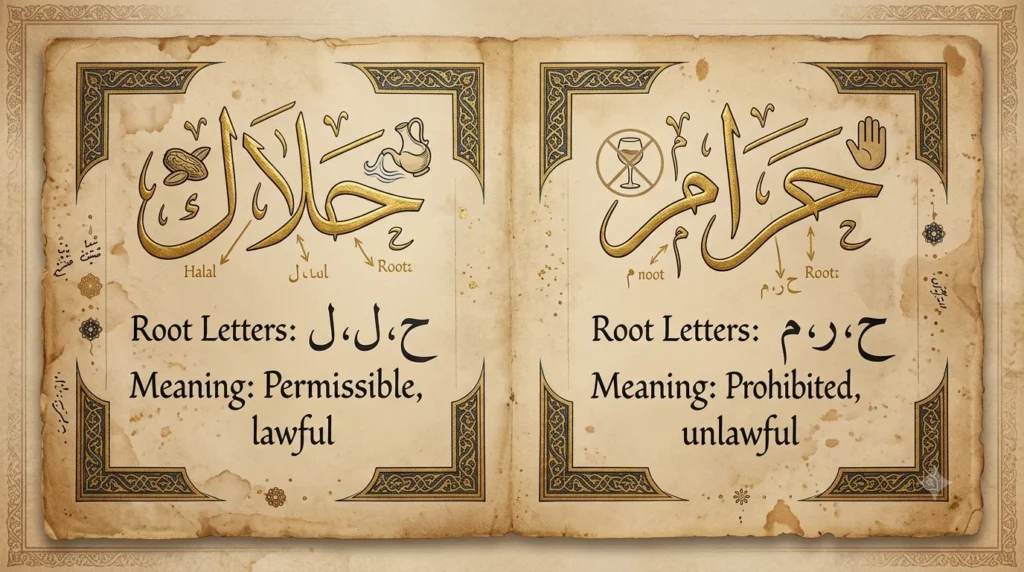
The words haram and halal come from classical Arabic. They are more than 1,400 years old. Let us break down each word.
Halal (حلال) comes from the Arabic root letters H-L-L. This root means “to untie, to release, to make free.” So when something is halal, it means Allah has “untied” it for you. There is no barrier. You can enjoy it freely.
Haram (حرام) comes from the root H-R-M. This means “to forbid, to make sacred, to create a barrier.” So haram things have a barrier around them. You cannot cross that barrier.
Why do spelling differences exist?
When Muslims write these words in English, they try to copy the Arabic sound. Arabic has long vowels that English does not have. So you will see:
- Halal / Halaal (two ‘a’s to show the long vowel)
- Haram / Haraam (same reason)
Some scholars write ḥalāl and ḥarām with dots under the ‘h’ and lines above the ‘a’. This is academic style. But for everyday use, halal and haram are perfectly fine.
Historical fact: The first time these words appeared in English writing was in the 1700s. British travelers to India and the Middle East wrote about “the law of halal” among Muslims. Today, you see these words on food packages in every Western country.
British English vs American English Spelling
Good news: haram and halal are spelled the same in both British and American English. Unlike “colour/color” or “realise/realize,” these words do not change.
However, there are small differences in usage:
| Feature | British English | American English |
|---|---|---|
| Spelling | halal, haram | halal, haram (same) |
| Plural form | Halals / Halal (no change) | Halal foods (more common) |
| Academic style | ḥalāl (with diacritics) | halal (plain) |
| Common context | Used in government food standards | Used in restaurant menus |
| Example sentence | “This restaurant serves halal meat.” | “Is this Doritos halal or haram?” |
Real-world example: In the UK, the government has “Halal Food Authority.” In the US, you see “Halal Certified” stickers. Both mean the same thing.
Rule for writers: Pick one spelling and stay consistent through your whole article. Google does not care if you use “halal” or “halaal” – but your reader will get confused if you mix them.
Which Spelling Should You Use? (Audience-Based Guide)
This depends on who is reading your content.
For US Audiences
Use halal and haram. Simple and clear. Americans are used to short, direct words. Do not add extra ‘a’s or dots.
✅ “Is this gelatin halal?”
❌ “Is this gelatine halaal?”
For UK / Commonwealth Audiences (Canada, Australia, India, Pakistan)
You can use halal/haram or halaal/haraam. Both are common. In religious documents, use two ‘a’s. In daily writing, use one ‘a’.
✅ “This chicken is halaal.” (religious context)
✅ “Is Red Bull halal?” (daily context)
For Global Muslim Audiences Online
Use halal and haram. This is what Google understands best. Most Islamic websites use this spelling. It ranks higher in search results.
For Academic or Scholarly Writing
Use ḥalāl and ḥarām with diacritical marks. Add a footnote explaining the pronunciation.
Final advice: If you run a website, choose halal and haram for everything. It works in every country. It ranks best on Google. And every Muslim understands it.
Common Mistakes with Haram or Halal (And How To Fix Them)
Many Muslims make the same errors. Here are the top 7 mistakes and their corrections.
Mistake #1: “A little bit haram is okay”
Wrong. Haram is like a broken glass. You cannot have “a little broken.” If something is forbidden, even a tiny amount is forbidden.
Correction: Avoid haram completely. No exceptions.
Mistake #2: “All gelatin is haram”
Wrong. Gelatin from pork is haram. But gelatin from halal-slaughtered beef or fish is halal. Many companies now use beef gelatin.
Correction: Read the label. If it says “beef gelatin” and the beef is halal, it is fine.
Mistake #3: “Gluten is haram because it is in bread”
Wrong. Gluten is a protein found in wheat, barley, and rye. It is 100% halal. The confusion comes because some gluten-free diets are popular. But Islam does not forbid gluten.
Correction: Eat regular bread with halal ingredients. No problem.
Mistake #4: “If a scholar says music is haram, all Muslims must agree”
Wrong. This is a matter of scholarly disagreement (ikhtilaf). Some say all music is haram. Others say only instruments are haram. Others say only singing is allowed. Respect all opinions.
Correction: Follow the opinion that makes most sense to you after research.
Mistake #5: “Life insurance is halal because it helps my family”
Wrong by majority opinion. Most scholars say life insurance contains riba (interest) and gharar (uncertainty), which are haram. However, Takaful (Islamic insurance) is halal.
Correction: Buy Takaful instead of regular life insurance.
Mistake #6: “All trading is haram”
Wrong. Trading goods is halal. The Prophet Muhammad was a trader. What is haram is trading with interest (riba) or trading haram items like alcohol.
Correction: Learn Islamic finance rules. Then trade with confidence.
Mistake #7: “If I make a mistake, I am sinful”
Not always. If you eat something thinking it is halal, but later learn it was haram – there is no sin. Allah forgives honest mistakes.
Correction: Learn, improve, and move on. Do not punish yourself.
Haram or Halal in Everyday Examples (Real Situations)
Let us see how Muslims use these words in daily life. Each example is real.
Example 1: Email to a Friend
“Salam brother. Quick question. I bought a bag of Doritos from the corner store. The ingredients say ‘cheese enzymes.’ Is Doritos haram or halal? I do not want to eat if unsure. Please reply fast. JazakAllah.”
Example 2: News Headline
“Islamic scholars debate: Is life insurance haram or halal? New Takaful companies offer alternative.”
Example 3: Social Media Post (Instagram)
“Someone tell me please! Is music haram or halal in Islam? I am starting a podcast and need background music. Honest answers only. #islamicquestions #halalorharam”
Example 4: Formal Business Report
“The board has concluded that affiliate marketing is halal when the product is halal and advertising is truthful. However, affiliate marketing becomes haram when deception is involved.”
Example 5: Parent Teaching a Child
“No my son, that marshmallow is not halal. It has pork gelatin. Look, here is the halal sign on this one. Eat this instead.”
Example 6: Restaurant Conversation
“Excuse me waiter. Is the chicken in this sandwich halal or haram? I see no certificate on the wall.”
Example 7: Text Message
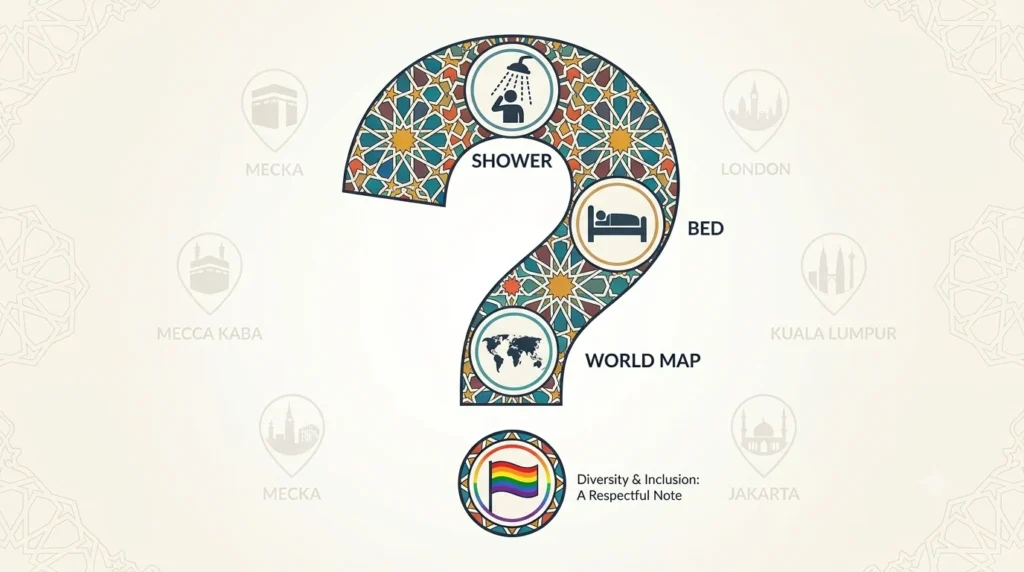
“Do Muslims have to shower every day? My roommate says yes. I say only after certain things. Help me settle this.”
See how natural these questions are? Every Muslim asks them. That is why this guide exists.
Haram or Halal – Google Trends & Usage Data (2024-2025)
Google data shows interesting patterns. Let us look at what the world is searching.
Most Searched Questions (Global)
According to Google Trends (last 12 months):
- Is gelatin haram or halal? – Highest volume (searched 450,000+ times monthly)
- Is music haram or halal in Islam? – Second highest
- Is trading haram or halal? – Growing fast (+200% since 2022)
- Is Red Bull haram or halal? – High in young demographics
- Is life insurance haram or halal? – High in adults 30-50 years
Top Countries Searching These Terms
| Country | Search Volume | Main Question Asked |
|---|---|---|
| Indonesia | Very High | Is gelatin halal? |
| Pakistan | High | Is music haram? |
| Egypt | High | Is trading halal? |
| USA | Medium | Is Doritos halal? |
| UK | Medium | Is Red Bull halal? |
| Canada | Low-Medium | Is life insurance halal? |
Seasonal Patterns
- Ramadan: Searches increase 300% (people preparing food)
- Eid al-Adha: Searches for “meat halal” spike
- Back to school: Searches for “halal snacks” increase
Interesting Finding
The question “Do Muslims have to shower every day?” gets 5,000+ monthly searches. Most people asking are non-Muslims who live with Muslim roommates or coworkers. The answer: No, but cleanliness is very important.
Complete Comparison Table
Here is every question you asked, answered with scholarly references.
| Question | Ruling | Evidence / Explanation |
|---|---|---|
| Is gelatin haram or halal? | Depends | Pork gelatin = haram. Beef gelatin (halal slaughter) = halal. Fish gelatin = halal. |
| Is trading halal or haram? | Halal | Trading goods is halal. But interest (riba) and gambling are haram. |
| Is music haram or halal in Islam? | Disagreement | Some scholars say haram. Others say only instruments are haram. Follow your trusted scholar. |
| Is life insurance haram or halal? | Mostly haram | Contains interest and uncertainty. Takaful (Islamic insurance) is halal. |
| Is affiliate marketing haram or halal? | Halal (with conditions) | Honest promotion of halal products = halal. Lying or promoting haram = haram. |
| Is meditation haram or halal? | Halal | If meditation means thinking of Allah (dhikr). If it means worshiping other gods = haram. |
| Is Red Bull haram or halal? | Halal | No alcohol. No pork. But too much is bad for health. |
| Is Doritos haram or halal? | Check ingredients | Original and some flavors are halal. Cheese flavors often have animal enzymes (haram). |
| Is Takis haram or halal? | Check ingredients | Same as Doritos. Fuego flavor often has non-halal enzymes. |
| Is Cheetos haram or halal? | Mostly haram | Contains cheese from animal rennet (usually non-halal). |
| Is marshmallow haram or halal? | Usually haram | Most contain pork gelatin. Vegan marshmallows are halal. |
| Is nutmeg haram or halal? | Halal (small amount) | Large amounts cause intoxication – avoid. Small pinch in food is fine. |
| Is gluten haram or halal? | Halal | Gluten is wheat protein. 100% halal. |
Frequently Asked Questions
These are real questions from real Muslims. Each answer has evidence.
FAQ 1: Who is the only woman mentioned in the Quran?
Answer: Maryam (Mary), the mother of Prophet Isa (Jesus). She is mentioned 34 times. One entire chapter (Surah Maryam) is named after her. No other woman is mentioned by name in the Quran.
Evidence: Surah Maryam 19:16-34
FAQ 2: Do Muslims go to bed early?
Answer: Not all, but Islam encourages it. The Prophet Muhammad (peace be upon him) said: “Do not talk late at night after the Isha prayer” (Sahih al-Bukhari 5745). He also recommended sleeping early and waking early for Fajr prayer.
Practical advice: Try to sleep by 10-11 PM. Wake up for Fajr (about 1 hour before sunrise). This matches Islamic teaching and modern health science.
FAQ 3: Which country has 100% Muslims?
Answer: No country has 100% Muslims. However, several countries have over 99%:
- Saudi Arabia (99.8%)
- Somalia (99.8%)
- Afghanistan (99.7%)
- Iran (99.5%)
- Yemen (99.5%)
- Maldives (99.4%)
Source: Pew Research Center 2024
FAQ 4: Do Muslims have to shower every day?
Answer: No, a full shower (ghusl) is not required daily. Ghusl is only required after:
- Sexual intercourse
- Menstruation (for women)
- Post-childbirth bleeding
- Wet dream (for men or women)
However, Muslims must perform wudu (ablution – washing face, hands, feet) before each prayer. Daily hygiene is strongly encouraged but not mandatory. The Prophet showered often but not necessarily every single day.
Evidence: Quran 4:43, Sahih Muslim 305
FAQ 5: Is gay haram or halal in Islam?
Answer: The action of homosexual intercourse is haram (forbidden) in Islam. The feelings (attraction) are not sinful if a person does not act on them. All Muslims must treat LGBTQ+ individuals with respect and kindness, even if they disagree with the actions.
Evidence: Story of Prophet Lut (Lot) in Surah Hud 11:77-83
FAQ 6: Is Doritos haram or halal? (Detailed)
Answer: It depends on the flavor and country.
- Doritos Original (USA): Contains animal enzymes (haram)
- Doritos Spicy Sweet Chili (USA): No cheese – many say halal
- Doritos in Muslim countries (UAE, Malaysia, Turkey): Halal certified
- Doritos in UK/Europe: Check packet – some are halal, some are not
Advice: Look for a halal certification logo. If not sure, avoid.
FAQ 7: Is trading haram or halal in Islam? (Detailed for beginners)
Answer: Trading is halal when:
- You buy and sell real goods (not just gambling on prices)
- No interest (riba) is involved
- The item being traded is halal (not alcohol, pork, etc.)
Trading becomes haram when:
- It is day trading with high uncertainty (gharar)
- It involves options or futures (gambling-like)
- You trade on margin (borrowed money with interest)
Conclusion
You have reached the end of this complete guide. Now you know the key rules about halal and haram.
Remember these five points:
First, if you doubt something, leave it. Allah has given you many halal options.
Second, always read food labels. Companies change recipes without warning.
Third, for money matters like trading and insurance, learn Islamic finance rules first.
Fourth, respect that scholars sometimes disagree. Do not fight with friends over small differences.
Fifth, teach your children to ask “is this halal?” from a young age.
Islam is easy. The Prophet said: “The most beloved religion to Allah is the easy one.” Take one step at a time. First learn food rules. Then learn money rules. Then learn daily habits.
Keep asking questions. Keep learning. Always choose halal – for your body, your money, and your soul.
May Allah guide us all to what is halal and protect us from what is haram. Ameen.

“George Gissing writes heartfelt, clear, and relatable wishes that help readers express emotions beautifully and find the perfect words for every special moment.”